Category Archives: Turkey

36th Istanbul Film Festival, 2017

This is about seeing six films in the Istanbul Film Festival, which began this year (2017) on Wednesday, April 5.

Kazimer Malevich, Suprematist Composition: White on White, 1918 (MoMA)

Continue reading

The Hands of an Angry Deity

I first drafted the following essay in late October, 2011, a few days after the first of the earthquakes in Van, and a few weeks after moving from Ankara to Istanbul. I rediscovered the essay recently by chance. It seems worth revisiting now, in the spring of 2017, given the political upheaval in the United States last fall, and the potential for more around the world.

Body of minivan with missing windows on overgrown grassy slope
Above Mehmetçik Caddesi in Şişli, one of the most densely populated of Istanbul’s 39 boroughs; 2017.04.02

Continue reading

Victor Vasarely

Tophane-i Amire
Tophane-i Amire, 2017.03.25

Last week I wrote about the Turkish Impressionist Feyhaman Duran, born in 1886. Now my subject is the Hungarian-French Op Artist born twenty years later as Győző Vásárhelyi. His “Rétrospective en Turquie” is at the Tophane-i Amire Culture and Art Center in an Ottoman cannon foundry.

Vasarely show Continue reading

Feyhaman Duran

Born on the Asian side of Istanbul in Kadıköy in 1886, İbrahim Feyhaman was orphaned nine years later. His father had been a poet and calligrapher. His mother’s dying wish was that Feyhaman attend the Lycée Impérial Ottoman de Galata-Sérai; his maternal grandfather, Duran Çavuş, saw that this happened. Some time after graduation, headmaster Tevfik Fikret had Feyhaman come back to Galatasaray to teach calligraphy.


Garden of Aşiyan, September 10, 2015

Continue reading

Nature and Death

Thoughts on mortality and the evolution of the universe, occasioned by a funeral and by Collingwood’s Idea of Nature and Plato’s Phaedo

Cebeci, Ankara, 2016.05.17

When the husband of my second-grade teacher died, I wanted to pay my respects. My father took me to the funeral home, where I hid behind him as he greeted the family of the deceased. My teacher was not among them. When invited to view the body, I looked over and saw it, lying off to the side in an open casket. I had never seen the man when he was alive. I declined the opportunity to gaze at his lifeless form. Until I came to Turkey, this was my closest approach to the materiality of death—except for a visit to the medical school of the University of New Mexico in Albuquerque. There, as part of the laboratory program at St John’s College in Santa Fe, students viewed dissected human cadavers.

Continue reading

Freedom to Listen

“It’s a free country, so shut up!”

On Thursday, February 16 of this year (2017), at Bosphorus University, a talk on the subject of freedom of speech was given by a Guardian columnist who was a history professor at Oxford. This was Timothy Garton Ash, who observed that freedom of speech and of the press had been severely curtailed in Turkey. For a defender of the regime, the accusation might be belied by the speaker’s freedom to make it. Academics can still come from abroad and give their critical talks. However, as Professor Garton Ash detailed, many Turkish academics have been fired from their positions; many journalists have been imprisoned; other journalists cannot get their articles published.

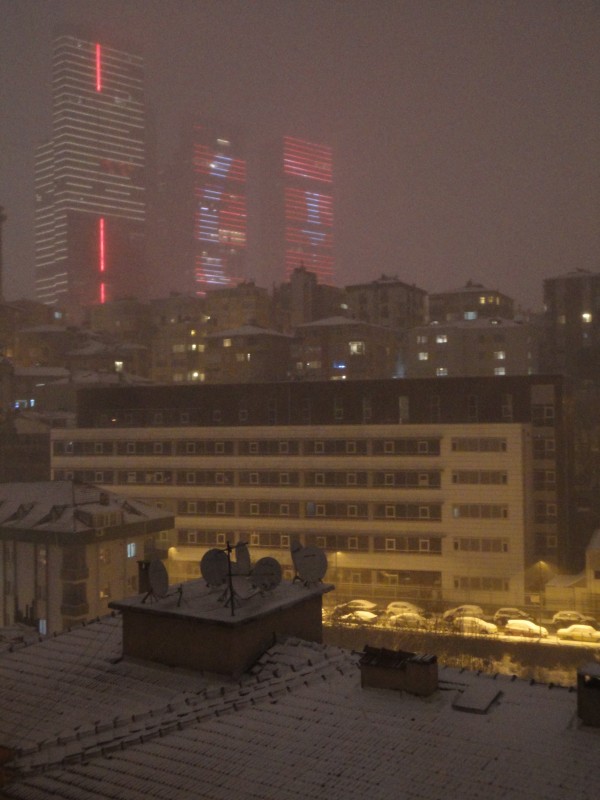
Nocturnal scene of city buildings under snow, loomed over by towers displaying the crescent and star of the Turkish flag in colored lights
Fulya, Şişli, Istanbul
Friday evening, January 6, 2017

Continue reading

NL XIII: “Choice”

Index to this series

Adolph Gottlieb, “Centrifugal,” gouache on paperboard, 1961 (National Gallery of Art, Washington; gift of the Woodward Foundation)

Adolph Gottlieb, “Centrifugal,” 1961 (National Gallery of Art, Washington; gift of the Woodward Foundation)

The key idea of Chapter XIII of New Leviathan is the correct statement of the “problem of free will”:

Continue reading

NL X: “Passion”

Index to this series

Passion is literally the correlate of action, as suffering is the correlate of doing. In the ordinary, vulgar sense, passion is our response to what we suffer. This is how we shall understand it.

Above, from a cross made of steel I-beams, a stone figure hangs, while others mourn at his feet; below, more stone figures, one bearing a cross, another, back to us, with robe bearing the image of a face

Sagrada Familia, Passion Façade, November, 2008

Continue reading

Writing, Typography, and Nature

Note added February 10, 2019: I return to this rambling essay, two years later in the Math Village. The main points are as follows.

  • Writing is of value, even if you never again read what you write.
  • There is also value to reading again, as in the present case.
  • A referee rejected a submitted article of mine in the history of mathematics because its order did not make sense – to that referee, though a fellow mathematician thought well of the article. A revision was eventually published as “On Commensurability and Symmetry.”
  • In the preface to The Elements of Typographical Style, Robert Bringhurst wonders how he can write a rulebook when we are all free to be different. He thus sets up an antithesis, such as I would investigate later in “Antitheses.”
  • From being simply a means of copying, typography has become a means of expression.
  • Yet typography should not draw attention to itself, just as, according to Fowler in A Dictionary of Modern English Usage, pronunciation (notably of foreign words) should not.
  • Through my own experience of typography with LaTeX [and HTML, as in this blog], I have developed some opinions differing from some others’.
  • Bringhurst samples Thoreau,
    • whose ridicule of letters sent by post applies today to electronic media, and
    • who rightly bemoans how enjoying the woods is thought idle; cutting them down, productive.
  • In Gödel, Escher, Bach, Douglas Hofstadter wonders how a message can be recognized by any intelligence. Bringhurst restricts the question to concern intelligences on this earth.
  • In my youth, Hofstadter introduced me to Zen Flesh, Zen Bones, (edited by Reps and Senzaki), whose influence on me I consider.
  • The Zen story about whether “this very mind is Buddha” suggests a further development of Collingwood’s “logic of question and answer.”
  • Through looking at another translation, I consider how Reps and Senzaki turned Chinese into English.
  • Rereading this blog led me back to Hofstadter.

Here are some meditations on some books read during a stay in the Nesin Mathematics Village, January, 2017. I originally posted this article from the Village; now, back in Istanbul, a few days into February, recovering from the flu that I started coming down with in the Village, I am correcting some errors and trying to clarify some obscurities.

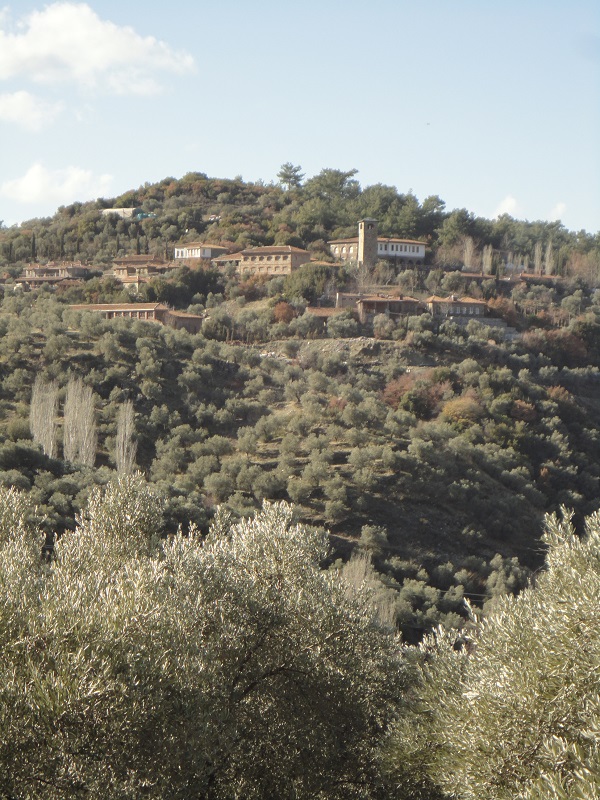
From below, a wooded hill, with buildings near the crest
Nesin Mathematics Village from the east
Wednesday, January 18, 2017

Continue reading

Şirince January 2017

Having enjoyed spending a January week at the Nesin Mathematics Village in 2016, this year I came back for two weeks. My spouse will join me for the second week. Meanwhile, here are some photographs from this amazing place. Continue reading