Tag Archives: Julian Jaynes

Verity (Iliad Book X)

The Trojans are watching, lest the Achaeans sail away in the night. Achilles is staying in his own camp. As we open Book X of the Iliad, Agamemnon cannot sleep. He worries, not just about the Trojans, but about whether his own men are properly worried.

A swimming man leaves a wake in a calm sea, whose gravelly bottom is seen in the foreground
One of two men I found swimming near Kireçburnu
Sarıyer, Istanbul
Sunday, New Year’s Day, 2023

Continue reading

On The Human Condition of Hannah Arendt 2

Index to this series

CHAPTER II The Public and the Private Realm [1]

Contents

There are four more sections in the chapter, and these constitute the next reading: 7 the public realm: the common; 8 the private realm: property; 9 the social and the private; 10 the location of human activities.

Graffiti: “Now or never” and “Oku” (that is, “Read”) on a wall by a street with a parked car; skyscrapers in the distance

Beşiktaş, February 15, 2022
Oku = “Read” (second-person singular imperative)

History and law

A significant passage in this reading lies on page 42 (¶ 6.9):

… the significance of a historical period shows itself only in the few events that illuminate it. The application of the law of large num­bers and long periods to politics or history signifies nothing less than the wilful obliteration of their very subject matter.

My post “Law and History” took up something like this argument. Continue reading

On Plato’s Republic, 3

Index to this series

We are reading now Book II of Plato’s Republic, Stephanus pages 357–83, covering:

  1. The conventional arguments in favor of injustice and justice, reviewed by Plato’s brothers Glaucon and Adeimantus respectively.
  2. The beginning of the construction of the city in speech, wherein the advent of justice is to be discerned; the guardians of the city are to be like dogs and to be given a traditional education, although with none of the traditional stories, since they talk about things like parricide and bad luck.

A book next to a dog lying on the beach

Dog with copy of Alain Badiou, Plato’s Republic:
A Dialogue in Sixteen Chapters, with a Prologue and an Epilogue, 2012
Profesörler Sitesi, Altınova, Balıkesir, Turkey, September 2, 2021

Continue reading

On the Odyssey, Book I

  • In reading his rendition of the Iliad, having enjoyed hearing Chapman speak out loud and bold;

  • having enjoyed writing here about each book, particularly the last ten books in ten days on an Aegean beach in September of this year (2019);

  • having taken the name of this blog from the first line of the Odyssey;

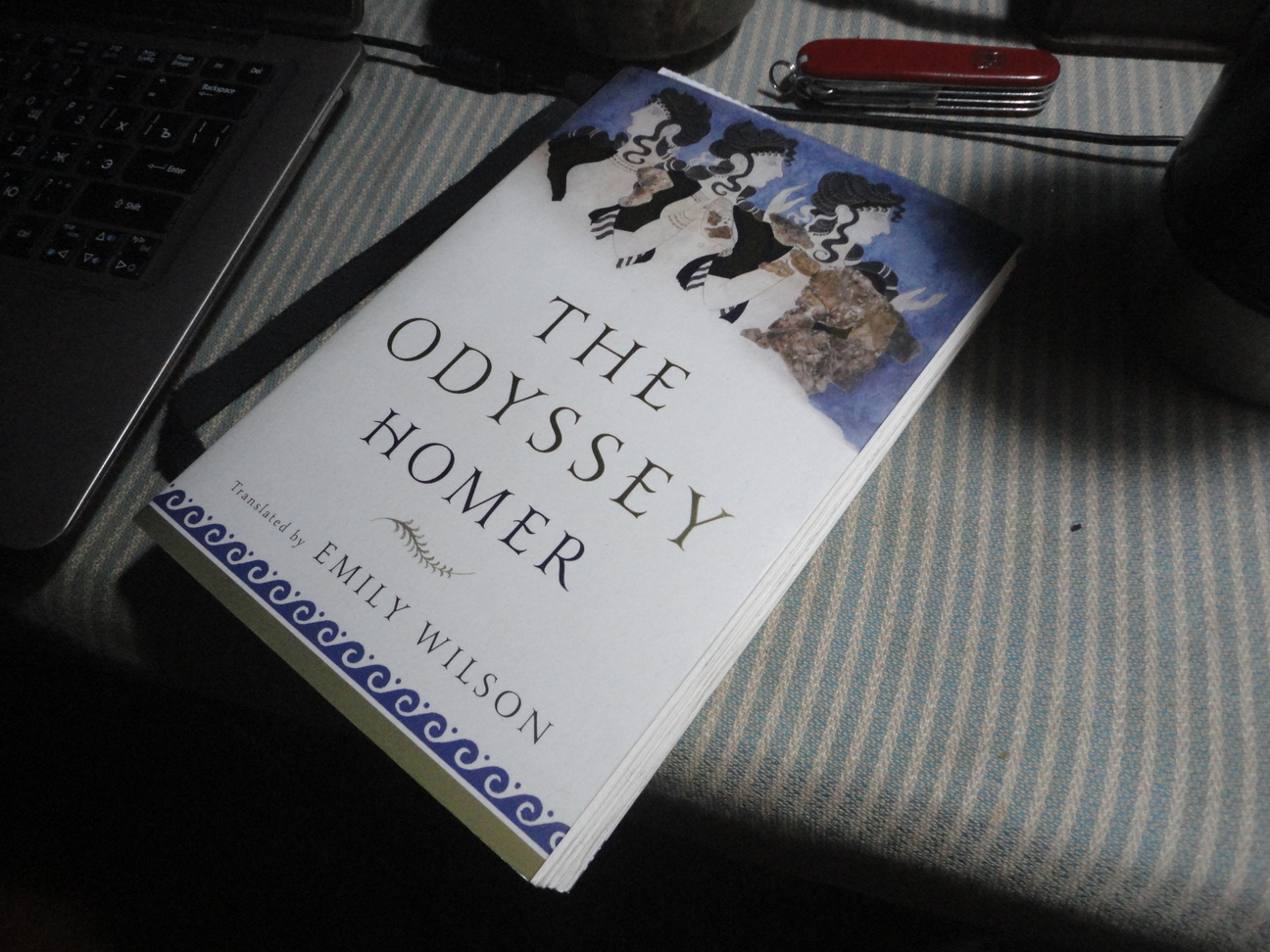
  • having obtained, from Homer Books here in Istanbul, Emily Wilson’s recent translation (New York: Norton, 2018);

  • Book on table, Wilson's Odyssey Continue reading

On Translation

Achilles is found singing to a lyre, in a passage of Book IX of the Iliad. Homer sets the scene in five dactylic hexameters; George Chapman translates them into four couplets of fourteeners.

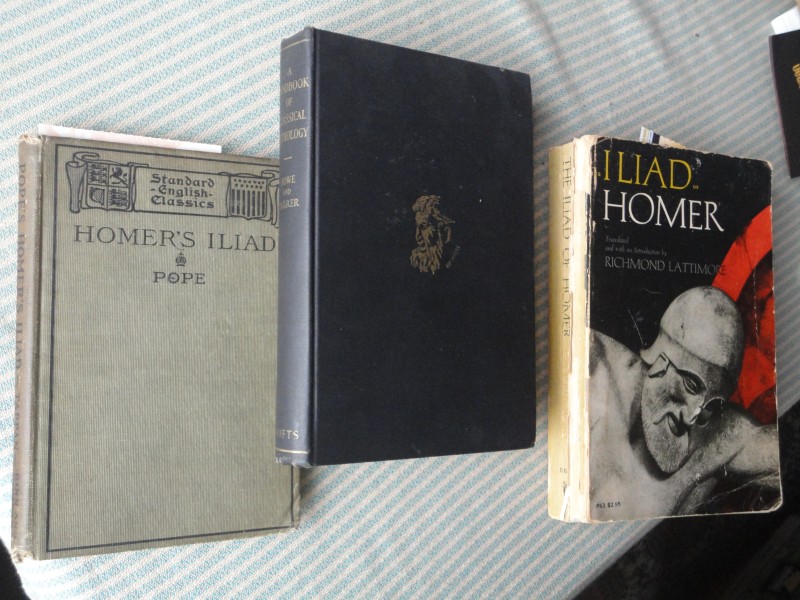
I wrote a post about each book of the Iliad, in Chapman’s version of 1611. As I said at the end, I look forward to reading Emily Wilson’s version. Meanwhile, here I examine the vignette of the lyre in several existing English translations, as well as in the original.

Three books mentioned in the text Continue reading

On Being Given to Know

  1. What if we could upload books to our brains?
  2. What if a machine could tell us what was true?

We may speculate, and it is interesting that we do speculate, because I think the questions do not ultimately make sense – not the sense that seems to be intended anyway, whereby something can be got for nothing.

Trees, clearings, and houses in the foreground; mountains receding into the background; clouds above
View from Şavşat

Continue reading

On Chapman’s Homer’s Iliad, Book XIV

Index to this series | Text of Chapman’s Homer’s Iliad

When Neptune was helping the Greeks stave off certain defeat, I tried to suggest that divine intervention in the course of events might be understood as human resolve to change that course. This was in Book XIII of the Iliad, where Neptune took the form of one of the Greeks – Calchas – in order to exhort the others. They would have listened to Calchas anyway; he was a prophet. Ajax Oileus said he could tell Calchas was “really” a god; we can read this to mean Calchas was inspiring. We can say this of somebody today, without meaning to suggest any supernatural influence.

Mostly a calm sea, with heads of two swimmers; behind, a strip of pink sky with setting sun

Continue reading

On Chapman’s Homer’s Iliad, Book IX

Index to this series | Text of Chapman’s Homer’s Iliad

Note added August 25; edited and augmented, August 27; 2024: In my view, the key events of the Iliad are Achilles’s holding back from

  1. killing Agamemnon in Book I;
  2. fighting on Agamemnon’s side in Book IX.

The latter case of self-restraint may be a disaster for Achilles, not to mention Patroclus and the other Greeks who die as a result; but it is also somehow a result of the former case. Not killing on impulse is probably a good thing; otherwise you have the situation of Njal’s Saga, which I took up in writing “On Homer’s Iliad Book I” (November 29, 2022).

Continue reading

On Chapman’s Homer’s Iliad, Book I

This post, originally of April 14, 2017, is the first of twenty-four, one on each book of Homer’s Iliad in Chapman’s translation.

A later series began on November 29, 2022. Again there was a post on each book of the Iliad, but now I was reading Murray’s translation in the Loeb Classical Library.

Achilles banefull wrath” is to be resounded by the Goddess, whom the poet invokes.

Strife between Achilles and Agamemnon is the story of the Iliad. It begins with Apollo, who has plagued the Greek army.

Homer denies no human responsibility. Apollo has plagued the army, because Agamemnon insists on keeping a man’s daughter as his slave. The woman’s father is a priest of Apollo called Chryses; we shall come to know the daughter’s name only as Chryseis. She has been taken in a Greek raid on her home town, which will be called Chrysa. We shall hear more about the raid later in Book I, when Achilles tells the story to his mother.

Thus Homer’s narrative is not sequential. In a technique that will become standard in literature, we start in medias res.

Continue reading