Tag Archives: St. Albans School

Be Sex Binary, We Are Not

Content warning: suicide.

The following sentence is bold in the last paragraph of an essay: “the science is clear and conclusive: sex is not binary, transgender people are real.” I don’t know what the writer means by this. As far as I can tell, as a biological concept used for explaining reproduction, sex has two kinds or parts or sides or aspects, and the essay tacitly affirms this; at the same time, obviously persons called transgender exist.

☾ ♂ ☿ ♃ ♀ ♄ ☉

The title of the essay is a command: “Stop Using Phony Science to Justify Transphobia.” I can support that. I don’t even need the qualifier “phony.” If transphobia is the kind of morbid fear suggested by the suffix “-phobia,” then science ought to help dispel this, not promote it.

One might also just say, Stop using phony science.

Continue reading

Donne’s Undertaking

To ease the strain of pandemic restrictions, I was recently called on to recommend a poem. I chose “The Undertaking” of John Donne. I want to say here why. Briefly:

  1. The poem (which I transcribe below) has a sound that impressed me when I first read it, more than thirty years ago.
  2. The poem alludes to ideals:
    • of recognizing what is good for its own sake, and
    • of climbing a rung or two on Diotima’s ladder of love.
  3. The sound of Donne’s poem may seduce one into thinking the ideals worthy.

          ⯅          

I also indulge myself here in reminiscences not obviously relevant to “The Undertaking.” They do conclude with my sitting down to read Donne for myself. (Note added November 3, 2025.)

          ⯆          

Diotima’s ladder, or stairway, is recounted by Socrates in Plato’s Symposium (211c, here in the translation of Jowett, which is the one I read at school, though it may not be the most faithful; the bullets and insertions from the Greek text are mine):

And the true order of going, or being led by another, to the things of love (τὰ ἐρωτικά), is to begin from the beauties of earth and mount upwards for the sake of that other beauty, using these as steps (οἳ ἐπαναβαθμοί) only, and from

  • one going on to
  • two, and from two to
  • all fair forms (τὰ καλὰ σώματα), and from fair forms to
  • fair practices (τὰ καλὰ ἐπιτηδεύματα), and from fair practices to
  • fair notions (τὰ καλὰ μαθήματα), until from fair notions he arrives at
  • the notion of absolute beauty, and at last knows what the essence of beauty is (ὃ ἔστι καλόν).

Analytic Geometry and Donne’s complete poetry
Two books that were my mother’s

Continue reading

Mood

Executive summary. The English grammatical moods – indicative, imperative, subjunctive – were not understood till the nineteenth century, according to an 1882 doctoral dissertation, On the Use of the Subjunctive Mood in Anglo-Saxon. Considering illustrative passages that happen to be from Plato, Alfred Douglas, Evelyn Waugh, and especially John Donne; looking ultimately at John McWhorter’s 2015 essay, “English is not normal”; I review the subjunctive mood, grammar in general, and my own lack of understanding till I was in college.

The copyright page has, with the preceding pages and cover, fallen away from the rest of the book with use
Copyright and contents pages of the Concise Oxford Dictionary, 6th edition

Continue reading

Doing and Suffering

To do injustice is worse than to suffer it. Socrates proves this to Polus and Callicles in the dialogue of Plato called the Gorgias.

I wish to review the proofs, because I think they are correct, and their result is worth knowing.

Loeb Plato III cover

Or is the result already clear to everybody?

Whom would you rather be: a Muslim in India, under attack by a Hindu mob, or a member of that mob?

You would rather not be involved; but if you had to choose, which option would be less bad: to be driven to an insane murderous fury, or to be the object of that fury?

Continue reading

On Being Given to Know

  1. What if we could upload books to our brains?
  2. What if a machine could tell us what was true?

We may speculate, and it is interesting that we do speculate, because I think the questions do not ultimately make sense – not the sense that seems to be intended anyway, whereby something can be got for nothing.

Trees, clearings, and houses in the foreground; mountains receding into the background; clouds above
View from Şavşat

Continue reading

Writing Rules

Executive summary (added July 16, 2018): I have had enough of misrepresentation by experts of what other experts have to say about grammar.


An ongoing concern of this blog is the subject taught in school called grammar. See for example

  • the previous post, “Writing and Inversion,” about how a supposed rule against the passive voice might be better understood as a rule to avoid certain inversions of order (namely those inversions that add words and torpor);
  • the post before that, “A New Kind of Science,” presenting a theory that grammar is properly neither prescriptive nor descriptive, but “criteriological,” because it examines the criteria that we apply to our own speaking and writing;
  • an early expression (from six years ago) of some of those ideas: “Strunk and White.”

Grammar causes anxiety. Every aspect of school would seem to cause anxiety in somebody. Decades after they have left school, how many persons have nightmares of missing an examination? Quite a few, it would seem; see the evidence appended to this post. My mother and her brother were such persons, as I learned when growing up. I seem not to be such a person, though I once dreamt of missing a plane.

How much support of current US President Donald Trump is due to memories of belittlement by teachers at school? Similar questions may be raised about

  • UK government minister Michael Gove’s saying, “people in this country have had enough of experts …”;
  • the rise in Turkey of Recep Tayyip Erdoğan, who has perceived a special threat from the Peace Academics.

On that last matter, see my blog essay of March, 2016, “Academic Freedom.”

In the blog generally, I may criticize some of my fellow academics; but I criticize them for their own criticism of fellow academics and thinkers. Thus in the article “Strunk and White” listed above, I say Geoffrey Pullum was stupid to decry, in 2009, the “50 Years of Stupid Grammar Advice” offered by Strunk and White’s Elements of Style.

Still I have respected Pullum’s recommendation of Style: Toward Clarity and Grace, by Joseph M. Williams. I bought Williams’s book, and in this post I focus on some of his advice.

I thought Williams’s book might be more “democratic” than Strunk and White’s, in the sense of being aimed at a broader audience. That broader audience might include students whose parents didn’t go to college or grow up speaking English.

Now I have doubts that Williams has such an audience in mind. In his final chapter, called “Usage,” Williams writes (on page 176) of

Three Kinds of Rules

1. Some rules characterize the basic structure of English … No native speaker of English has to think about these rules at all.

2. Some rules distinguish standard from nonstandard speech … The only writers and speakers who worry about these rules are those upwardly mobile types who are striving to join the educated class of writers and speakers …

3. Finally, some grammarians try to impose on those who already write educated standard English particular items of usage that they think those educated writers should observe – don’t split infinitives; use that, not which for restrictive clauses …

This may not be much evidence to go on; but judging from the style of #1, I’m not sure Williams has considered the possibility of having readers who are not native speakers of English. In #2, by referring pejoratively to “those upwardly mobile types,” Williams seems to think they are not readers either.

Appearances are corroborated on the next page, after Williams describes again his three kinds of rules:

1. Some rules account for the fundamental structure of English …

2. Some rules distinguish the dialects of the educated and the uneducated …

3. And some rules belong to that category of rules observed by some well-educated people, and ignored by others equally well-educated …

Ordinarily, the first set of rules concerns us not at all. And if you are interested in this book, you probably aren’t much concerned with the second set either. It is the third set of rules that concern – sometimes obsess – already competent but not entirely secure writers. They are the rules of usage out of which the Pop Grammarians have created their cottage industry.

In faithfully transcribing Williams’s words about rules of usage, I have noticed that they violate a certain rule: “Enclose parenthetic expressions between commas.” Indeed, in the first block quotation above, giving the first list of “Three Kinds of Rules,” look again at the last clause (itself a rule):

use that, not which for restrictive clauses.

Here the phrase “not which” is parenthetic, but is not printed that way. Since a comma precedes it, a comma ought also to follow it, at least if one agrees with the rule that I stated, “Enclose parenthetic expressions between commas.”

That rule happens to be Rule 3 of Strunk’s original eight “Elementary Rules of Usage.” It is still Rule 3 in the version of The Elements of Style edited by E. B. White, although some of the other rules have been changed.

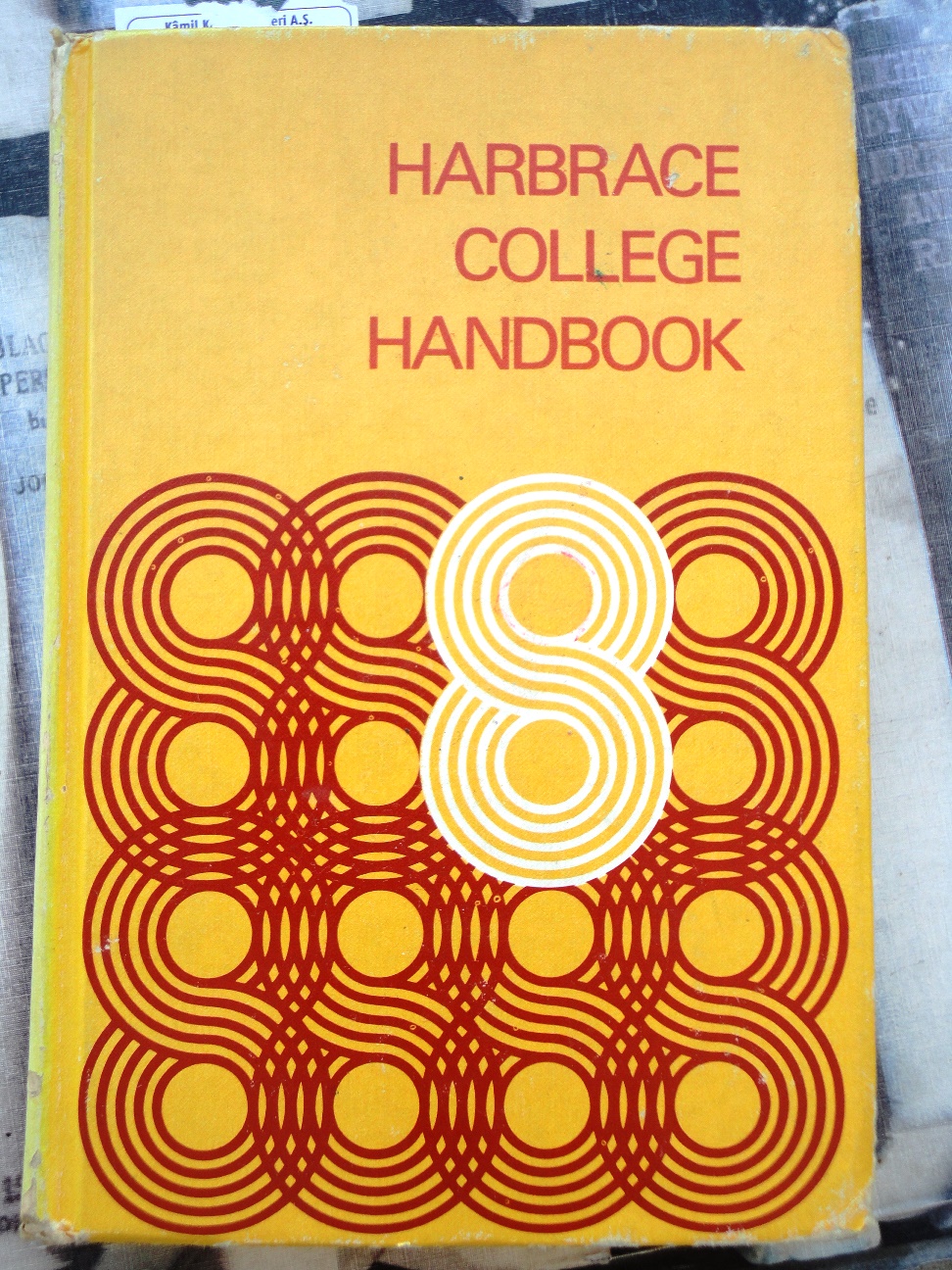
I find the same rule also as part of Rule 12d in the Harbrace College Handbook (8th edition, 1977), used in the ninth-grade English class at my private, college-preparatory school for boys in Washington. According to the Handbook:

Commas set off nonrestrictive clauses and phrases and other parenthetical and miscellaneous elements, such as transitional expressions, items in dates, words used in direct address, and so on. Restrictive clauses and phrases are not set off by commas.

Surely I was taught this rule in earlier years too. The rule seems unobjectionable and even natural to me now, and I do not recall any difficulty with it.

Yellow cover of Harbrace College Handbook 8

Continue reading

Some Say Poetry

In a poetry review, a remark on being a student has drawn my attention:

In My Poets, a work of autobiographical criticism with occasional ventriloquial interludes, McLane recalls two “early impasses in reading,” freshman-year encounters with Charles Olson and Frank O’Hara. She writes about not “getting it” but wanting to get it, about a desire to get it that was left wanting by code-breaking and analysis and satisfied by hearing and feeling.

This is from the second half of a “New Books” column by Christine Smallwood, in the Reviews section of Harper’s, July 2017. After quoting Smallwood’s review, I want to say something about learning and creating, in poetry and also in mathematics.

Potted palms with plaster farm animals on hillside behind
Kuzguncuk, 2017.11.05

Continue reading

Ahtamar Island

During a mathematics conference, I visit the ruins of a monastery on a remote island in an inland sea. This moves me to consider the relation between introversion and, if not mathematics, then monasticism. On the origins of Christian monasticism, I look at several sources, notably Gibbon (see the References); also Maugham, who writes of a hermit on an island of the Torres Strait. Since the monastery on the island was Armenian, in what is now Turkey, one should consider also the treatment of minority populations here. I only acknowledge the issue, suggesting Wikipedia pages (linked to presently) as a starting point for research. On this subject, old books on my shelves are not much help; my own experience is not much more help, at least not in a way that lends itself to being written of here. I do know that Turkish politicians will treat imputations of their own Armenian ancestry as an insult.


We visited Ahtamar Island for a second time on Wednesday, August 23, 2017. Thus we saw again the remains of the Church of the Holy Cross. This Armenian church was consecrated in 921 and presumably desecrated in 1915, if not earlier; now, since our last visit, though officially a museum, the church would seem to have been reconsecrated, to judge by the new altarpiece, featuring an icon of the Madonna and Child.

Madonna and child
Altarpiece, Church of the Holy Cross, Ahtamar Island

Continue reading

On Chapman’s Homer’s Iliad, Book I

This post, originally of April 14, 2017, is the first of twenty-four, one on each book of Homer’s Iliad in Chapman’s translation.

A later series began on November 29, 2022. Again there was a post on each book of the Iliad, but now I was reading Murray’s translation in the Loeb Classical Library.

Achilles banefull wrath” is to be resounded by the Goddess, whom the poet invokes.

Strife between Achilles and Agamemnon is the story of the Iliad. It begins with Apollo, who has plagued the Greek army.

Homer denies no human responsibility. Apollo has plagued the army, because Agamemnon insists on keeping a man’s daughter as his slave. The woman’s father is a priest of Apollo called Chryses; we shall come to know the daughter’s name only as Chryseis. She has been taken in a Greek raid on her home town, which will be called Chrysa. We shall hear more about the raid later in Book I, when Achilles tells the story to his mother.

Thus Homer’s narrative is not sequential. In a technique that will become standard in literature, we start in medias res.

Continue reading

All You Need Is Love

Note added May 31, 2018: Here are some meditations on education from the summer of 2016, when Donald Trump was threatening to become President of the United States. Education cannot be forced on unwilling students. Neither need students know just what they are accepting; they may be enticed or beguiled into learning. Whether they have learned cannot be directly tested. I include some memories of racism (as an observer, not a victim) and of my own liberal education.

Note added May 22, 2023: I return to this post, precisely because of that assertion that testing does not show directly whether students have learned. As I have learned recently through a friend, Emily Bender said something similar on Medium last year, in response to Steven Johnson in “A.I. Is Mastering Language. Should We Trust What It Says?” (New York Times Magazine, April 15, 2022):

First, large language models have been making steady improvements, year after year, on standardized reading comprehension tests.

Bender’s response is “On NYT Magazine on AI: Resist the Urge to be Impressed” (April 18, 2022):

just because the tests were designed to test for reading comprehension by people, and even if we assume that they do a good job of measuring that, doesn’t mean that comparable scores by machines on the same tests entail that machines are doing something comparable …

Bender goes on to talk about “construct validity.”


Would education solve the world’s problems? A meaningfully positive answer would imply that the appropriate education could actually be supplied to us, or enough of us; and yet education is not a drug that can be administered willy-nilly.

Tables for art entrance exam, MSGSÜ, 2016.08.02

Continue reading