Tag Archives: Taoism

Mathematics and Logic

Large parts of this post are taken up with two subjects:

  1. The notion (due to Collingwood) of criteriological sciences, logic being one of them.

  2. Gödel’s theorems of completeness and incompleteness, as examples of results in the science of logic.

Like the most recent in the current spate of mathematics posts, the present one has arisen from material originally drafted for the first post in this series.

In that post, I defined mathematics as the science whose findings are proved by deduction. This definition does not say what mathematics is about. We can say however what logic is about: it is about mathematics quâ deduction, and more generally about reasoning as such. This makes logic a criteriological science, because logic seeks, examines, clarifies and limits the criteria whereby we can make deductions. As examples of this activity, Gödel’s theorems are, in a crude sense to be refined below, that

  • everything true in all possible mathematical worlds can be deduced;

  • some things true in the world of numbers can never be deduced;

  • the latter theorem is one of those things.

Continue reading

Donne’s Undertaking

To ease the strain of pandemic restrictions, I was recently called on to recommend a poem. I chose “The Undertaking” of John Donne. I want to say here why. Briefly:

  1. The poem (which I transcribe below) has a sound that impressed me when I first read it, more than thirty years ago.
  2. The poem alludes to ideals:
    • of recognizing what is good for its own sake, and
    • of climbing a rung or two on Diotima’s ladder of love.
  3. The sound of Donne’s poem may seduce one into thinking the ideals worthy.

          ⯅          

I also indulge myself here in reminiscences not obviously relevant to “The Undertaking.” They do conclude with my sitting down to read Donne for myself. (Note added November 3, 2025.)

          ⯆          

Diotima’s ladder, or stairway, is recounted by Socrates in Plato’s Symposium (211c, here in the translation of Jowett, which is the one I read at school, though it may not be the most faithful; the bullets and insertions from the Greek text are mine):

And the true order of going, or being led by another, to the things of love (τὰ ἐρωτικά), is to begin from the beauties of earth and mount upwards for the sake of that other beauty, using these as steps (οἳ ἐπαναβαθμοί) only, and from

  • one going on to
  • two, and from two to
  • all fair forms (τὰ καλὰ σώματα), and from fair forms to
  • fair practices (τὰ καλὰ ἐπιτηδεύματα), and from fair practices to
  • fair notions (τὰ καλὰ μαθήματα), until from fair notions he arrives at
  • the notion of absolute beauty, and at last knows what the essence of beauty is (ὃ ἔστι καλόν).

Analytic Geometry and Donne’s complete poetry
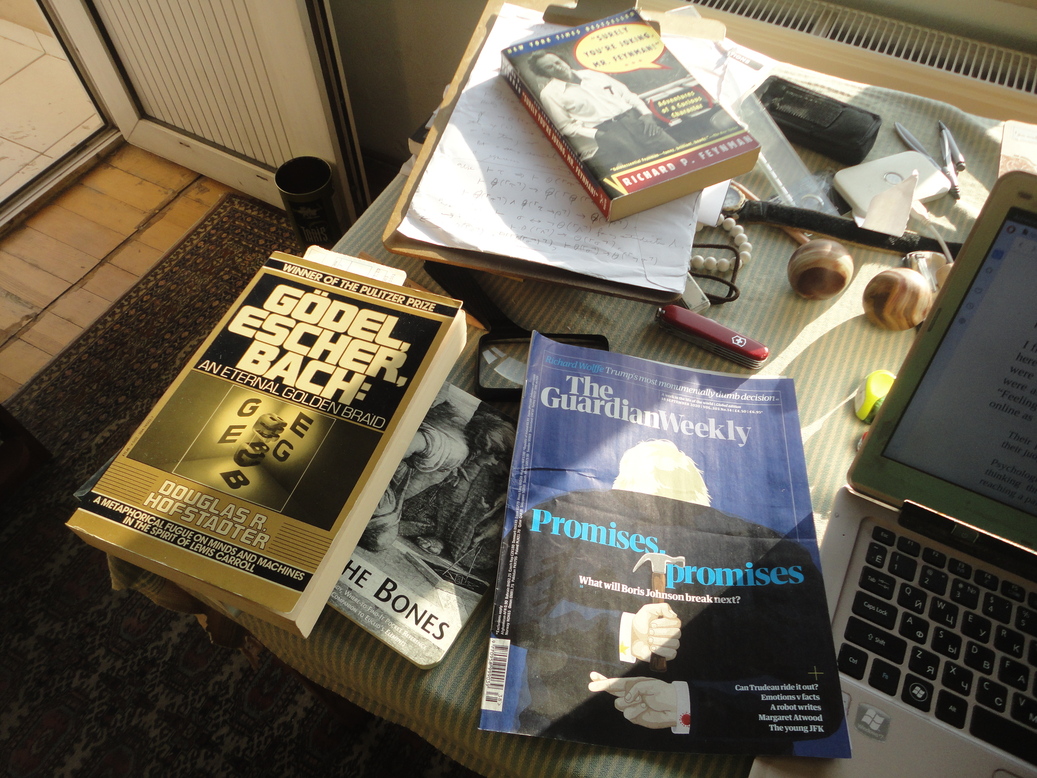
Two books that were my mother’s

Continue reading

Anthropology of Mathematics

This essay was long when originally published; now, on November 30, 2019, I have made it longer, in an attempt to clarify some points.

The essay begins with two brief quotations, from Collingwood and Pirsig respectively, about what it takes to know people.

  • The Pirsig quote is from Lila, which is somewhat interesting as a novel, but naive about metaphysics; it might have benefited from an understanding of Collingwood’s Essay on Metaphysics.

  • A recent article by Ray Monk in Prospect seems to justify my interest in Collingwood; eventually I have a look at the article.

Ideas that come up along the way include the following.

  1. For C. S. Lewis, the reality of moral truth shows there is something beyond the scope of natural science.

  2. I say the same for mathematical truth.

  3. Truths we learn as children are open to question. In their educational childhoods, mathematicians have often learned wrongly the techniques of induction and recursion.

  4. The philosophical thesis of physicalism is of doubtful value.

  5. Mathematicians and philosophers who ape them (as in a particular definition of physicalism) use “iff” needlessly.

  6. A pair of mathematicians who use “iff” needlessly seem also to misunderstand induction and recursion.

  7. Their work is nonetheless admirable, like the famous expression of universal equality by the slave-driving Thomas Jefferson.

  8. Mathematical truth is discovered and confirmed by thought.

  9. Truth is a product of every kind of science; it is not an object of natural science.

  10. The distinction between thinking and feeling is a theme of Collingwood.

  11. In particular, thought is self-critical: it judges whether itself is going well.

  12. Students of mathematics must learn their right to judge what is correct, along with their responsibility to reach agreement with others about what is correct. I say this.

  13. Students of English must learn not only to judge their own work, but even that they can judge it. Pirsig says this.

  14. For Monk, Collingwood’s demise has meant Ryle’s rise: unfortunately so since, for one thing, Ryle has no interest in the past.

  15. In a metaphor developed by Matthew Arnold, Collingwood and Pirsig are two of my touchstones.

  16. Thoreau is another. He affects indifference to the past, but his real views are more subtle.

  17. According to Monk, Collingwood could have been a professional violinist; Ryle had “no ear for tunes.”

  18. For Collingwood, Victoria’s memorial to Albert was hideous; for Pirsig, Victorian America was the same.

  19. Again according to Monk, some persons might mistake Collingwood for Wittgenstein.

  20. My method of gathering together ideas, as outlined above, resembles Pirsig’s method, described in Lila, of collecting ideas on index cards.

  21. Our problems are not vague, but precise.


When Donald Trump won the 2016 U.S. Presidential election, which opinion polls had said he would lose, I wrote a post here called “How To Learn about People.” I thought for example that just calling people up and asking whom they would vote for was not a great way to learn about them, even if all you wanted to know was whom they would vote for. Why should people tell you the truth?

Saturn eclipse mosaic from Cassini

Continue reading

On Chapman’s Homer’s Iliad, Book X

Index to this series | Text of Chapman’s Homer’s Iliad

In Book X of the Iliad, Diomedes and Ulysses go to spy on the Trojan camp at night. When they return to the Greek camp (lines 482 & 3),

Then entred they the meere maine sea, to cleanse their honord sweate
From off their feet, their thighes and neckes: and when their vehement heate …

I can enter the same sea now. After more than ten months, I return to my reading of Homer, and Chapman’s Homer, as I have returned to the place where I was doing it last year, on the Aegean coast opposite Lesbos.

Continue reading

What It Takes

This essay ends up considering arguments that natural science – especially mathematical physics – is based on absolute presup­positions whose mythological expression is found in Christianity – especially the doctrine of Incarnation.

I take note along the way of continuing censorship of Wikipedia by the Turkish state.

The post falls into sections as follows.

  • Where to start. To the thesis that everybody can be a philosopher, an antithesis is that persons with the professional title of philosopher ought to know the history of their subject.

  • Ontology. Disdain for this history may lead to misunderstanding of Anselm’s supposed proof of the existence of God.

  • Presupposition. To prove anything, you need a pou sto, or what Collingwood calls an absolute presupposition.

  • Progression. Newton rejected antiquated presuppositions.

  • Reaction. Coal-burners and racists reject new presuppositions.

  • Universality. From the 47th chapter of the Tao Te Ching (in the translation of Gia-fu Feng and Jane English):

    Without going outside, you may know the whole world.
    Without looking through the window, you may see the ways of heaven.
    The farther you go, the less you know.
    Thus the wise know without traveling;
    See without looking;
    Work without doing.

  • Religion. To say that we can know the laws governing the entire universe is like saying a human can be God.

  • Censorship. Thus everybody who believes in mathematical physics is a Christian, if only in the way that, by the Sun Language Theory, everybody in the world already speaks Turkish.

  • Trinity. That the university has several departments, all studying the same world – this is supposed to correspond to the triune conception of divinity.

This post began as a parenthesis in another post, yet to be completed, about passion and reason. To anchor that post in an established text, I thought back to David Hume, according to whom,

Reason is, and ought only to be[,] the slave of the passions, and can never pretend to any other office than to serve and obey them.

David Hume, A Treatise of Human Nature

Continue reading

One & Many

0

This essay – these notes for an essay, this draft of an essay – is inspired by Robert Pirsig’s first book. I have made sectional divisions where they seemed to occur naturally.

Photo of paperback and hardback editions of Zen and the Art of Motorcycle Maintenance

Continue reading

The Peace of Liberal Education

The wall of Dolmabahçe Sarayı, January 11, 2015

The wall of Dolmabahçe Sarayı, January 11, 2015

The occasion of this article is my discovery of a published Turkish translation of Collingwood’s Speculum Mentis or The Map of Knowledge (Oxford, 1924). Published as Speculum Mentis ya da Bilginin Haritası (Ankara: Doğu Batı, 2014), the translation is by Kubilay Aysevenler and Zerrin Eren. Near the end of the book, Collingwood writes the following paragraph about education, or what I would call more precisely liberal education. The main purpose of this article then is to offer the paragraph to any reader who happens to stop by.

Continue reading

Books hung out with

Here are some books that I have read more times than I can remember.

  1. R. G. Collingwood, The Principles of Art (1938);
  2. Somerset Maugham, The Razor’s Edge (1944);
  3. Robert M. Pirsig, Zen and the Art of Motorcycle Maintenance (1974).

The years of my first readings were 1987, 1984, and 1982, respectively, as best I can remember; in any case, their order is opposite to the order of publication.

I want to say some things about the books and their writers. I intend especially to address the last book, which I shall call ZAMM. From Pirsig’s more recent book, Lila, I mention only the author’s description of keeping notes on slips of paper, then arranging and rearranging them, in hopes that he might finally produce a book out of them. The present article might be considered as a collection of such notes, not necessarily forming a coherent whole. There are more notes that I might add in future.


While I was in high school, I paid the price of three dollars and thirty-three cents (plus tax) for the peculiar purple book in square format called Be Here Now. I suppose the title can be taken as a summation of the spiritual advice contained in the book. This advice is apparently derived mainly from Hinduism, though given to us by an American once called Richard Alpert, who spent a lot of time taking LSD with Timothy Leary. After I had gone off to read Great Books at St John’s College in Annapolis in 1983, and transferred to Santa Fe after a year, I learned that the Director of Laboratories on the occidental campus had lived at a sort of monastery or commune, elsewhere in New Mexico, supported by sales of Be Here Now.

The book ends with lists of recommended reading, headed with the warning, “Painted cakes do not satisfy hunger.” There are three lists:

  1. Books to hang out with.
  2. Books to visit with now and then.
  3. Books it’s useful to have met.

The “books to hang out with” are thirty-five authors and teachers and scriptures. Those that I have on my own shelves are the Bhagavad Gita, the Holy Bible, the Tibetan Book of the Dead, the Tao Te Ching, the I Ching, and the poems of Hafiz. I have not really hung out with any of these, except maybe parts of the Bible and the Tao Te Ching (the latter in the 1972 translation of Gia-Fu Feng and Jane English, illustrated with Chinese calligraphy of the former on lovely spare nature photographs by the latter).

From Be Here Now’s longer list of “books to visit with now and then,” I have read only some of the poetry of Rumi and William Blake, along with Hesse’s Siddhartha, Merton’s Seven Story Mountain, Reps’s Zen Flesh, Zen Bones, Rilke’s Duino Elegies, and Thoreau’s Walden. From the final, longest section, of “books it’s useful to have met,” the works that I have read are a curious mix of mostly science fiction and St John’s College Program books, by Asimov, Bradbury, Castaneda, Dante, Descartes, Heinlein, Milton, Pascal, Plotinus, Plato, Saint-Exupéry, Salinger, and Tolkien.


The three books that I listed at the beginning are among the books that I have hung out with. Let me record here a flaw in my memory concerning one of them. Before checking the lists in Be Here Now, I thought I remembered that The Razor’s Edge was there somewhere, if only among the “books it’s useful to have met”. But it is not there. Since it seems to fit the theme of spiritual journeys, I wonder if its absence is due to ignorance or oversight. Possibly Maugham was judged to be a spiritual lightweight. However, because on a web page I said The Razor’s Edge was one of my favorite books, I received emails from a fellow, calling himself the Wanderling, who said that his mentor, and not a fellow called Guy Hague, was the person who had been the source for Maugham’s character Larry Darrell.


Some people never read a book more than once. Some people cannot even conceive of doing this. Jerry Seinfeld would appear to be one of those people. In an early episode of his television series, Jerry ridicules George for wanting to retrieve some already-read books from the girlfriend with whom he has just broken up.

Presumably Seinfeld could conceive of watching a television show more than once. It is only because I have watched Seinfeld episodes more than once that I am able to recall and mention Jerry’s foolishness about books in the first place.

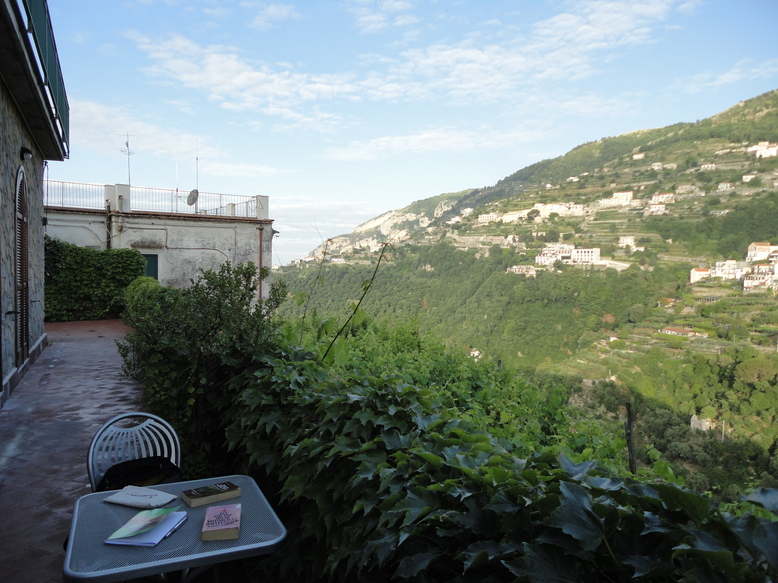
Recently I increased by one the unknown number of my readings of ZAMM. Earlier in this month of June, 2013, above the Tyrrhenian Sea, in the gorgeous hilltop setting of Ravello, where I was attending a mathematics conference, in the early mornings I would rise, sit outside, and either work on mathematics or read ZAMM.

photo of terrace in Ravello
ZAMM in the morning in Ravello

Continue reading