Category Archives: Art

Chaucer, CT, Miller’s and Reeve’s Tales

Index to this series

When I read the Miller’s Tale for high school, I thought it was supposed to show how titillation was possible through learning (in this case, learning Middle English). We didn’t read the Reeve’s ensuing tale (it was not in the selection that we had).

The two tales are comedies. Chaucer bases them on existing plots, as far as I know, but tries to make them fit his pilgrims. Though the Reeve may derive the lesson, “A gylour shal him-self bigyled be” (line 4321), I see no reason to think Chaucer is trying to teach this or any other lesson. He portrays corruption in the Church, but does not seem to be a Luther in the making.

There are many more tales to come. Meanwhile, I wonder how Chaucer came to describe the mote and beam of Matthew 7:3 as a stalk and a balk; see lines 3919–20.

Before passing to the text itself, I try to summarize, highlighting the comedy.

Continue reading

Chaucer, CT, Knight’s Tale

Index to this series

I had read the Knight’s Tale in college and written an essay about it, but I could remember little of the Tale itself or the essay.

After obtaining and annotating the text of the Tale as below, I went back to reread my old essay after thirty-six years. It’s better than I feared, and it drew my attention to points that I had missed in the latest reading of the Knight’s Tale itself. But my concerns are somehow different now.

This is what I say now about the Knight’s Tale. It is about the resolution of a love triangle. Palamon and Arcite both love Emily. Arcite wins her, but Palamon ends up with her.

By the anachronistic conceit of the teller of the tale (be he Chaucer or Chaucer’s Knight), Palamon and Arcite are knights in ancient Greece. Theseus arranges for them to fight one another for the hand of Emily. Palamon prays Venus to win Emily or die. Arcite prays Mars to give him victory. Emily prays Diana to leave her single, if possible.

Maidenhead is not allowed. However, Arcite will go to the man who loves her most. Victory is Arcite’s, but then accident takes his life, and Theseus gives Emily to Palamon.

I could keep adding details until I had repeated the whole story told in Chaucer’s verses; but I am not going to do that.

A question raised in our seminar is, What does it mean that Chaucer has a Christian knight tell a story about knights who worship pagan gods?

Palamon and Arcite get what they say they want, literally. Oracles work that way:

Continue reading

Hostility and Hospitality

After seventeen weekly posts of readings with my annotations, the Pensées of Pascal join two other works that I have blogged about systematically, chapter by chapter or book by book:

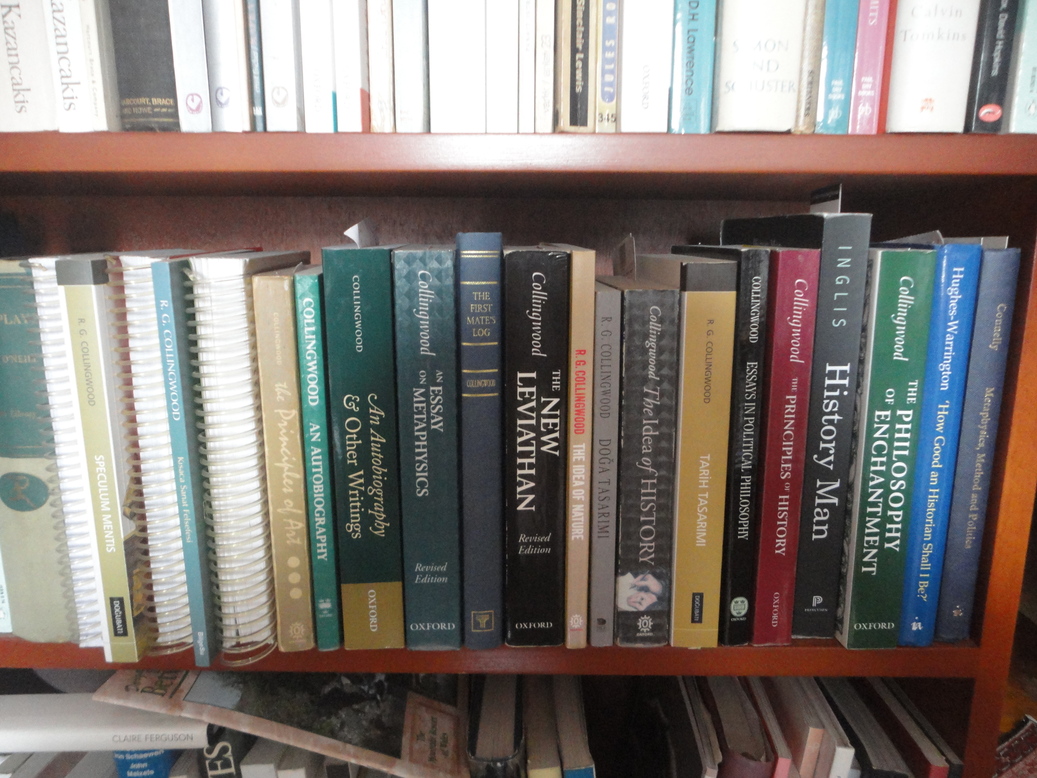
  • R. G. Collingwood, The New Leviathan, or Man, Society, Civilization, and Barbarism (1942);

  • Homer, the Iliad, in George Chapman’s translation.

Do three authors belong together, for any other reason than that I have spent time with each of them?

  • For Pascal, the Torah is history, but the Iliad was written too late to be that, and is just a novel (S 688 / L 436 / B 628). It has no concept of law, he says (S 691 / L 451 / B 620), but later Greeks took this and other things from the Jews. I discussed this in “Judaism for Pascal.” For example, Philo Judaeus thinks that when Heraclitus says, “We live their death and we die their life,” this is the death wrought by eating of the tree of the knowledge of good and evil in Genesis.

  • Pascal and Collingwood both come to terms with a world of contrariety. Collingwood calls it “a Heraclitean world,” alluding to how Plato has Socrates tell Hermogenes in the Cratylus (402a, Loeb translation by Harold North Fowler),

    Heracleitus says, you know, that all things move and nothing remains still, and he likens the universe to the current of a river, saying that you cannot step twice into the same stream.

    Continue reading

Words

This post is based on recent readings, often on or through Twitter, of the following writers.

  1. Lilith Saintcrow on “Domestic abusers, white supremacists, and religious bigots.”
  2. C. S. Lewis on gulling the educated, and objectivity as a dubious value.
  3. Marilynne Robinson on consensus as concealing the objectively true.
  4. Neil deGrasse Tyson on objectivity as a good value.
  5. Plato on seeming wise, without being so.
  6. Mark Vernon on imagination in William Blake.
  7. whoever wrote an “Open Letter Concerning Transphobia in Philosophy,” signed by many professional philosophers.
  8. Agnes Callard on how philosophers shouldn’t be signing petitions.
  9. Rebecca Reilly-Cooper, on the incoherence of the notion of gender identity.
  10. Christopher Bertram, a signer of the “Open Letter.”
  11. Nathan Oseroff-Spicer, who noticed who had not signed the letter.
  12. Aaden Friday, on what’s wrong with Reilly-Cooper and other such women.
  13. Brian Earp, on why declaring pronouns is not obviously a good thing.
  14. Liam Kofi Bright, another signer of the “Open Letter.”
  15. Masha Gessen, on wishing he could have transitioned as a teen.
  16. John Steinbeck, on being a man.
  17. Christa Peterson, on what gender identity might be.
  18. Holly Lawford-Smith, on third bathrooms and being banned from social media.
  19. Jason Stanley, who signed the “Open Letter,” but also calls for left unity.
  20. Isaac Asimov, on behaviorism.
  21. Dominic Berry, who will block anybody who follows the editor who published Reilly-Cooper’s essay.
  22. Kathleen Stock, the subject of the “Open Letter.”
  23. Caitlin Green, on what people such as Stock should do if they are going to change their research focus.

Having originally posted this essay on January 9, 2021, I edited and augmented it, on January 19 and December 19 of that year. I return to it now, on June 22, 2023, having posted “On Dialectic,” two days ago; this one is another post that quotes lots of people, and I want to check how it reads. It reads fine, to me, although I did have to correct occurrences of “behavior” spelled as “behavor.” Moreover, although I had forgotten what was here, I recognized it instantly as I read; another reader would not experience this recognition.

What stands out most to me now is Christa Peterson’s suggestion,

A representation of our own gender … could … be a means of picking out people as who we are co-gendered with …

As the essay already suggests, if you replaced “gender” with “race,” then the resulting speculation could get you called a racist, and that is supposed to be something bad. However, if we replace “gender” with “sex,” we obtain a proposition that is fundamental to contemporary biology, as I understand it, because evolution is

  • not only by natural selection, or “survival of the fittest” – selection by the rigors of the natural environment,
  • but also by sexual selection, or selection for mating by members of the opposite sex of one’s (sexually reproducing) species.

I think this is why Nina Paley can say, in a blog post called “Why I Don’t Use ‘Preferred Pronouns’,” which I referred to also in “Imagination,”

Like most mammals, I can’t help but identify someone’s sex with +99% accuracy. (… Women, I think, are better at identifying sex than men, either due to instinct or conditioning for survival …)

We know that there are two sexes, and we know who is of which sex, the way we know that some foods are good to eat. However, Peterson seems to think of this knowledge a bit differently:

Trans people’s dignity and legitimacy does not depend on the success of any one attempt to conceptualize their experience. But the most common way, in terms of “gender identity,” is perfectly functional. The commitments of the popular notion are minimal: people have an internal sense of their own gender that can come apart from their knowledge of their assigned sex, and is generally fixed, and certainly not revisable in the way ordinary beliefs are.

What is the word “assigned” doing here? Does whether you are trans depend on whether somebody made a mistake when checking one of the boxes marked “male” and “female” at your birth?


A lot of old PSA’s about drugs are on YouTube and the Web Archive, and sometimes they are linked to by articles that ridicule them. There is one that I have not been able to find, perhaps from around 1970, in which parents confront their teenager with the drug paraphernalia that they have found in his room. The boy storms out of the house, saying, “You don’t understand!”

There’s a lot that I don’t understand. I must not, since it seems childish, but is coming from adults. Some of these adults stormed the US Capitol the other day; others encourage them; still others are professors of philosophy.

Figure in book showing egg and sperm. The circular egg has a fiery corona, and little sperm with wavy flagella come at it from one side. There are also two sperm with parallel straight flagella whose length is the diameter of the egg
“Human egg and sperm cells.”
Asimov’s New Guide to Science (1984), page 600

Continue reading

The Asıl of the Iliad

Etymologically speaking, the asıl of a thing is its root. The Arabic root of the Turkish word means bitki kökü, “vegetable root,” according to Sevan Nişanyan’s Turkish etymological dictionary.

In the Iliad, why is Achilles so affronted by Agamemnon as to refuse to help the Greeks, even as their attack on Troy is becoming a defensive war, at the wall that they have erected about their own ships? If the answer is to be found through study, then Book IX of the Iliad is what to study.

Continue reading

Automatia

One day during the Trojan War, Apollo and Athena decide to give the combatants a break. The general conflict is to be replaced with a one-on-one. The Olympians induce Helenus to tell his brother Hector to take on whichever of the Greeks is up for it.

Twilight beach scene
Day or night?
Sunset over Lesbos
From the Anatolian mainland
Tuesday, August 1, 2023

Continue reading

Pacifism

Pacifism is properly pacificism, the making of peace: not a belief or an attitude, but a practice. Mathematics then is pacifist, because learning it means learning that you cannot fight your way to the truth. Might does not make right. If others are going to agree with you, they will have to do it freely. Moreover, you cannot rest until they do agree with you, if you’ve got a piece of mathematics that you think is right; for you could be wrong, if others don’t agree.

The book *Dorothy Healey Remembers,* with photo of subject

Continue reading

Articles on Collingwood

This article gathers, and in some cases quotes and examines, popular articles about R. G. Collingwood (1889–1943).

  • By articles, I mean not blog posts like mine and others’, but essays by professionals in publications that have editors.

  • By popular, I mean written not for other professionals, but for the laity.

Continue reading

Map of Art

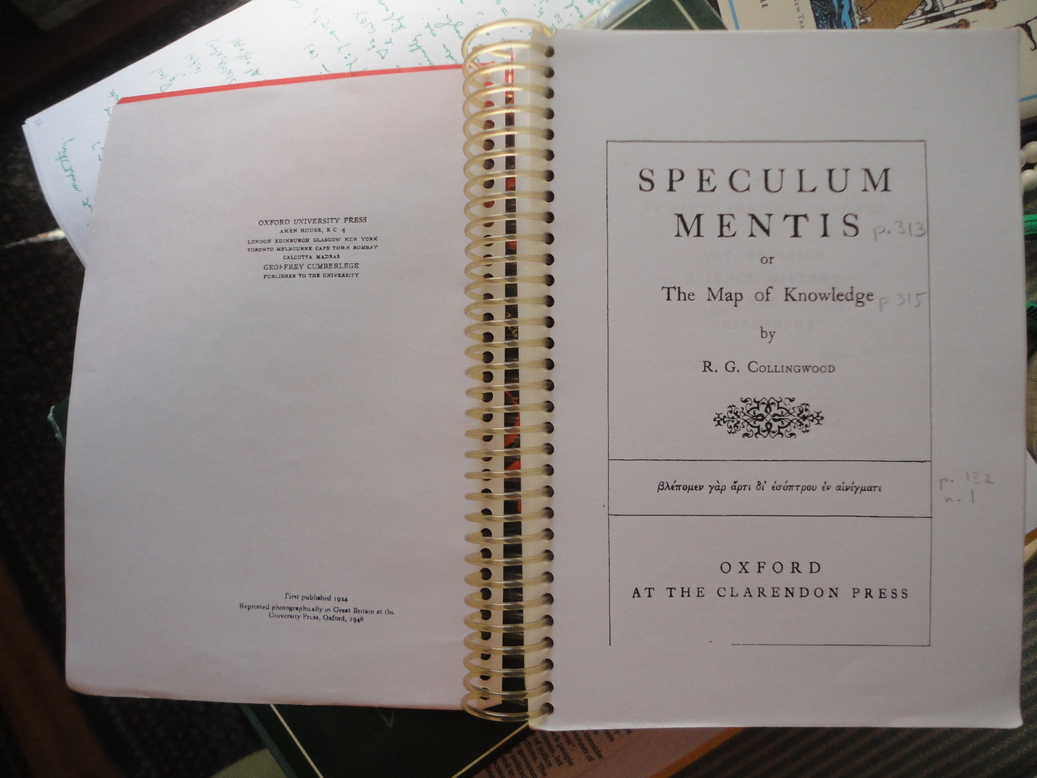
The bulk of this post is a summary of the chapter on art in Collingwood’s Speculum Mentis: or The Map of Knowledge (1924). The motto of the book is the first clause of I Corinthians 13:12:

Βλέπομεν γὰρ ἄρτι δι’ ἐσόπτρου ἐν αἰνίγματι

For now we see through a glass, darkly

The chapter “Art” has eight sections:

Continue reading

Discrete Logarithms

In the fall of 2017, I created what I propose to consider as being both art and mathematics. Call the art conceptual; the mathematics, expository; here it is, as a booklet of 88 pages, size A5, in pdf format.

More precisely, the work to be considered as both art and mathematics is the middle of the three chapters that make up the booklet. The first chapter is an essay on art, ultimately considering some examples that inspire my own. The last chapter establishes the principle whereby the lists of numbers in Chapter 2 are created.

Continue reading