Category Archives: Prose

Romance

At the end of Shakespeare’s romance called The Tempest, Prospero plans to retire to Milan, where “Every third thought shall be my grave.” I remember these words from reading the play in school and college. I also have thoughts of my grave, and their frequency may increase as the years pass. However, for each of those thoughts, I seem to have more thoughts that are based on memories of youth and childhood.

Continue reading

NL XXV: The Three Laws of Politics

Index to this series

Executive summary (added September 11, 2018): The the three laws of politics are that (1) within the body politic, there is a ruling class, which is a society proper; (2) the ruling class can take in members from the ruled class; (3) the ruled and ruling classes will resemble one another, so that e.g. rulers of slaves will become slavish themselves. I compare such laws with physical laws, as discussed by Einstein; but on this subject, a look ahead to Chapter XXXI, “Classical Physics and Classical Politics,” would be in order. Meanwhile, by the Second Law, the body politic, or its ruling class, can be a permanent society; Nazi claims about the youth or senility of different states are bogus. There are further gradations within the ruling and ruled classes, according to strength of will; a weak will can be strengthened by another person’s stronger will through induction.


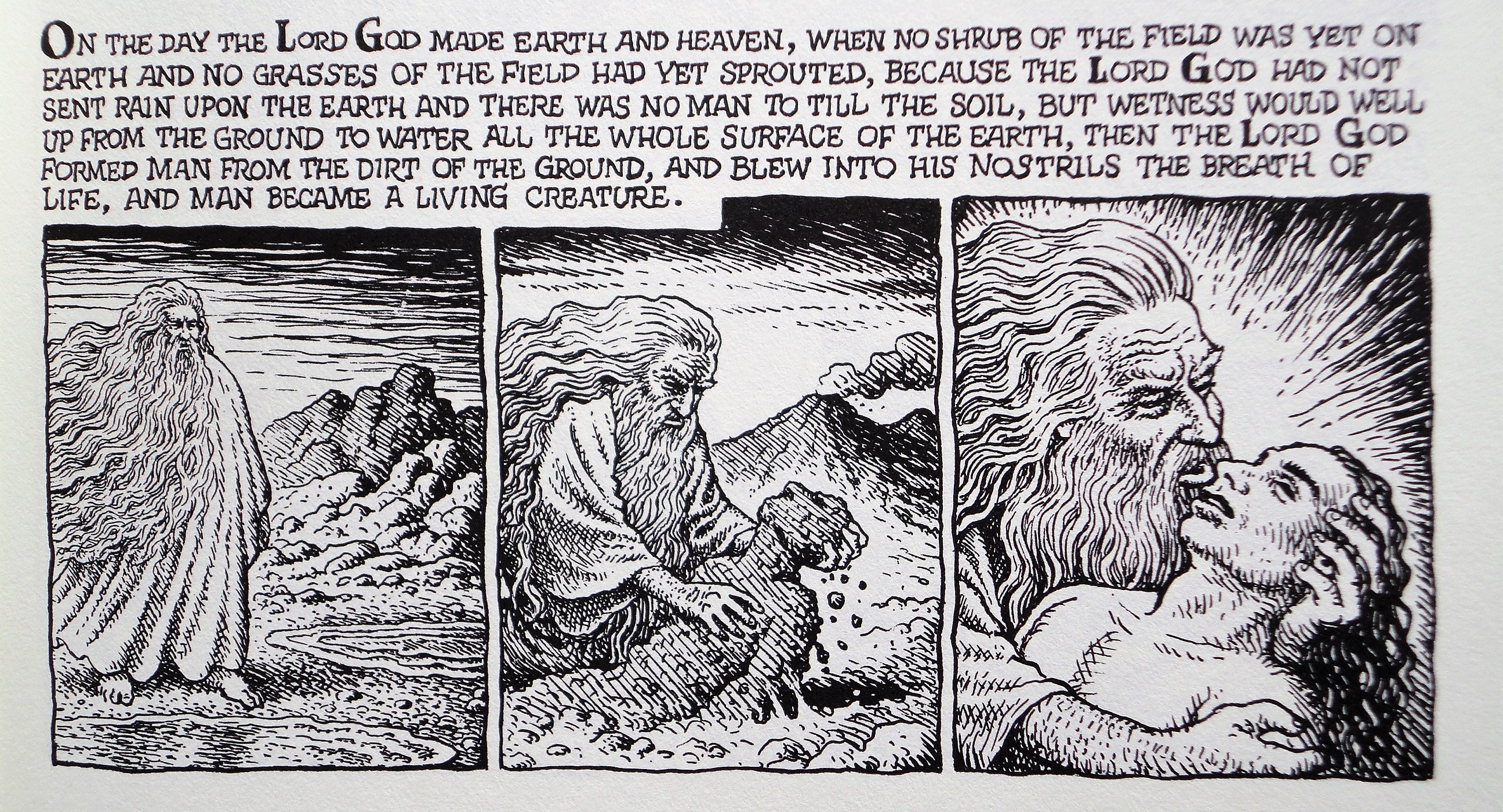
A pervading theme of the New Leviathan is freedom of will. Whether we actually have it is only a pseudo-problem (13. 17). Some persons have been fooled into thinking it a problem, perhaps by the misleading myth that free will is a divine gift, like life itself, breathed into our nostrils when, in Genesis 2:7, God forms us of the dust of the ground. As Collingwood observes at the end of Chapter XXIII, “The Family As a Society,” we are born neither free nor in chains. We have to grow up. Growing up is becoming free.

The Book of Genesis Illustrated by Robert Crumb (New York: Norton, 2009)

Continue reading

NL XXI: Society as Joint Will

Index to this series

Executive summary (added September 10, 2018):

1.
I cannot say “I will” without recognizing the possibility of joining with others to say “we will.”
2.
A social consciousness consists of (1) a precise idea of one’s place in a society and (2) a vague sense of the society as a whole. The latter sense may be incorrect, having been foolishly accepted on the word of an authority.
3.
Properly understood, ruling, of itself and perhaps of a non-social community, may be all that a society does. It is the responsibility of the members alone.
4.
To form a society means (1) to form social relations and (2) to do this for some purpose. To focus on (1) yields the idea of a universal society—which cannot actually exist, despite foolish hopes for the League of Nations.
5.
The universal society cannot exist, because we produce a society by transforming an earlier community, and some trace of this must remain.
6.
Members of a society are equal, (1) in having the freedom to join and (2) in just being members. A society may create an inequality, as by delegating authority. There may be natural inequalities, not produced by the society itself; society may compensate for them, turn them into assets, or even depend on them, as in the case of initiative.
7.
Rule by force (in a non-social community) may be by rewards and punishments, that is, objects of desire and fear. These may be promised or threatened fraudulently. One who grows too accustomed to exerting force may lose freedom of will.
8.
Societies institute criminal law to mitigate members’ losses of freedom of will.
9.
Societies can be temporary or permanent.

Continue reading

Ahtamar Island

During a mathematics conference, I visit the ruins of a monastery on a remote island in an inland sea. This moves me to consider the relation between introversion and, if not mathematics, then monasticism. On the origins of Christian monasticism, I look at several sources, notably Gibbon (see the References); also Maugham, who writes of a hermit on an island of the Torres Strait. Since the monastery on the island was Armenian, in what is now Turkey, one should consider also the treatment of minority populations here. I only acknowledge the issue, suggesting Wikipedia pages (linked to presently) as a starting point for research. On this subject, old books on my shelves are not much help; my own experience is not much more help, at least not in a way that lends itself to being written of here. I do know that Turkish politicians will treat imputations of their own Armenian ancestry as an insult.


We visited Ahtamar Island for a second time on Wednesday, August 23, 2017. Thus we saw again the remains of the Church of the Holy Cross. This Armenian church was consecrated in 921 and presumably desecrated in 1915, if not earlier; now, since our last visit, though officially a museum, the church would seem to have been reconsecrated, to judge by the new altarpiece, featuring an icon of the Madonna and Child.

Madonna and child
Altarpiece, Church of the Holy Cross, Ahtamar Island

Continue reading

War and Talk

This is a foray into the mystery of how things happen, based the 164th of the 361 chapters of War and Peace. This chapter contains, in a one-sentence paragraph, a summary of Tolstoy’s theory of history:

Each man lives for himself, using his freedom to attain his personal aims, and feels with his whole being that he can now do or abstain from doing this or that action; but as soon as he has done it, that action performed at a certain moment in time becomes irrevocable and belongs to history, in which it has not a free but a predestined significance.

Continue reading

The Private, Unskilled One

I went into Istanbul’s Pandora Bookshop a month ago, looking for an English translation of War and Peace, since the Garnett translation I had read at college was falling apart. I was told the Oxford World’s Classics edition (with the Maude translation) was coming the next week, and it did come.

Elif Batuman, The Idiot, in Nesin Matematik Köyü, Kayser Dağı Mevkii, Şirince, Selçuk, İzmir, Turkey, 2017.05.18

Continue reading

Duty to Nature

Index to this series

Summary and update (added October 14, 2018): When we do something, or propose to do something, we may explain it or justify it—give a reason for it—as being useful, right, or dutiful. Such is the theory of Collingwood, analyzed here, especially with regard to a question that has increasing urgency: have we a duty, not only to one another, but to nature?

When I originally composed this post, in February of 2017, I had recently analyzed several relevant chapters of Collingwood’s New Leviathan:

Those chapters are the last in the book’s Part I, called “Man.” Collingwood returns to the same ideas in Part II, “Society,” and specifically in Chapter XXVIII, “The Forms of Political Action.” I went on analyze this chapter, 18 months later; it discusses an abuse of the concept of duty by the German political theorist Treitschke.

By one interpretation of a passage in Herodotus, the ancient Persians perceived a duty to nature, through a teaching now attributed to Zoroaster. His teachings influenced Manichaeism, and thus in turn the “Albigensian heresy,” the subject of Chapter XLIII of the New Leviathan.

A theme of Collingwood is that we tend to explain what happens in the world the way we explain what we ourselves do. If our ethics are utilitarian, then, like the ancient Greeks, we may see things in nature too as serving purposes. If we govern our own behavior by laws, then we may also seek laws of nature, as physicists do now.

Since utility and law are general in form, they provide incomplete accounts of exactly what we do. Utility tells us that some kind of thing is useful for some other kind; law keeps us within some bounds, but leaves us free within those bounds. By contrast, duty is to be conceived as providing a complete account of what we do. Conscience tells us that we have a duty; then we have to reason out what it is. The corresponding science of the world is history, which studies us as free agents. Collingwood does not describe a corresponding science of nature as such, at least not in the New Leviathan; but at the end of his first book, Religion and Philosophy, he concluded that everything that happened must be an act of will. This was in the chapter called “Miracle,” which I looked at especially in “Effectiveness.”

It may be hard to distinguish lawful action from dutiful action. In the present post, I look at the examples of

  • paying off a student loan;
  • smoking cigarettes, when rules restrict it;
  • collecting armaments, because, at the Last Supper, by the account in Luke, Jesus recommended buying swords;
  • Islam, as a rule-bound religion;
  • Christian denigrators of Islam, who find in it rules that they think believers must be bound by, even as some Muslims find inspiration in the teachings of Prophet Jesus.

I conclude with the example of an Episcopal priest called Stephen Blackmer, for whom nature is a church and a member of his congregation.


This is a synthesis of some ideas from a recent spate of posts in this blog. A theme is the question of why we do what we do, and whether we can change what we do, especially to Nature.

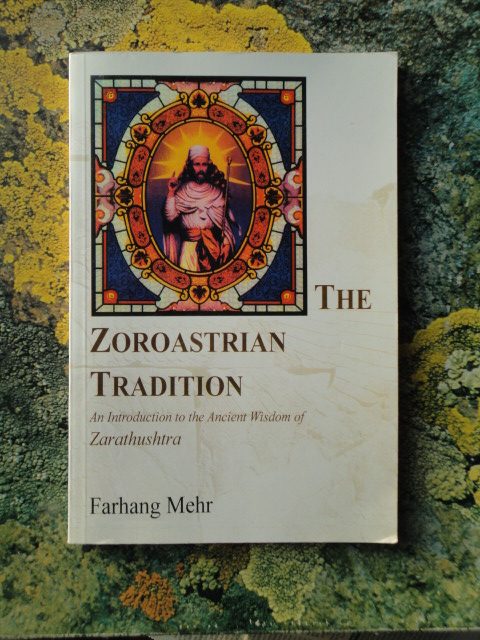
Book cover with image of a bearded man in white robes with a cap or turban, long flowing hair below this, a staff in his left hand, index finger raised on his right hand
Farhang Mehr, The Zoroastrian Tradition.
I bought the book in Yazd, Iran, in 2012

Continue reading

NL XI: “Desire”

Index to this series

The four parts of Collingwood’s New Leviathan (1942) are Man, Society, Civilization, and Barbarism. From the first part, we are considering Chapter XI, “Desire.”

Pablo Picasso, The Lovers (1923; National Gallery of Art, Washington)
Pablo Picasso, “The Lovers,” 1923
National Gallery of Art, Washington

Continue reading

NL X: “Passion”

Index to this series

Passion is literally the correlate of action, as suffering is the correlate of doing. In the ordinary, vulgar sense, passion is our response to what we suffer. This is how we shall understand it.

Above, from a cross made of steel I-beams, a stone figure hangs, while others mourn at his feet; below, more stone figures, one bearing a cross, another, back to us, with robe bearing the image of a face

Sagrada Familia, Passion Façade, November, 2008

Continue reading

Writing, Typography, and Nature

Note added February 10, 2019: I return to this rambling essay, two years later in the Math Village. The main points are as follows.

  • Writing is of value, even if you never again read what you write.
  • There is also value to reading again, as in the present case.
  • A referee rejected a submitted article of mine in the history of mathematics because its order did not make sense – to that referee, though a fellow mathematician thought well of the article. A revision was eventually published as “On Commensurability and Symmetry.”
  • In the preface to The Elements of Typographical Style, Robert Bringhurst wonders how he can write a rulebook when we are all free to be different. He thus sets up an antithesis, such as I would investigate later in “Antitheses.”
  • From being simply a means of copying, typography has become a means of expression.
  • Yet typography should not draw attention to itself, just as, according to Fowler in A Dictionary of Modern English Usage, pronunciation (notably of foreign words) should not.
  • Through my own experience of typography with LaTeX [and HTML, as in this blog], I have developed some opinions differing from some others’.
  • Bringhurst samples Thoreau,
    • whose ridicule of letters sent by post applies today to electronic media, and
    • who rightly bemoans how enjoying the woods is thought idle; cutting them down, productive.
  • In Gödel, Escher, Bach, Douglas Hofstadter wonders how a message can be recognized by any intelligence. Bringhurst restricts the question to concern intelligences on this earth.
  • In my youth, Hofstadter introduced me to Zen Flesh, Zen Bones, (edited by Reps and Senzaki), whose influence on me I consider.
  • The Zen story about whether “this very mind is Buddha” suggests a further development of Collingwood’s “logic of question and answer.”
  • Through looking at another translation, I consider how Reps and Senzaki turned Chinese into English.
  • Rereading this blog led me back to Hofstadter.

Here are some meditations on some books read during a stay in the Nesin Mathematics Village, January, 2017. I originally posted this article from the Village; now, back in Istanbul, a few days into February, recovering from the flu that I started coming down with in the Village, I am correcting some errors and trying to clarify some obscurities.

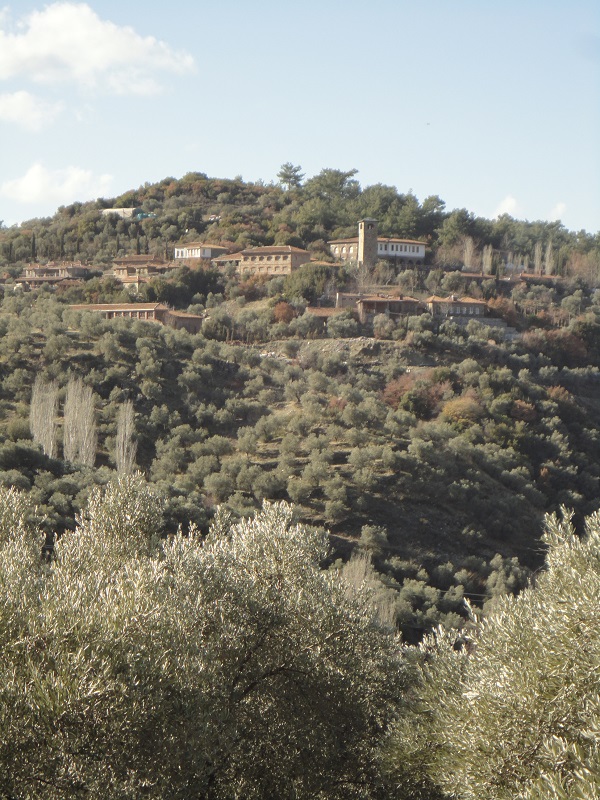
From below, a wooded hill, with buildings near the crest
Nesin Mathematics Village from the east
Wednesday, January 18, 2017

Continue reading