Category Archives: Education

Reading and Writing

Suppose you are reading a book of poetry; it could be the one published anonymously, in 1798, as Lyrical Ballads, With a Few Other Poems. You have somehow accepted that the book is worth reading. Do you care about any of the following?

  1. What is or is not on the title page.
  2. What is in the Advertisement that precedes the poems themselves.
  3. What order the poems were printed in.
  4. What meter or rhyme scheme they have.
  5. What was happening in the world in the year of publication.

You may care. You should not feel that you ought to care, if you are reading the poems in school.

That is the thesis of this post. I have learned that it may not be accepted.

I would seem to be defending the practice that I learned as an undergraduate at St John’s College. However, most of that defense will come in a later post. I drafted it earlier, but then it seemed as if there was a lot more to say, or acknowledge, or recognize. That more is here.


Three bananas, mostly black with some white foam, lie on paper bags on a counter among assorted jars

Would you accept a black banana? We learned this year (on Monday, September 22, 2025) that leaving bananas at home for a month need not be a disaster (except for not getting to eat the bananas)

Continue reading

Machinations

Sources for this post include the following.

  • On recent events in the US:

    1. Seth Masket, “Friday Night Musk-acre” (February 1, 2025).
    2. Olga Lautman: “Why has Musk gained access to our data?” (February 2, 2025).
    3. Timothy Snyder, “The Logic of Destruction: And how to resist it” (February 2, 2025).
    4. Heather Cox Richardson, “February 2, 2025.”
    5. Malcolm Nance, “In The Trump ‘White’ House: No Spies Matter” (February 7, 2025).
    6. “An Uproar as Trump and Musk Wreak Havoc” (New York Times, letters, February 7, 2025).
    7. Elad Nehorai, “Elon Musk Isn’t a White Nationalist. He’s a White Globalist” (February 7, 2025).
  • On technological fantasies and what they may do to students:

    1. Michael Townsen Hicks, James Humphries, and Joe Slater, “ChatGPT is bullshit” (2024).
    2. John Warner, “AI Boosters Think You’re Dumb” (February 2, 2025).
    3. Seth Bruggeman, “A Crisis of Trust in the Classroom” (January 14, 2025) – students either cheat with technology, or do little of anything.
    4. Robert Pirsig, Zen and the Art of Motorcycle Maintenance (1974) – perhaps students motivated only by grades should drop out.
    5. Steve Rose (interviewer), “Five ways AI could improve the world: ‘We can cure all diseases, stabilise our climate, halt poverty’” (Thu 6 Jul 2023) – Ray Kurzweil thinks “Our mobile phone … makes us more intelligent,” and since we already have nukes, AI is “not really making life more dangerous”; anyway, “More intelligence will lead to better everything.”
    6. Rachel Uda, “In Such a Connected World, Why Are We Lonelier Than Ever?” (February 6, 2023).
    7. Hanna Rosin interviewing Jonathan Haidt, “The Smartphone Kids Are Not All Right” (March 21, 2024).
  • On a particular fantasy of effortless learning:

    1. Wikipedia, “Decoded neurofeedback.”
    2. Adam Hadhazy, “Science Fiction or Fact: Instant, ‘Matrix’-like Learning” (June 21, 2012).
    3. Takeo Watanabe and others, “Perceptual Learning Incepted by Decoded fMRI Neurofeedback Without Stimulus Presentation” (9 December 2011).
    4. Kevin Le Gendre, “Steel pan virtuoso Leon Foster Thomas: ‘Some people don’t think it’s a serious instrument’ ” (February 24, 2023).
  • Works leading me, somehow, to all of that:

    1. Northrop Frye, The Double Vision (1991).
    2. Peter Jukes, “In a rare interview, Philip Pullman tells us his own origin story, and why the great questions are still religious ones” (13 January 2014).

Towering over tourists are stone figures that have “the body of a bull, wings of an eagle, and the crowned head of a bearded men”
At Persepolis, outside Shiraz, Iran, Tuesday, September 4, 2012, this is the Gate of Xerxes – the Xerxes whose failed invasion of Greece is recounted by Herodotus


Continue reading

Creativity

In the Platonic dialogues, Socrates frequently mentions τέχνη (technê), which is art in the archaic sense: skill or craft. The concern of this post is how one develops a skill, and what it means to have one in the first place.

Books quoted or mentioned in the text, by Midgley, Simone Weil, Thoreau, Amy Mandelker (on Tolstoy), Oliver Byrne (on Euclid), Wittgenstein, Arendt, and Caroline Alexander (on Homer)

Continue reading

Mathematics and Logic

Large parts of this post are taken up with two subjects:

  1. The notion (due to Collingwood) of criteriological sciences, logic being one of them.

  2. Gödel’s theorems of completeness and incompleteness, as examples of results in the science of logic.

Like the most recent in the current spate of mathematics posts, the present one has arisen from material originally drafted for the first post in this series.

In that post, I defined mathematics as the science whose findings are proved by deduction. This definition does not say what mathematics is about. We can say however what logic is about: it is about mathematics quâ deduction, and more generally about reasoning as such. This makes logic a criteriological science, because logic seeks, examines, clarifies and limits the criteria whereby we can make deductions. As examples of this activity, Gödel’s theorems are, in a crude sense to be refined below, that

  • everything true in all possible mathematical worlds can be deduced;

  • some things true in the world of numbers can never be deduced;

  • the latter theorem is one of those things.

Continue reading

Multiplicity of Mathematics

I continue with the recent posts about mathematics, which so far have been as follows.

  1. What Mathematics Is”: As distinct from the natural sciences, mathematics is the science whose findings are proved by deduction. I say this myself, and I find it at least implicit in an address by Euphemia Lofton Haynes.
  2. More of What It Is”: Some mathematicians do not distinguish mathematics from physics.
  3. Knottedness”: Topologically speaking, there is a sphere whose outside is not that of a sphere. The example is Alexander’s Horned Sphere, but it cannot be constructed physically.
  4. Why It Works”: Why there can be such a thing as the horned sphere.

When I first drafted the first post above, I said a lot more than I eventually posted. I saved it for later, and later is starting to come now.

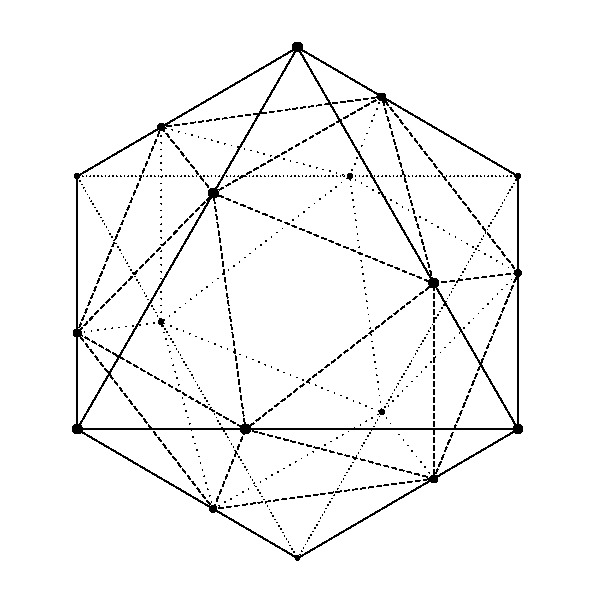
Octahedron with edges divided in the Golden Ratio by the vertices of an icosahedron

Continue reading

An Exercise in Analytic Geometry

This past spring (of 2020), when my university in Istanbul was closed (like all others in Turkey) against the spread of the novel coronavirus, I created for my students an exercise, to serve at least as a distraction for those who could find distraction in learning.

Diagram from textbook page shows, centered at the origin of coordinates, a circle and an ellipse whose four points of intersection are traversed by two lines in red through the origin
From Weeks & Adkins, Second Course in Algebra, p. 395

Note added, April 17, 2023: An account of the mathematics involved in the exercise would ultimately be published as: Pierce, D. (2021). “Conics in Place.” Annales Universitatis Paedagogicae Cracoviensis | Studia Ad Didacticam Mathematicae Pertinentia, 13, 127–150.

Continue reading

On Being Given to Know

  1. What if we could upload books to our brains?
  2. What if a machine could tell us what was true?

We may speculate, and it is interesting that we do speculate, because I think the questions do not ultimately make sense – not the sense that seems to be intended anyway, whereby something can be got for nothing.

Trees, clearings, and houses in the foreground; mountains receding into the background; clouds above
View from Şavşat

Continue reading

NL XLV: The Germans

Index to this series

At the end of Collingwood’s New Leviathan (1942), we reach a chapter whose theme is that of my more recent articles on grammar.

By August Macke – The Yorck Project (2002) 10.000 Meisterwerke der Malerei (DVD-ROM), distributed by DIRECTMEDIA Publishing GmbH. ISBN: 3936122202., Public Domain, Link

As history, Collingwood’s last chapter is difficult, for the reasons that trouble Herbert Read at the beginning of his Concise History of Modern Painting (revised 1968, augmented 1974). Read opens his first chapter with a passage from Collingwood’s Speculum Mentis (1924):

Continue reading

NL XXXVII: Civilization As Education

Index to this series

Knowing, from the previous chapter, what civilization is, we ask: How do we bring it about? Collingwood’s answer is to homeschool our children.

This is the New Leviathan’s first detailed piece of positive advice, and it may sound crazy. Rather than list reasons why, I want to see what sense can be made of the ideas.

Civility is respect (37. 15). To respect another person is to recognize their freedom (37. 14). To do this, one needs self-respect (37. 13).

Instead of respect, we may approach another person with servility, namely “the demeanour of a man lacking self-respect towards one whom he fears” (37. 17). The will to barbarism is just the will to servility (37. 19).


Mary Cassatt (American, 1844-1926)
The Boating Party, 1893/1894, oil on canvas
Chester Dale Collection, National Gallery of Art Continue reading

Writing Rules

Executive summary (added July 16, 2018): I have had enough of misrepresentation by experts of what other experts have to say about grammar.


An ongoing concern of this blog is the subject taught in school called grammar. See for example

  • the previous post, “Writing and Inversion,” about how a supposed rule against the passive voice might be better understood as a rule to avoid certain inversions of order (namely those inversions that add words and torpor);
  • the post before that, “A New Kind of Science,” presenting a theory that grammar is properly neither prescriptive nor descriptive, but “criteriological,” because it examines the criteria that we apply to our own speaking and writing;
  • an early expression (from six years ago) of some of those ideas: “Strunk and White.”

Grammar causes anxiety. Every aspect of school would seem to cause anxiety in somebody. Decades after they have left school, how many persons have nightmares of missing an examination? Quite a few, it would seem; see the evidence appended to this post. My mother and her brother were such persons, as I learned when growing up. I seem not to be such a person, though I once dreamt of missing a plane.

How much support of current US President Donald Trump is due to memories of belittlement by teachers at school? Similar questions may be raised about

  • UK government minister Michael Gove’s saying, “people in this country have had enough of experts …”;
  • the rise in Turkey of Recep Tayyip Erdoğan, who has perceived a special threat from the Peace Academics.

On that last matter, see my blog essay of March, 2016, “Academic Freedom.”

In the blog generally, I may criticize some of my fellow academics; but I criticize them for their own criticism of fellow academics and thinkers. Thus in the article “Strunk and White” listed above, I say Geoffrey Pullum was stupid to decry, in 2009, the “50 Years of Stupid Grammar Advice” offered by Strunk and White’s Elements of Style.

Still I have respected Pullum’s recommendation of Style: Toward Clarity and Grace, by Joseph M. Williams. I bought Williams’s book, and in this post I focus on some of his advice.

I thought Williams’s book might be more “democratic” than Strunk and White’s, in the sense of being aimed at a broader audience. That broader audience might include students whose parents didn’t go to college or grow up speaking English.

Now I have doubts that Williams has such an audience in mind. In his final chapter, called “Usage,” Williams writes (on page 176) of

Three Kinds of Rules

1. Some rules characterize the basic structure of English … No native speaker of English has to think about these rules at all.

2. Some rules distinguish standard from nonstandard speech … The only writers and speakers who worry about these rules are those upwardly mobile types who are striving to join the educated class of writers and speakers …

3. Finally, some grammarians try to impose on those who already write educated standard English particular items of usage that they think those educated writers should observe – don’t split infinitives; use that, not which for restrictive clauses …

This may not be much evidence to go on; but judging from the style of #1, I’m not sure Williams has considered the possibility of having readers who are not native speakers of English. In #2, by referring pejoratively to “those upwardly mobile types,” Williams seems to think they are not readers either.

Appearances are corroborated on the next page, after Williams describes again his three kinds of rules:

1. Some rules account for the fundamental structure of English …

2. Some rules distinguish the dialects of the educated and the uneducated …

3. And some rules belong to that category of rules observed by some well-educated people, and ignored by others equally well-educated …

Ordinarily, the first set of rules concerns us not at all. And if you are interested in this book, you probably aren’t much concerned with the second set either. It is the third set of rules that concern – sometimes obsess – already competent but not entirely secure writers. They are the rules of usage out of which the Pop Grammarians have created their cottage industry.

In faithfully transcribing Williams’s words about rules of usage, I have noticed that they violate a certain rule: “Enclose parenthetic expressions between commas.” Indeed, in the first block quotation above, giving the first list of “Three Kinds of Rules,” look again at the last clause (itself a rule):

use that, not which for restrictive clauses.

Here the phrase “not which” is parenthetic, but is not printed that way. Since a comma precedes it, a comma ought also to follow it, at least if one agrees with the rule that I stated, “Enclose parenthetic expressions between commas.”

That rule happens to be Rule 3 of Strunk’s original eight “Elementary Rules of Usage.” It is still Rule 3 in the version of The Elements of Style edited by E. B. White, although some of the other rules have been changed.

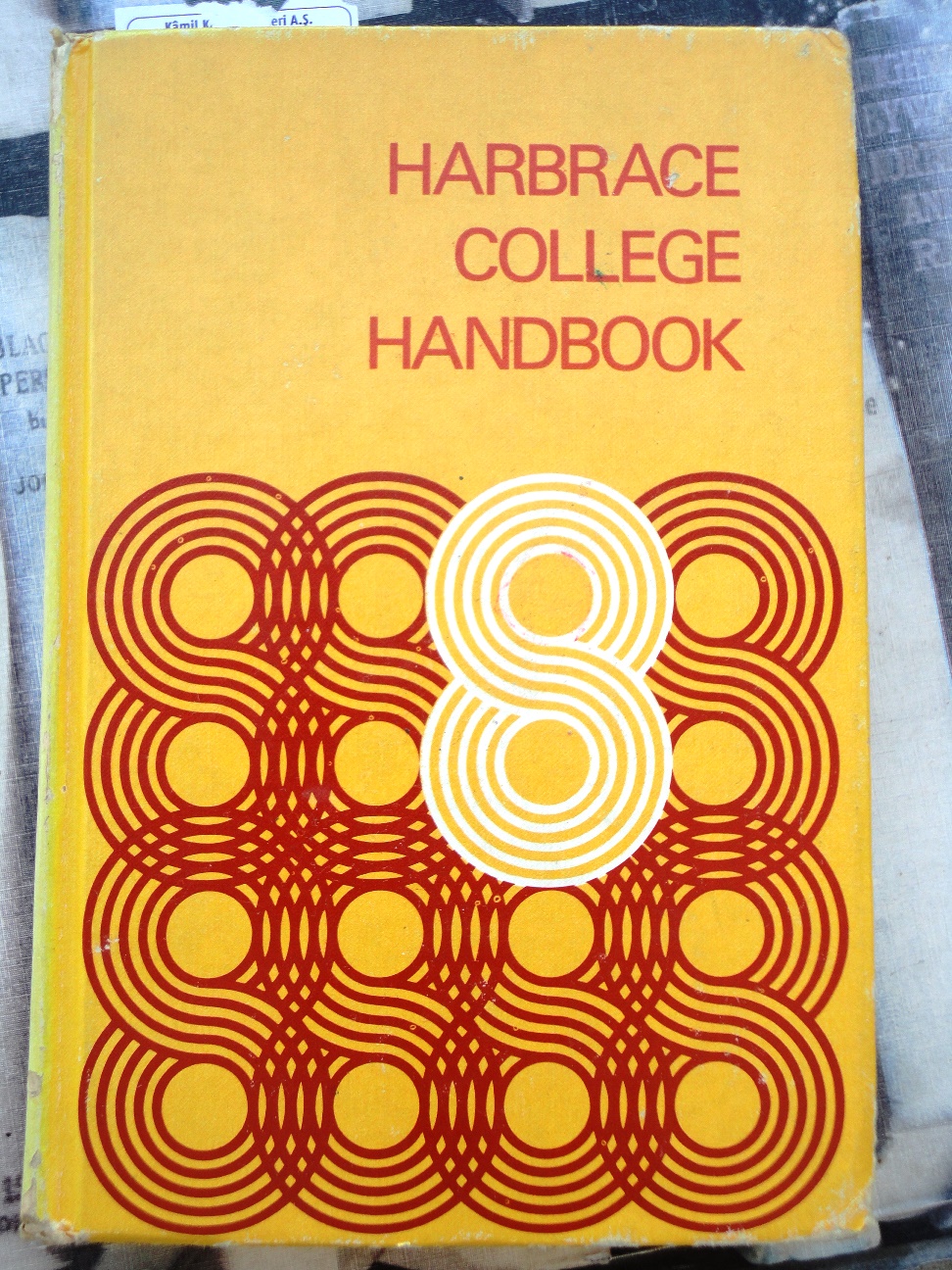
I find the same rule also as part of Rule 12d in the Harbrace College Handbook (8th edition, 1977), used in the ninth-grade English class at my private, college-preparatory school for boys in Washington. According to the Handbook:

Commas set off nonrestrictive clauses and phrases and other parenthetical and miscellaneous elements, such as transitional expressions, items in dates, words used in direct address, and so on. Restrictive clauses and phrases are not set off by commas.

Surely I was taught this rule in earlier years too. The rule seems unobjectionable and even natural to me now, and I do not recall any difficulty with it.

Yellow cover of Harbrace College Handbook 8

Continue reading