-
-
Meta
-
Archives
-
Categories
- Art (185)
- Music (3)
- Poetry (107)
- Homer (75)
- Sylvia Plath (4)
- T. S. Eliot (12)
- Prose (71)
- Visual Art (26)
- Film (5)
- Education (54)
- Facebook (14)
- History (66)
- Archeology (6)
- Tourism (30)
- Language (36)
- Fowler (6)
- Grammar (12)
- Strunk and White (9)
- Turkish (8)
- Logic (12)
- Mathematics (77)
- Exposition (20)
- Mathematical Topics (10)
- Calculus (4)
- Conic Sections (6)
- Mathematicians (29)
- Archimedes (8)
- Euclid (21)
- G. H. Hardy (7)
- Philosophy of Mathematics (18)
- Nature (27)
- Philosophy (298)
- “God is a circle …” (5)
- Categorical Thinking (6)
- Causation (12)
- Contradiction (8)
- Criteriological Science (8)
- dialectic (28)
- Freedom (23)
- Ontological Proof (6)
- Pacifism (9)
- Persons (245)
- Aristotle (59)
- Collingwood (166)
- absolute presuppositions (18)
- “ceases to be a mind” (5)
- New Leviathan (70)
- overlap of classes (11)
- Principles of Art (46)
- question and answer (5)
- Descartes (18)
- Leo Strauss (11)
- Midgley (13)
- Pirsig (38)
- Plato (100)
- Philosophy of History (27)
- Sex and Gender (12)
- Stoicism (2)
- Psychology (19)
- Science (30)
- Galileo (7)
- Turkey (98)
- coup (3)
- Istanbul (59)
- Bosphorus (5)
- Gezi (8)
- The Islands (3)
- Tophane (3)
- Nesin Mathematics Village (27)
- Uncategorized (8)
- West Virginia (16)
- Art (185)
-
Recent Posts
Category Archives: Mathematics
Math, Maugham, and Man
September 1, 2019 – 7:49 am
Note added, August 28, 2023. The main purpose of this post of September 1, 2019, seems to have been to assemble some information about the etymologies of “man” and “woman,” because of ongoing controversy about what the words even mean today. I started to take up the controversy itself on December 30 of that year, in “Sex and Gender.” Meanwhile, this post suggests, or points out:
- a generic “person” may still be male in people’s minds;
- becoming a woman may be like becoming Jewish;
- there are no gendered pronouns in Turkish;
- the series freshman, sophomore, junior, senior is like pinkie, ring finger, middle finger;
- Greek does not have such an interesting series for the fingers;
- Greek mathematics includes Thales’s Theorem and Pappus’s Hexagon Theorem.
There does not seem to be any connection between the mathematics and the etymology here, except that I was studying both at the same time. I must have been reading The Razor’s Edge too, where Maugham
- places himself in a tradition founded by Herodotus;
- uses “he/him” for for somebody who can be a woman as well as a man.
More themes I took up:
- what it means to be natural;
- that I don’t consider myself ADHD;
- the etymology of “squirrel”;
- the Etymological Fallacy.
NL I: “Body and Mind” Again
August 17, 2019 – 8:58 am
“We are beginning an inquiry into civilization,” writes Collingwood, “and the revolt against it which is the most conspicuous thing going on at the present time.” The time is the early 1940s.
Elliptical Affinity
April 17, 2019 – 2:21 pm
After Descartes gave geometry the power of algebra in 1637, a purely geometrical theorem of Apollonius that is both useful and beautiful was forgotten. This is what I conclude from looking at texts from the seventeenth century on.
Piety
March 14, 2019 – 9:33 pm
The post below is a way to record a passage in the Euthyphro where Socrates says something true and important about mathematics.

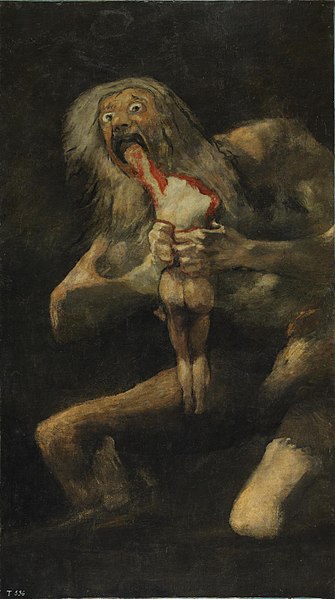
Goya, [Cronus] Devouring His Son
(see below)
The passage is on a list of Platonic passages that I recently found, having written it in a notebook on May 23, 2018. The other passages are in the Republic; here they are, for the record, with some indication of why they are worth noting (translations are Shorey’s, originally from 1930 and 1935 in the old Loeb edition):
Logic of Elliptic Curves
January 6, 2019 – 8:49 pm
In my 1997 doctoral dissertation, the main idea came as I was lying in bed one Sunday morning. Continue reading
On Gödel’s Incompleteness Theorem
December 15, 2018 – 8:43 am
This is an appreciation of Gödel’s Incompleteness Theorem of 1931. I am provoked by a depreciation of the theorem.
I shall review the mathematics of the theorem, first in outline, later in more detail. The mathematics is difficult. I have trouble reproducing it at will and even just confirming what I have already written about it below (for I am adding these words a year after the original publication of this essay).
The difficulty of Gödel’s mathematics is part of the point of this essay. A person who thinks Gödel’s Theorem is unsurprising is probably a person who does not understand it.
Effectiveness
May 17, 2018 – 6:36 pm
Preface
First posted May 17, 2018, this essay concerns Eugene Wigner’s 1960 article “The Unreasonable Effectiveness of Mathematics in the Natural Sciences.” I wrote a lot, which I now propose to summarize by section. (The meditations also continue in the next article.)
-
Some things are miraculous. Among Wigner’s examples are
- that mathematics is possible at all, and
- that “regularities” in the physical world can be discovered, as by Galileo and Newton.
For Wigner, we should be grateful for the undeserved gift of a mathematial formulation of the laws of physics. This makes no sense theologically – and here I agree with the character Larry Darrell in Somerset Maugham’s novel The Razor’s Edge. Wigner’s idea that our mathematical reasoning power has been brought to perfection makes no sense to me either.
-
Everything is miraculous. Here I agree with Collingwood in Religion and Philosophy. A miracle cannot be the breaking of a natural law, since such a thing cannot be broken. A great artist like Beethoven follows no rules in the first place, or makes them up as he goes along; and he is like God in this way.
-
Natural law. That it cannot be broken is part of the very concept of natural law. Quantum phenomena and the theory of relativity have not in fact been brought under a single law; for Wigner, it may not be possible.
-
Mystery. Not only can we not define miracles, but (as we should have observed in the first place) we cannot even say when they happen. If like Wigner we call something miraculous, this means it cleanses our own doors of perception, in the sense of William Blake.
-
Definitions. In his treatment of miracle in Religion and Philosophy, Collingwood shows the futility of trying to define a term when you are not sure how to use it. He makes this futility explicit in The Principles of Art. If we are going to think about the use of mathematics in natural science, this means we ought to be mathematician, natural scientist, and philosopher; and not just “natural scientist,” but physicist and biologist, since if mathematics is effective in physics, it would seem to be ineffective in biology.
-
Being a philosopher. We are all philosophers, in the sense that Maugham describes in the story “Appearance and Reality,” if only we think. All thought is for the sake of action. This does not mean that thought occurs separately from an action and is to be judged by the action. We may value “pure” thought, such as doing mathematics or making music or living the contemplative life of a monk. This however moves me to a give a thought to the disaster of contemporary politics.
-
Philosophizing about science. For present purposes, compartmentalization of knowledge is a problem. So is the dominance of analytic philosophy, for suggesting (as one cited person seems to think) that big problems can be broken into little ones and solved independently. In mathematics, students should learn their right to question somebody else’s solutions to problems. In philosophy, the problems themselves will be our own. Philosophy as such cannot decide what the problems of physics or biology are, though it may help to understand the “absolute presuppositions” that underlie the problems. Philosophers quâ metaphysicians cannot determine once for all what the general structure of the universe is. This does not mean they should do “experimental philosophy,” taking opinion polls about supposedly philosophical questions. What matters is not what people say, but what they mean and are trying to mean. As Collingwood observes, metaphysics is an historical science.
For more on the last points, see a more recent article, “Re-enactment.” (This Preface added June 3, 2018.)
I am writing from the Math Village, and here I happen to have read that Abraham Lincoln kept no known diary as such, but noted his thoughts on loose slips of paper. Admired because he “could simply sit down and write another of his eloquent public letters,”
Lincoln demurred. “I had it nearly all in there,” he said, pointing to an open desk drawer. “It was in disconnected thoughts, which I had jotted down from time to time on separate scraps of paper.” This was how he worked, the president explained. It was on such scraps of paper, accumulating over the years into a diaristic density, that Lincoln saved and assembled what he described to the visitor as his “best thoughts on the subject.”
Thus Ronald C. White, “Notes to Self,” Harper’s, February 2018. My own notes to self are normally in bound notebooks, and perhaps later in blog articles such as the present one, which is inspired by the 1960 article called “The Unreasonable Effectiveness of Mathematics in the Natural Sciences,” by Eugene Wigner.
Boolean Arithmetic
May 5, 2018 – 7:38 am
Mathematics can be highly abstract, even when it remains applicable to daily life. I want to show this with the mathematics behind logic puzzles, such as how to derive a conclusion using all of the following premisses:
- Babies are illogical.
- Nobody is despised who can manage a crocodile.
- Illogical persons are despised.
The example, from Terence Tao’s blog, is attributed to Lewis Carroll. By the first and third premisses, babies are despised; by the second premiss then, babies cannot manage crocodiles.
Continue reading