


-
-
Meta
-
Archives
-
Categories
- Art (187)
- Music (4)
- Poetry (108)
- Homer (76)
- Sylvia Plath (4)
- T. S. Eliot (12)
- Prose (71)
- Visual Art (26)
- Film (5)
- Education (54)
- Facebook (14)
- History (66)
- Archeology (6)
- Tourism (30)
- Language (36)
- Fowler (6)
- Grammar (12)
- Strunk and White (9)
- Turkish (8)
- Logic (12)
- Mathematics (81)
- Exposition (21)
- Mathematical Topics (10)
- Calculus (4)
- Conic Sections (6)
- Mathematicians (31)
- Archimedes (8)
- Euclid (23)
- G. H. Hardy (7)
- Philosophy of Mathematics (18)
- Nature (28)
- Philosophy (300)
- “God is a circle …” (5)
- Categorical Thinking (6)
- Causation (12)
- Contradiction (8)
- Criteriological Science (8)
- dialectic (28)
- Freedom (23)
- Ontological Proof (6)
- Pacifism (9)
- Persons (247)
- Aristotle (59)
- Collingwood (166)
- absolute presuppositions (18)
- “ceases to be a mind” (5)
- New Leviathan (70)
- overlap of classes (11)
- Principles of Art (46)
- question and answer (5)
- Descartes (18)
- Leo Strauss (11)
- Midgley (13)
- Pirsig (39)
- Plato (101)
- Philosophy of History (27)
- Sex and Gender (12)
- Stoicism (2)
- Psychology (19)
- Science (30)
- Galileo (7)
- Turkey (98)
- coup (3)
- Istanbul (59)
- Bosphorus (5)
- Gezi (8)
- The Islands (3)
- Tophane (3)
- Nesin Mathematics Village (27)
- Uncategorized (8)
- West Virginia (16)
- Art (187)
-
Recent Posts
Category Archives: Collingwood
Math, Maugham, and Man
September 1, 2019 – 7:49 am
Note added, August 28, 2023. The main purpose of this post of September 1, 2019, seems to have been to assemble some information about the etymologies of “man” and “woman,” because of ongoing controversy about what the words even mean today. I started to take up the controversy itself on December 30 of that year, in “Sex and Gender.” Meanwhile, this post suggests, or points out:
- a generic “person” may still be male in people’s minds;
- becoming a woman may be like becoming Jewish;
- there are no gendered pronouns in Turkish;
- the series freshman, sophomore, junior, senior is like pinkie, ring finger, middle finger;
- Greek does not have such an interesting series for the fingers;
- Greek mathematics includes Thales’s Theorem and Pappus’s Hexagon Theorem.
There does not seem to be any connection between the mathematics and the etymology here, except that I was studying both at the same time. I must have been reading The Razor’s Edge too, where Maugham
- places himself in a tradition founded by Herodotus;
- uses “he/him” for for somebody who can be a woman as well as a man.
More themes I took up:
- what it means to be natural;
- that I don’t consider myself ADHD;
- the etymology of “squirrel”;
- the Etymological Fallacy.

Woman, man, and dog
Friday, August 18, 2023
Altınova, Balıkesir, Türkiye
On Being Given to Know
August 24, 2019 – 5:40 pm
- What if we could upload books to our brains?
- What if a machine could tell us what was true?
We may speculate, and it is interesting that we do speculate, because I think the questions do not ultimately make sense – not the sense that seems to be intended anyway, whereby something can be got for nothing.

View from Şavşat
On Causation
August 20, 2019 – 5:10 am
Causation seems commonly to be understood as a physical concept, like being a fossil. The paleontologist seeks the one right answer to the question of when a particular dinosaur bone became part of the fossil record; likewise readers of international news seem to think there is one right answer to the question of whether Donald Trump or Ali Khamenei caused the shooting down of Ukraine International Airlines Flight 752 on January 8, 2020.
There is not one right answer. If you are Trump, you caused 176 civilian deaths by attacking the Iranians and provoking their response. If you are Mitch McConnell, you caused the deaths by inhibiting the removal of Trump from office. If you are Khamenei, you did it by meeting Trump’s fire with fire.
Being a cause does not mean you deserve condemnation or praise: that is another matter.
NL I: “Body and Mind” Again
August 17, 2019 – 8:58 am
“We are beginning an inquiry into civilization,” writes Collingwood, “and the revolt against it which is the most conspicuous thing going on at the present time.” The time is the early 1940s.
Piety
March 14, 2019 – 9:33 pm
The post below is a way to record a passage in the Euthyphro where Socrates says something true and important about mathematics.
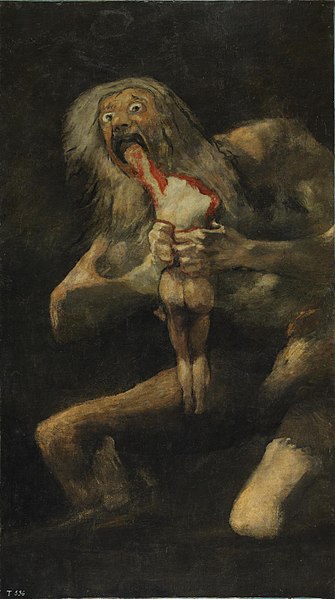
Goya, [Cronus] Devouring His Son
(see below)
The passage is on a list of Platonic passages that I recently found, having written it in a notebook on May 23, 2018. The other passages are in the Republic; here they are, for the record, with some indication of why they are worth noting (translations are Shorey’s, originally from 1930 and 1935 in the old Loeb edition):
NL XLV: The Germans
February 21, 2019 – 9:14 am
At the end of Collingwood’s New Leviathan (1942), we reach a chapter whose theme is that of my more recent articles on grammar.

By August Macke – The Yorck Project (2002) 10.000 Meisterwerke der Malerei (DVD-ROM), distributed by DIRECTMEDIA Publishing GmbH. ISBN: 3936122202., Public Domain, Link
As history, Collingwood’s last chapter is difficult, for the reasons that trouble Herbert Read at the beginning of his Concise History of Modern Painting (revised 1968, augmented 1974). Read opens his first chapter with a passage from Collingwood’s Speculum Mentis (1924):
NL XLIV: The Turks
February 20, 2019 – 7:47 am
The last part of Collingwood’s New Leviathan (Oxford, 1942) is “Barbarism.” The first chapter of the part is “What Barbarism Is”; the remaining chapters describe examples of barbarism in turn. The fourth and last example is the one that Britain is fighting as Collingwood writes.
Antitheses
December 13, 2018 – 10:18 am
This is an attempt at a dialectical understanding of freedom and responsibility, punishment and forgiveness, things like that. My text is a part of the Gospel, though I attribute no special supernatural power to this. I shall refer also to the Dialogues of Plato.

What is the spirit of the letters here? Encountered in Tarabya, Istanbul, on Wednesday, October 19, 2022, they could be the Latin XP or the Greek Chi Rho. Probably the former are meant, by way of discouraging parking (in Turkish park etmek, “to make a parking”). However, nearby is a Christian shrine, built over a holy spring by a great plane tree: the Ayia Kiriaki Ayazması, ΑΓΙΑΣΜΑ ΑΓΙΑΣ ΚΥΡΙΑΚΗΣ, pictured and described in the post “On Kant’s Groundwork” in connection with my question of just what Kant thought of Christianity
NL XLIII: The Second Barbarism: The ‘Albigensian Heresy’
October 13, 2018 – 7:01 am
Summary. Suppose your society has certain rites and customs, perceived as essential to its functioning. When some persons among you reject those rites and customs, what are you going to do? Persecution would be the normal response of a society that aimed to preserve itself. In the example to be considered here, the society is medieval Christendom, where
- buildings called churches were customarily the abode of friendly spirits, and
- the rite of swearing an oath was a sign of special commitment.
Oaths and churches were rejected by persons called Paulicians, or Bogomils, or Albigensians. Their beliefs were Manichaean. These persons were persecuted so successfully that we do not understand them very well. Therefore we must leave open the question of whether they were barbarists.
Here I am going to review, among other things,
- what it means to fight barbarism;
- the response to German bombardment described in Goodbye, Mr. Chips;
- what Jesus Christ says about swearing;
- how the United States accommodates various beliefs (as by allowing affirming instead of swearing, or allowing Muslims to swear on a Quran);
- the threat of a lying President;
- the threat of ignoring climate change;
- the etymology of heresy;
- the discussion of mythos and logos in Pirsig.
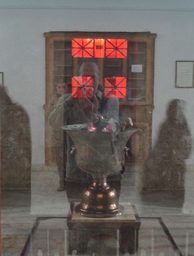
Fire temple, Yazd, Iran, September 2012. See “Duty to Nature”

