At the end of Book XVI of the Iliad, Hector
- pulled his spear from the body of Patroclus,
- took off in pursuit of Automedon, his victim’s charioteer, who was being drawn by Achilles’s immortal horses.
At the end of Book XVI of the Iliad, Hector
An editor of the Iliad might remove Book XIII, as I said last time; however, the book has
The strike can fail through the prowess of scabs. Poseidon encourages crossing the picket line. In Book XIV,
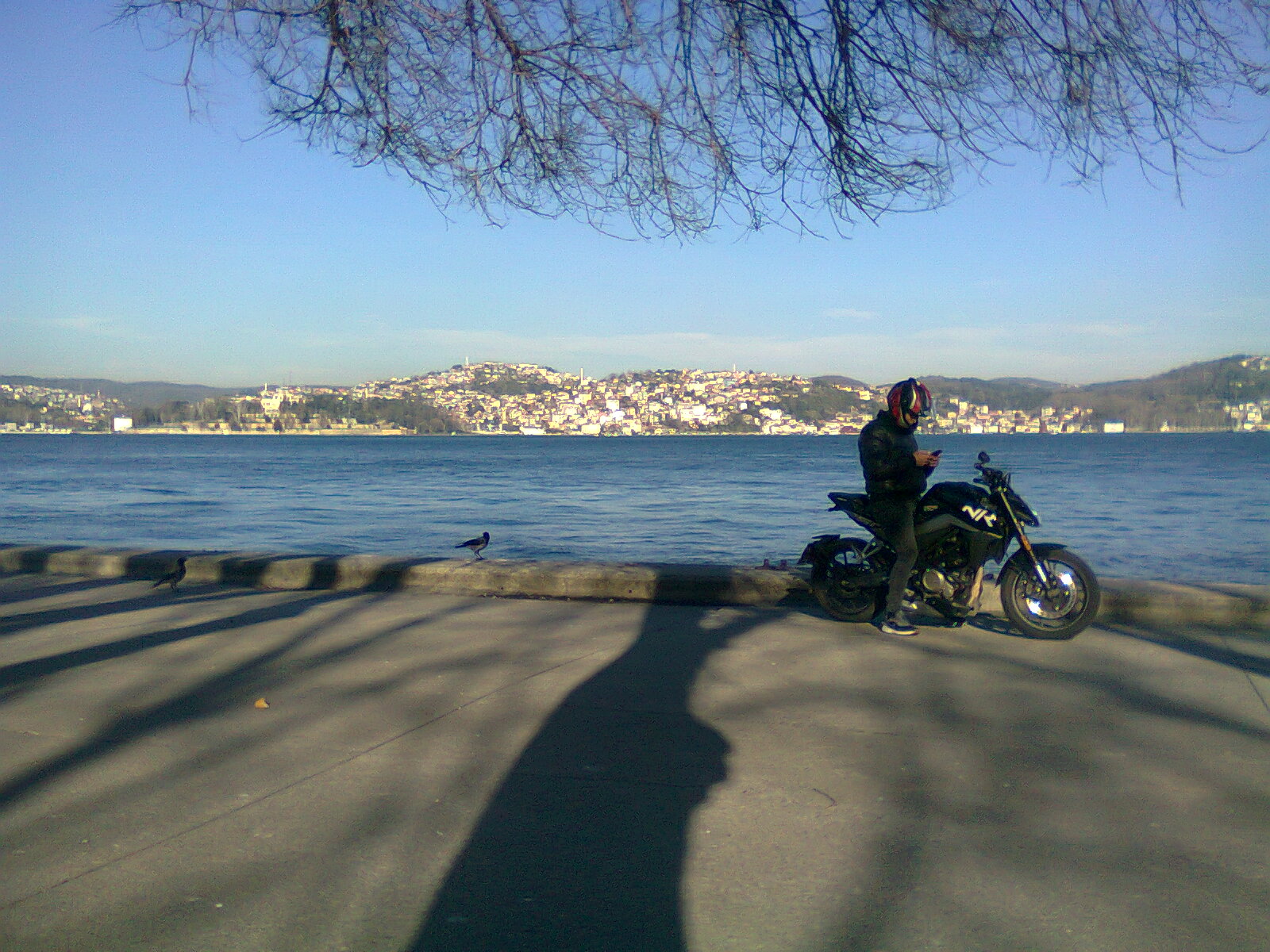
Yeniköy (Νεοχώριον), Sarıyer, Istanbul
Tuesday afternoon, February 21, 2023
On the day recounted in Book VIII of the Iliad,
I wrote a fuller summary in 2017. Because I was reading it, I also talked about Huysmans, Against Nature, and the belief of the main character that the prose poem could
contain within its small compass, like beef essence, the power of a novel, while eliminating its tedious analyses and superfluous descriptions.
Now I shall find reason to bring up Herodotus, Plato, Aristotle, Thoreau, and Freud, and especially William James and Collingwood on the subject of emotion.
“As is the generation of leaves, so is that of humanity.” Glaucus says that to Diomedes in the Iliad, when the two warriors meet on the battlefield, and Diomedes wants to know whether he is facing man or god.
Humans are multitudinous and ephemeral, like the folia of trees, says Glaucus; why should his own tree be of interest to anybody else? It’s a pro forma question, perhaps, since Glaucus does proceed to describe his family.
In Book I of the Iliad, Achilles restrains an impulse to run a sword through Agamemnon.
That may be the greatest act in the whole epic. I say so, having recently completed a reading of Njal’s Saga, which features a lot of impulsive killing. Now I am embarking on the Iliad again, a book at a time. Here I take up Book I, some comparisons with the saga, and some connections with Plato, Augustine, and Collingwood.
I wrote here about Homer’s epic, book by book, between April, 2017, and September, 2019. I was reading Chapman’s Elizabethan translation. In my account of Book I from then, there are details that do not otherwise stand out to me now, when
The noun “idea” came to English in the sixteenth century, via Latin, from Plato’s ἰδέα: so the dictionaries tell me. An older version, “idee,” came from the French idée. The adjective “ideal” came via the French idéal from the Latin ideālis, but this seems to have been a native coinage, derived from no Greek term. Leo Strauss corroborates this in a passage that I quoted in “Nature”: “ ‘ideal’ is not a Platonic term.” Nonetheless, in translations of the Republic that are still in print, Benjamin Jowett and Paul Shorey use the word “ideal.” This may blur the distinction between two activities:
I looked at the first creation myth of Genesis in my previous post, whose title quoted the Bible on God’s judgment of what he had created: “It Was Good.” The goodness of the world, I suggested, did not lie in its fitting a plan, since a plan would have had to be spoken into existence, and this is just how the world itself came to be.
I don’t know about God, but if we have a basis for calling something good, we might call this basis an ideal. However, I also don’t know whether this is what Plato actually has in mind when his translators use the term “ideal.”

Executive summary. An experiment has been performed to detect whether we are living in a simulation. The experiment is to tell Abraham to sacrifice his son. Whatever he does, he breaks a law. Thus there is more to the world than can be understood by natural science.
This is inspired by Charlotte Brontë’s Villette. After reading this 1853 novel a second time in the summer of 2018, I put some passages I liked into a LaTeX file. I added some commentary and came up with a document more than 90 A5 pages long. I recently reread it and was reminded how much I had enjoyed the novel. I thought some of my commentary could be adapted to stand alone as a blog post – this one.

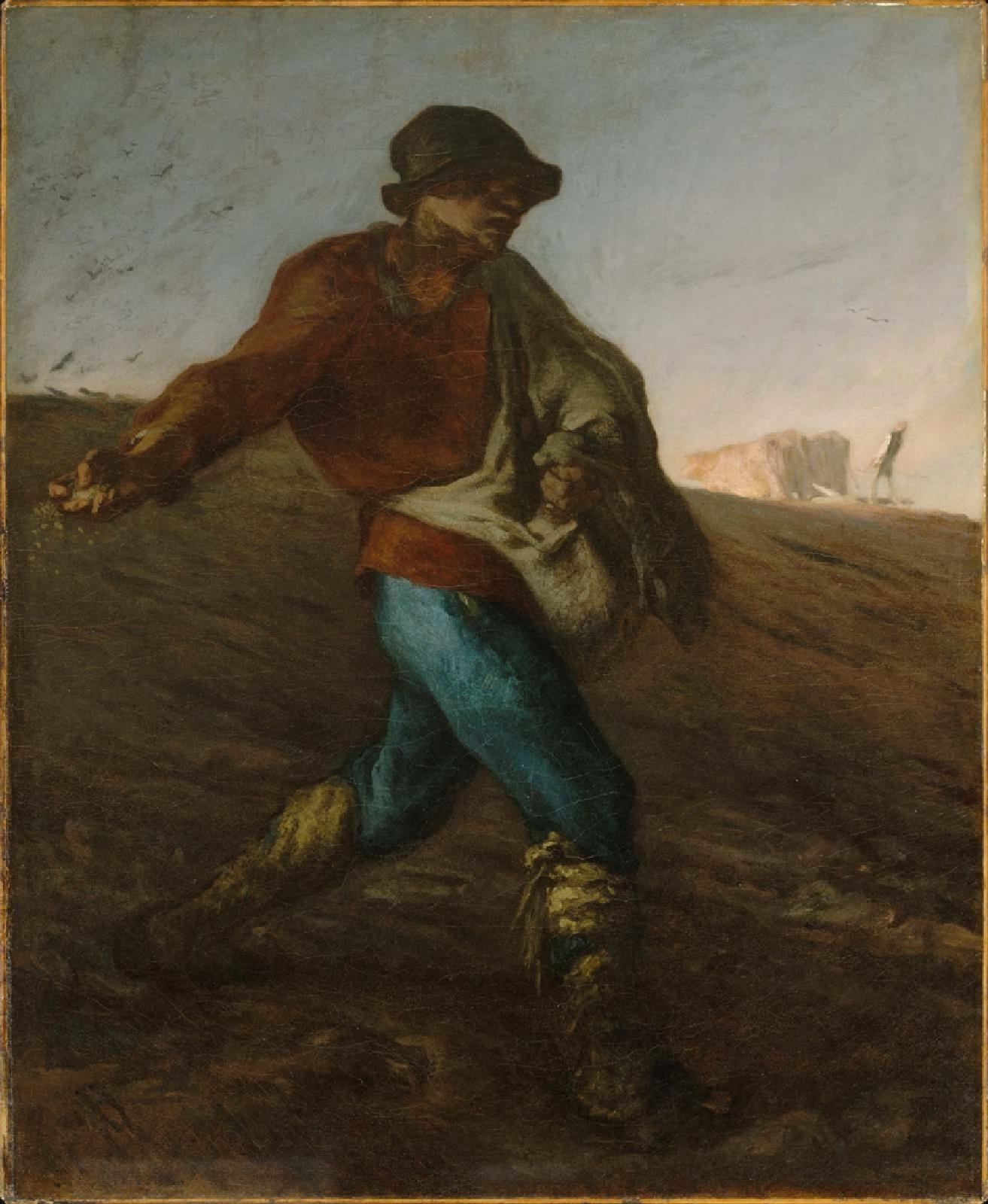
“The Sower,” 1850
Jean-François Millet (French, 1814–1875)
Museum of Fine Arts, Boston
Here is an annotated transcription of a 1981 manuscript by Charles Greenleaf Bell (1916–2010) called “The Axiomatic Drama of Classical Physics.” A theme is what Heraclitus observed, as in fragment B49a of Diels, LXXXI of Bywater, and D65a of Laks and Most:
We step and we do not step into the same rivers,
we are and we are not.ποταμοῖς τοῖς αὐτοῖς ἐμβαίνομέν τε καὶ οὐκ ἐμβαίνομεν,
εἶμέν τε καὶ οὐκ εἶμεν.
Bell reviews the mathematics, and the thought behind it, of
In a postlude called “The Uses of Paradox,” Bell notes:
Forty-five years ago I decided that when reason drives a sheer impasse into an activity which in fact goes on, we have to think of the polar cleavage as both real and unreal.
I like that reference to “an activity which in fact goes on.” In youth it may be hard to recognize that there are activities that go on. We do things then, but that they will get anywhere may be no more than a dream. In any case, Bell himself goes on:
… that is a job as huge and demanding as Aristotle’s, and for me at 70, just begun.
“Look,” my friends say, “Bell’s been doing the same thing since he was 25. About that time he had a vision of Paradox as paradise, and he’s been stuck there ever since.”
In the Platonic dialogues, Socrates frequently mentions τέχνη (technê), which is art in the archaic sense: skill or craft. The concern of this post is how one develops a skill, and what it means to have one in the first place.