Tag Archives: Heraclitus

Manliness

The scholarship is uncertain, but the Greek word ἀρετή, which we translate as virtue, may not be etymologically related to either of

  • ἀνήρ, ἀνδρός, he-man;
  • Ἄρης, Ἄρεως, the god of war.

However,

  • “virtue” is related to the first part of “werewolf,” were being the old English word for a he-man (as wife was the word for a “she-man,” that is, a she-human, a woman; see “Math, Maugham, and Man”; the Wikipedia article “Indo-European vocabulary” currently gives ἱέραξ “hawk, falcon” as sharing the root of “virtue” and were, but Beekes gives a different root, uncertainly);
  • ἀνήρ yields the adjective ἀνδρεῖος, α, ον and the abstract noun ἀνδρεία (which like many abstract nouns is feminine), denoting respectively the person who has, and that which is, the virtue that in English is called bravery or courage.

This post is the sequel of the previous one, “Eudemony” (now extensively revised), which was on and of the first book of Aristotle’s Nicomachean Ethics. The present post is on and of the second book, whose theme is moral virtue in general.

I do wonder to what extent Aristotle thinks of ἀρετή as manliness. Homer may have done so in the Iliad, as in one of the passages (Book XV, lines 641–3) cited in the lexicon of Liddell, Scott, and Jones. This concerns a man slain by Hector, namely Periphetes, son of Copreus:

τοῦ γένετ᾽ ἐκ πατρὸς πολὺ χείρονος υἱὸς ἀμείνων
παντοίας ἀρετάς, ἠμὲν πόδας ἠδὲ μάχεσθαι,
καὶ νόον ἐν πρώτοισι Μυκηναίων ἐτέτυκτο.

Of him, a father baser by far, was begotten a son goodlier in all manner of excellence, both in fleetness of foot and in fight, and in mind he was among the first of the men of Mycenae.
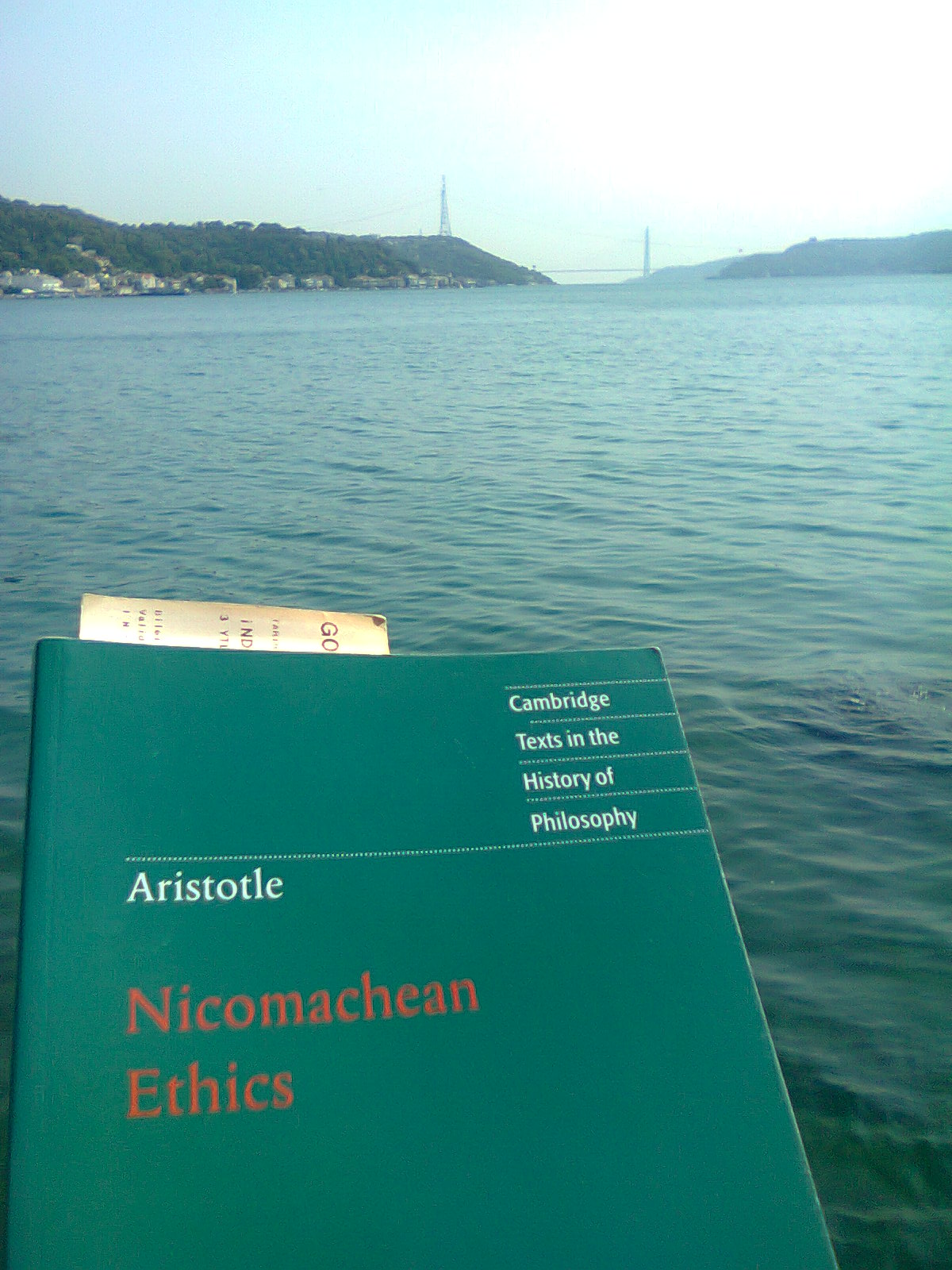
Green cover of Nicomachean Ethics, Crisp translation, against water
Lock and Key of the Bosphorus
opening to the Black Sea
Tuesday, July 11, 2023

Continue reading

Charles Bell’s Axiomatic Drama

Here is an annotated transcription of a 1981 manuscript by Charles Greenleaf Bell (1916–2010) called “The Axiomatic Drama of Classical Physics.” A theme is what Heraclitus observed, as in fragment B49a of Diels, LXXXI of Bywater, and D65a of Laks and Most:

We step and we do not step into the same rivers,
we are and we are not.

ποταμοῖς τοῖς αὐτοῖς ἐμβαίνομέν τε καὶ οὐκ ἐμβαίνομεν,
εἶμέν τε καὶ οὐκ εἶμεν.

Bell reviews the mathematics, and the thought behind it, of

  1. free fall,
  2. the pendulum,
  3. the Carnot heat engine.

In a postlude called “The Uses of Paradox,” Bell notes:

Forty-five years ago I decided that when reason drives a sheer impasse into an activity which in fact goes on, we have to think of the polar cleavage as both real and unreal.

I like that reference to “an activity which in fact goes on.” In youth it may be hard to recognize that there are activities that go on. We do things then, but that they will get anywhere may be no more than a dream. In any case, Bell himself goes on:

… that is a job as huge and demanding as Aristotle’s, and for me at 70, just begun.

“Look,” my friends say, “Bell’s been doing the same thing since he was 25. About that time he had a vision of Paradox as paradise, and he’s been stuck there ever since.”

Bell’s picture next to Aristotle’s Physics
The back of Bell’s Five Chambered Heart with
the front of the OCT of Aristotle’s Physics

Continue reading

Hostility and Hospitality

After seventeen weekly posts of readings with my annotations, the Pensées of Pascal join two other works that I have blogged about systematically, chapter by chapter or book by book:

  • R. G. Collingwood, The New Leviathan, or Man, Society, Civilization, and Barbarism (1942);

  • Homer, the Iliad, in George Chapman’s translation.

Do three authors belong together, for any other reason than that I have spent time with each of them?

  • For Pascal, the Torah is history, but the Iliad was written too late to be that, and is just a novel (S 688 / L 436 / B 628). It has no concept of law, he says (S 691 / L 451 / B 620), but later Greeks took this and other things from the Jews. I discussed this in “Judaism for Pascal.” For example, Philo Judaeus thinks that when Heraclitus says, “We live their death and we die their life,” this is the death wrought by eating of the tree of the knowledge of good and evil in Genesis.

  • Pascal and Collingwood both come to terms with a world of contrariety. Collingwood calls it “a Heraclitean world,” alluding to how Plato has Socrates tell Hermogenes in the Cratylus (402a, Loeb translation by Harold North Fowler),

    Heracleitus says, you know, that all things move and nothing remains still, and he likens the universe to the current of a river, saying that you cannot step twice into the same stream.

    Continue reading

Judaism for Pascal

This blog’s occupation with Pascal may continue four more weeks. Four readings of the Pensées remain to be posted here, with my annotations.

The present post will take up a question raised by the latest reading so far, which is the thirteenth.

In the twelfth reading, to somebody looking for faith, Pascal recommended acting as if he already had it. For the person of today, faced with various options, at least in a liberal society, the question remains (which was asked in our seminar) of which faith to follow. Could the person of Pascal’s day, whether gentile or Jew by breeding, have sensibly considered the option of Judaism as a faith, according to Pascal?

Continue reading

Automatia

One day during the Trojan War, Apollo and Athena decide to give the combatants a break. The general conflict is to be replaced with a one-on-one. The Olympians induce Helenus to tell his brother Hector to take on whichever of the Greeks is up for it.

Twilight beach scene
Day or night?
Sunset over Lesbos
From the Anatolian mainland
Tuesday, August 1, 2023

Continue reading

We the Pears of the Wild Coyote Tree

This is a preliminary report on two recent films:

  • The Wild Pear Tree, by Nuri Bilge Ceylan;
  • We the Coyotes, by Marco La Via and Hanna Ladoul.

The report is preliminary, not because there is going to be another, but because I have seen each film only once, and I may see one of them again.

I remember that François Truffaut liked to see films at least twice. I believe I read this in The Washington Post, and I might have guessed it was in an appreciation published when Truffaut died; however, he died on October 21, 1984, during the first semester of my sophomore year at St John’s College in Santa Fe, and I would not have been reading the Post then.

While in college, I did enjoy seeing some films twice, or a second time; Truffaut’s own 400 Coups was an example, a French teacher having shown it to us in high school.

The two films that I am reviewing now concern young adults trying to find their own way in the world, in defiance of their elders. We all have to do this. In every generation, some will do it more defiantly than others. Heraclitus can be defiant, he of Ephesus and thus one of the Ionian philosophers, whose spirit I imagine to haunt the Nesin Mathematics Village. A further reason to bring up Heraclitus will be a theme that is explicit in Pear Tree, implicit (or metaphorical) in Coyotes: gold.

A book, whose cover shows a bonfire, sits on a rock dampened by waves of the sea, which laps on the sand beyond
A copy of The Logos of Heraclitus,
by Eva Brann,
on Marmara Island, July, 2012

Continue reading

Some Say Poetry

In a poetry review, a remark on being a student has drawn my attention:

In My Poets, a work of autobiographical criticism with occasional ventriloquial interludes, McLane recalls two “early impasses in reading,” freshman-year encounters with Charles Olson and Frank O’Hara. She writes about not “getting it” but wanting to get it, about a desire to get it that was left wanting by code-breaking and analysis and satisfied by hearing and feeling.

This is from the second half of a “New Books” column by Christine Smallwood, in the Reviews section of Harper’s, July 2017. After quoting Smallwood’s review, I want to say something about learning and creating, in poetry and also in mathematics.

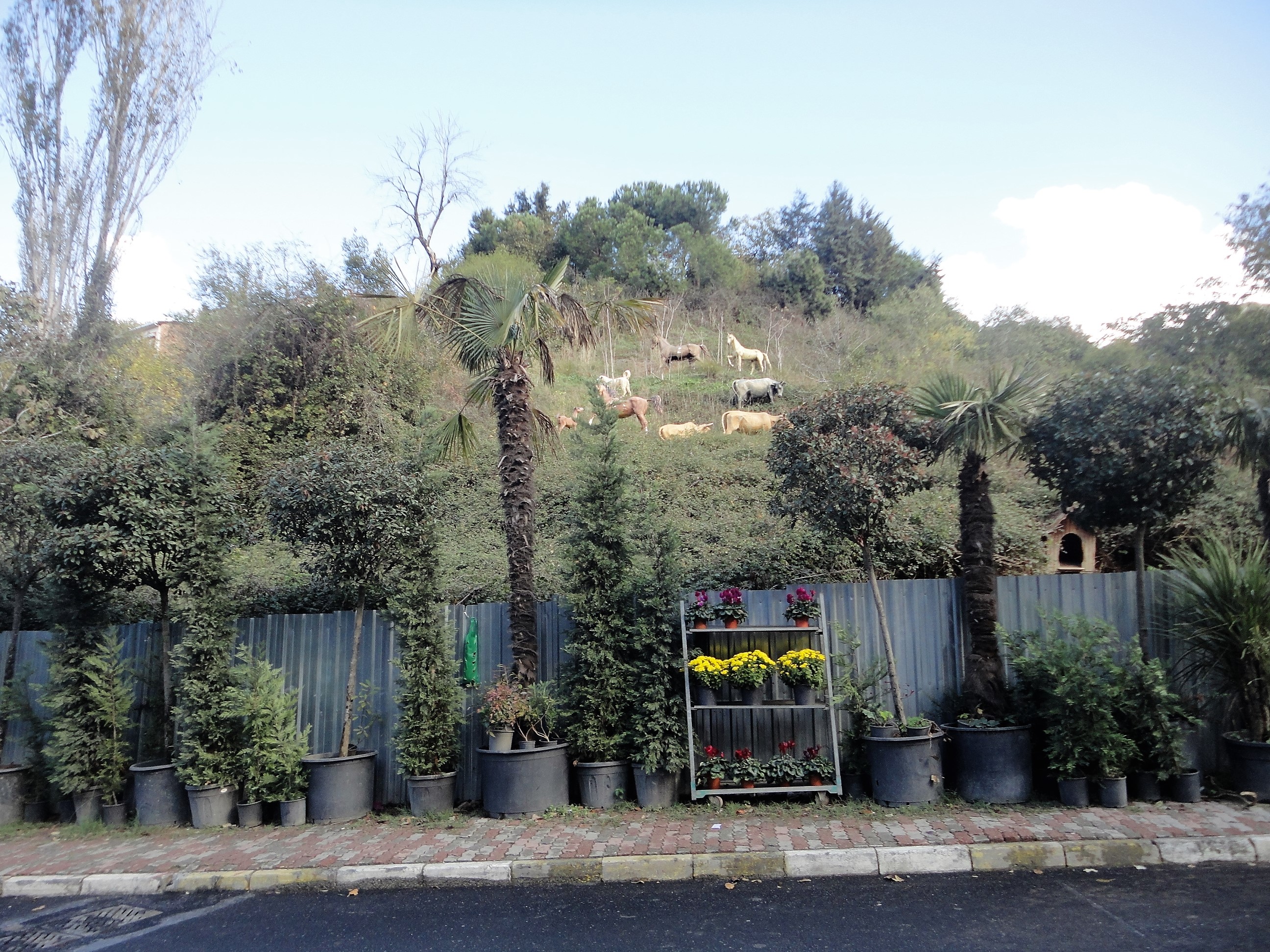
Potted palms with plaster farm animals on hillside behind
Kuzguncuk, 2017.11.05

Continue reading

NL XXIV: The Body Politic, Social and Non-Social

Index to this series

Executive summary (added September 11, 2018): The subject of political theory is the kind of community called a body politic. For the Ancients, this is a society, composed of, for example, the citizens of Athens, excluding women, children, slaves, and foreigners. In medieval times, all human beings in the community compose a body politic, which is thus non-social, though having within it the societies called estates; sovereigns rule by force (e.g. by the bribery called the granting of liberties), but may in turn be ruled, as is the husband, sovereign of the wife. For Hobbes, a sovereign can also rule by authority. An eristic argument would insist that only one of these accounts of the body politic is correct; but the world is in the flux described by Heraclitus, and the way to come to terms with it is not eristic, but dialectic, as described in the Meno of Plato.


Dialectic is the way to come to terms with a world of constant change. On the internet in particular, too many persons engage in eristic, staking out a position like the Greeks at Troy, who built a wall around their ships on the shore and tried to defend it against all comers.

Dogs stake out their positions in the shade,
2017.09.14

In the argument of the New Leviathan, we pass from the family to the state, which Collingwood calls the body politic. This is what political theory must give a scientific account of (24. 1). We consider three phases of political theory:

  1. ancient,
  2. medieval, and
  3. modern.

Continue reading

NL XXIII: The Family As a Society

Index to this series

Executive summary (added September 11, 2018):

1.
The society at the nucleus of the family is temporary, ending with the death of one of the two members.
2.
The family has a life-cycle, with three phases: (1) before children; (2) after children, but before they have free will; (3) after the children have free will.
3.
The community consisting of husband and wife is now a society. It was not a society when a marriage was arranged by the groom or the groom’s father and the father of the bride. The non-social aspect of a marriage survives in the custom of formally “giving away” the bride.
4.
If today a bride and groom do not quite recognize themselves as forming a society, they may come to do so in time.
5.
Contraception helps clarify that a marriage is normally for the sake of having children.
6.
In order to grow up and leave the nursery, the child must be educated. The work of this is both the child’s and its teachers’. Parents must also allow the child to leave the nursery and join their society.
7.
There are three possible needs, and they are distinct: (1) to have a baby, (2) to have a child, (3) to have a grown-up child.
8.
Any of those three needs is fulfilled by an act of will; there is no parental “instinct”—not a scientific term anyway, though it is used popularly for an appetite or desire.
9.
Born without free will, we are not born in chains either, since this would mean suppression of a will that didn’t exist.

The last chapter was called “The Family As a Mixed Community,” because the family consists of both a society and a non-social part, called the nursery. Now we are looking at “The Family As a Society.” We are not in contradiction, but are in the flux that Heraclitus observed in all existence (24. 62). The inmates of the nursery normally grow and join the society of their parents: the family as a whole is a society in this sense.

Altınova bazaar, Wednesday, September 13, 2017

Continue reading

Logic (notes on the finger-wagging Cratylus)

The senior essay that I wrote at St John’s College was called something like ‘An account based in Aristotle of the Law of Contradiction’. I do not know now what the point was. I had read the Metaphysics in a preceptorial, so I decided to spend even more time with this book in writing my essay. I remember noting ultimately that humans could indeed be self-contradictory. Hector was an example. To Andromache he described two incompatible expectations: that their son would win renown, and that the boy would die as an infant when the Greeks took Troy. Continue reading