Tag Archives: Richmond Lattimore

On Homer’s Iliad Book I

In Book I of the Iliad, Achilles restrains an impulse to run a sword through Agamemnon.

That may be the greatest act in the whole epic. I say so, having recently completed a reading of Njal’s Saga, which features a lot of impulsive killing. Now I am embarking on the Iliad again, a book at a time. Here I take up Book I, some comparisons with the saga, and some connections with Plato, Augustine, and Collingwood.

I wrote here about Homer’s epic, book by book, between April, 2017, and September, 2019. I was reading Chapman’s Elizabethan translation. In my account of Book I from then, there are details that do not otherwise stand out to me now, when

  • I am reading mainly Murray’s translation in the Loeb Classical Library, and
  • comparisons with Njal’s Saga are in mind.

Bench on concrete wharf, looking out across a bay to the hills beyond; coast guard vessel in view
Sarıyer, Istanbul (European side)
Loeb Iliad, volume I
November 25, 2022

Continue reading

Automatia

One day during the Trojan War, Apollo and Athena decide to give the combatants a break. The general conflict is to be replaced with a one-on-one. The Olympians induce Helenus to tell his brother Hector to take on whichever of the Greeks is up for it.

Twilight beach scene
Day or night?
Sunset over Lesbos
From the Anatolian mainland
Tuesday, August 1, 2023

Continue reading

On Translation

Achilles is found singing to a lyre, in a passage of Book IX of the Iliad. Homer sets the scene in five dactylic hexameters; George Chapman translates them into four couplets of fourteeners.

I wrote a post about each book of the Iliad, in Chapman’s version of 1611. As I said at the end, I look forward to reading Emily Wilson’s version. Meanwhile, here I examine the vignette of the lyre in several existing English translations, as well as in the original.

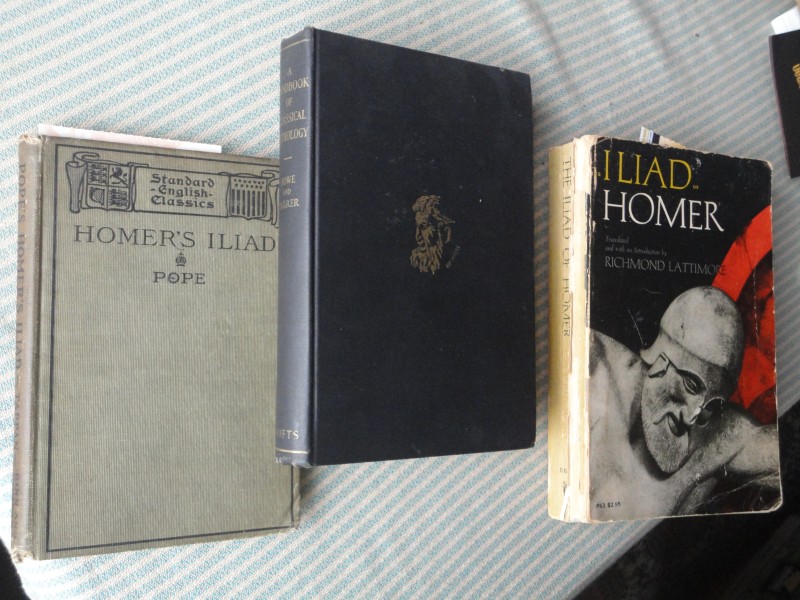
Three books mentioned in the text Continue reading

On Chapman’s Homer’s Iliad, Book IX

Index to this series | Text of Chapman’s Homer’s Iliad

Note added August 25; edited and augmented, August 27; 2024: In my view, the key events of the Iliad are Achilles’s holding back from

  1. killing Agamemnon in Book I;
  2. fighting on Agamemnon’s side in Book IX.

The latter case of self-restraint may be a disaster for Achilles, not to mention Patroclus and the other Greeks who die as a result; but it is also somehow a result of the former case. Not killing on impulse is probably a good thing; otherwise you have the situation of Njal’s Saga, which I took up in writing “On Homer’s Iliad Book I” (November 29, 2022).

Continue reading

Homer for the Civilian

The sources of this essay (originally posted April 8, 2017) are an earlier one, written as an email in 2009, and a conversation that ensued it, on the theme of what Homer may mean in one’s life, and whether an application to one’s life involves an abuse of the original text. I wrote on this blog, in July 2016, on analogies in Homer and elsewhere, in “Thinking & Feeling.” My last post considered an apparent instance of abuse of the Hebrew Bible.

At the end of the Iliad, to retrieve the body of Hector from its killer, King Priam of Troy visits Achilles in his tent in the evening, in the camp of the hostile Greeks. The scene may recall two political enemies from the 1980s, President Ronald Reagan and Congressman Thomas O’Neill, Speaker of the House: these two were able to be on friendly terms “after 6 PM.”

Homer, Iliad, Wordworth edition
Aleksandr Andreevich Ivanov
“King Priam begging Achilles for the Return of Hector’s Body,” 1824
Tretyakov Gallery, Moscow

Continue reading