Category Archives: Art

Feyhaman Duran

Born on the Asian side of Istanbul in Kadıköy in 1886, İbrahim Feyhaman was orphaned nine years later. His father had been a poet and calligrapher. His mother’s dying wish was that Feyhaman attend the Lycée Impérial Ottoman de Galata-Sérai; his maternal grandfather, Duran Çavuş, saw that this happened. Some time after graduation, headmaster Tevfik Fikret had Feyhaman come back to Galatasaray to teach calligraphy.


Garden of Aşiyan, September 10, 2015

Continue reading

Duty to Nature

Index to this series

Summary and update (added October 14, 2018): When we do something, or propose to do something, we may explain it or justify it—give a reason for it—as being useful, right, or dutiful. Such is the theory of Collingwood, analyzed here, especially with regard to a question that has increasing urgency: have we a duty, not only to one another, but to nature?

When I originally composed this post, in February of 2017, I had recently analyzed several relevant chapters of Collingwood’s New Leviathan:

Those chapters are the last in the book’s Part I, called “Man.” Collingwood returns to the same ideas in Part II, “Society,” and specifically in Chapter XXVIII, “The Forms of Political Action.” I went on analyze this chapter, 18 months later; it discusses an abuse of the concept of duty by the German political theorist Treitschke.

By one interpretation of a passage in Herodotus, the ancient Persians perceived a duty to nature, through a teaching now attributed to Zoroaster. His teachings influenced Manichaeism, and thus in turn the “Albigensian heresy,” the subject of Chapter XLIII of the New Leviathan.

A theme of Collingwood is that we tend to explain what happens in the world the way we explain what we ourselves do. If our ethics are utilitarian, then, like the ancient Greeks, we may see things in nature too as serving purposes. If we govern our own behavior by laws, then we may also seek laws of nature, as physicists do now.

Since utility and law are general in form, they provide incomplete accounts of exactly what we do. Utility tells us that some kind of thing is useful for some other kind; law keeps us within some bounds, but leaves us free within those bounds. By contrast, duty is to be conceived as providing a complete account of what we do. Conscience tells us that we have a duty; then we have to reason out what it is. The corresponding science of the world is history, which studies us as free agents. Collingwood does not describe a corresponding science of nature as such, at least not in the New Leviathan; but at the end of his first book, Religion and Philosophy, he concluded that everything that happened must be an act of will. This was in the chapter called “Miracle,” which I looked at especially in “Effectiveness.”

It may be hard to distinguish lawful action from dutiful action. In the present post, I look at the examples of

  • paying off a student loan;
  • smoking cigarettes, when rules restrict it;
  • collecting armaments, because, at the Last Supper, by the account in Luke, Jesus recommended buying swords;
  • Islam, as a rule-bound religion;
  • Christian denigrators of Islam, who find in it rules that they think believers must be bound by, even as some Muslims find inspiration in the teachings of Prophet Jesus.

I conclude with the example of an Episcopal priest called Stephen Blackmer, for whom nature is a church and a member of his congregation.


This is a synthesis of some ideas from a recent spate of posts in this blog. A theme is the question of why we do what we do, and whether we can change what we do, especially to Nature.

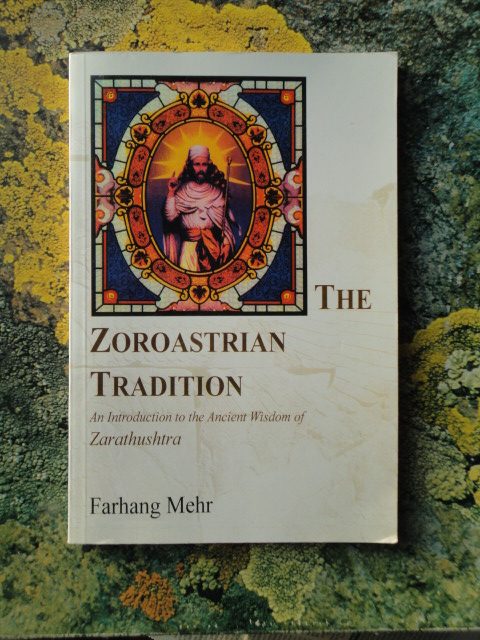
Book cover with image of a bearded man in white robes with a cap or turban, long flowing hair below this, a staff in his left hand, index finger raised on his right hand
Farhang Mehr, The Zoroastrian Tradition.
I bought the book in Yazd, Iran, in 2012

Continue reading

NL XI: “Desire”

Index to this series

The four parts of Collingwood’s New Leviathan (1942) are Man, Society, Civilization, and Barbarism. From the first part, we are considering Chapter XI, “Desire.”

Pablo Picasso, The Lovers (1923; National Gallery of Art, Washington)
Pablo Picasso, “The Lovers,” 1923
National Gallery of Art, Washington

Continue reading

NL X: “Passion”

Index to this series

Passion is literally the correlate of action, as suffering is the correlate of doing. In the ordinary, vulgar sense, passion is our response to what we suffer. This is how we shall understand it.

Above, from a cross made of steel I-beams, a stone figure hangs, while others mourn at his feet; below, more stone figures, one bearing a cross, another, back to us, with robe bearing the image of a face

Sagrada Familia, Passion Façade, November, 2008

Continue reading

Writing, Typography, and Nature

Note added February 10, 2019: I return to this rambling essay, two years later in the Math Village. The main points are as follows.

  • Writing is of value, even if you never again read what you write.
  • There is also value to reading again, as in the present case.
  • A referee rejected a submitted article of mine in the history of mathematics because its order did not make sense – to that referee, though a fellow mathematician thought well of the article. A revision was eventually published as “On Commensurability and Symmetry.”
  • In the preface to The Elements of Typographical Style, Robert Bringhurst wonders how he can write a rulebook when we are all free to be different. He thus sets up an antithesis, such as I would investigate later in “Antitheses.”
  • From being simply a means of copying, typography has become a means of expression.
  • Yet typography should not draw attention to itself, just as, according to Fowler in A Dictionary of Modern English Usage, pronunciation (notably of foreign words) should not.
  • Through my own experience of typography with LaTeX [and HTML, as in this blog], I have developed some opinions differing from some others’.
  • Bringhurst samples Thoreau,
    • whose ridicule of letters sent by post applies today to electronic media, and
    • who rightly bemoans how enjoying the woods is thought idle; cutting them down, productive.
  • In Gödel, Escher, Bach, Douglas Hofstadter wonders how a message can be recognized by any intelligence. Bringhurst restricts the question to concern intelligences on this earth.
  • In my youth, Hofstadter introduced me to Zen Flesh, Zen Bones, (edited by Reps and Senzaki), whose influence on me I consider.
  • The Zen story about whether “this very mind is Buddha” suggests a further development of Collingwood’s “logic of question and answer.”
  • Through looking at another translation, I consider how Reps and Senzaki turned Chinese into English.
  • Rereading this blog led me back to Hofstadter.

Here are some meditations on some books read during a stay in the Nesin Mathematics Village, January, 2017. I originally posted this article from the Village; now, back in Istanbul, a few days into February, recovering from the flu that I started coming down with in the Village, I am correcting some errors and trying to clarify some obscurities.

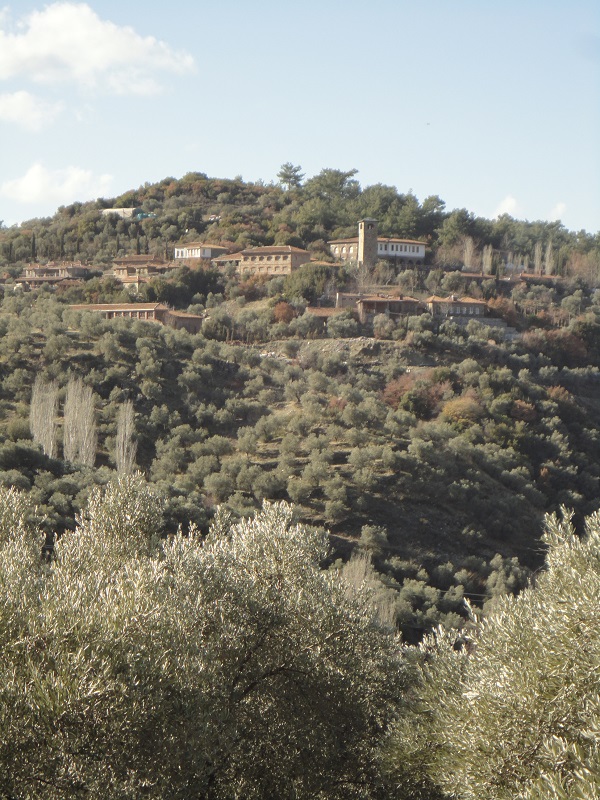
From below, a wooded hill, with buildings near the crest
Nesin Mathematics Village from the east
Wednesday, January 18, 2017

Continue reading

Confessions

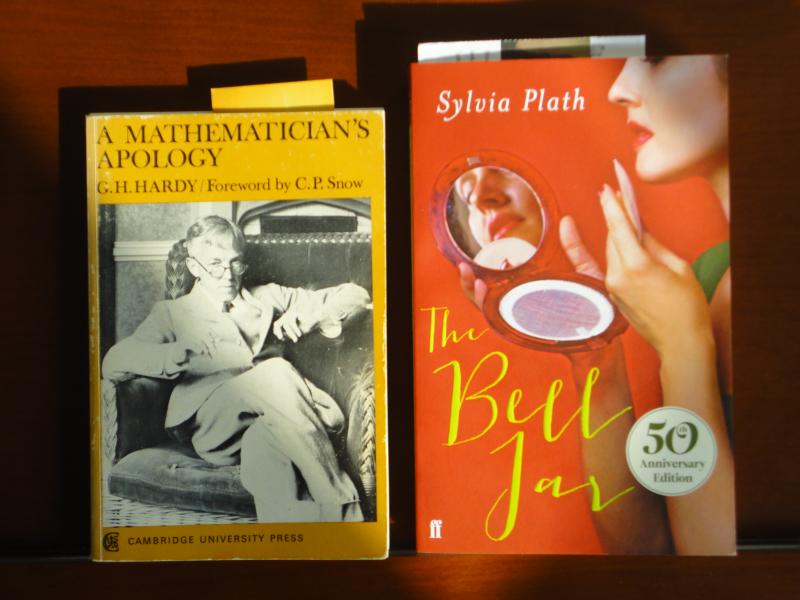
This is about G. H. Hardy and Sylvia Plath: Hardy quâ author of A Mathematician’s Apology (1940); Plath, The Bell Jar (1963).

Photo: the Hardy and Plath books

I first read Plath only recently, after encountering The Bell Jar by chance in the Istanbul bookshop called Pandora. After I finished reading it next day in Espresso Lab on İstiklâl, a woman who had earlier been speaking Turkish asked in English to look at the book. She pondered the front and the back before handing the book back to me. When I asked whether she knew of it, she simply said yes. She may not have understood my meaning; but I did not put her English (or my Turkish) to the test. Had she been made curious by the cover, showing a woman applying powder with the aid of a compact mirror? Did that cover accurately reflect the novel?

On an airplane once I was reading a paperback whose cover displayed a painting of ruins beneath the Acropolis of Athens. “I love historical fiction!” gushed a flight attendant. The term might be stretched to cover what I was reading; but it was the Oxford World’s Classics edition of Plato’s Republic.

Plato’s Republic

I had first read Hardy’s Apology in high school, thanks to the suggested reading at the end of Spivak’s Calculus. A couple of weeks ago, I somehow found a blog that took its title from the end of Hardy’s opening paragraph. That paragraph reads:

It is a melancholy experience for a professional mathematician to find himself writing about mathematics. The function of a mathematician is to do something, to prove new theorems, to add to mathematics, and not to talk about what he or other mathematicians have done. Statesmen despise publicists, painters despise art-critics, and physiologists, physicists, or mathematicians have usually similar feelings: there is no scorn more profound, or on the whole more justifiable, than that of the men who make for the men who explain. Exposition, criticism, appreciation, is work for second-rate minds.

The blog was called just that: Second Rate Minds. “We quote Hardy with irony,” says one of the two creators,

because we do not agree with him.

I believe there is great importance in communicating mathematics as widely as possible. I think it is important that children are encouraged to enjoy mathematics so that they might take further interest in the subject. Equally important is the view of mathematics held by the general public. Despite Hardy’s disdain for applications, mathematics nevertheless pervades the modern world and benefits from society valuing its role.

This is all fine; except I wonder if the writer has been corrupted by the same culture that made Hardy into somebody he found himself in disagreement with. This is the culture of judging people against one another, in order to rank them. Hardy gives a hint of this culture in the closing section of his essay:

I cannot remember ever having wanted to be anything but a mathematician. I suppose that it was always clear that my specific abilities lay that way, and it never occurred to me to question the verdict of my elders. I do not remember having felt, as a boy, any passion for mathematics, and such notions as I may have had of the career of a mathematician were far from noble. I thought of mathematics in terms of examinations and scholarships: I wanted to beat other boys, and this seemed to be the way in which I could do so most decisively.

I do not remember just what I thought of Hardy’s Apology in high school. I was at a school for boys, where I won prizes for mathematics and other subjects. I did not wish to emulate Hardy, either in pursuing just one thing, or in trying to beat others at it. Nonetheless, at the end of my freshman year at St John’s College in Annapolis, I bought my own copy of Hardy’s Apology in the College bookshop. The manager remarked that the book had decided her against pursuing mathematics. She had had dreams of doing good for the world; by Hardy’s account, mathematics was about personal glory.

I did want to do mathematics, as I ultimately understood. But this final understanding came after four more years: three in college, and one at large. I was working at a farm when I understood in a dream that I must learn modern mathematics. I cannot say that Hardy had any role in this, one way or other. Still, I would suggest now that, if Hardy does discourage you from pursuing mathematics, this may be just as well. You will have to focus like a laser if you want to do mathematics; you will be judged mercilessly, as mathematical truth is merciless; and you will suffer self-doubt, when it seems that the hardest you can work is still not good enough.

I am sorry that Hardy continued to be preoccupied with comparing himself to others:

I still say to myself when I am depressed, and find myself forced to listen to pompous and tiresome people, ‘Well, I have done one the thing you could never have done, and that is to have collaborated with both Littlewood and Ramanujan on something like equal terms.’

At least Hardy can accept that he was not quite at the level of his two collaborators. The mathematician must guard against all illusions.

In the end, I say, think what you like about Hardy; but give him credit for giving us a window into his life. Reading his essay yet again, I am impressed by the clarity and rhythm of the language, and by the frankness of the writer.

Sylvia Plath reminds me of Hardy. This is not because she ultimately gives up her virginity to a mathematician, at least in her novel. Like Hardy, she appears early on as an unpleasant person.

Plath’s character Esther proposes to Doreen that they ditch a party and have drinks with a man who wears cowboy boots and a lumber shirt. Doreen agrees to go up to Lenny’s apartment, as long as Esther will go. In the apartment, Doreen asks Esther to stick around. Still, Esther slips out; and back at the hotel, when a drunken Doreen pounds on her door, Esther won’t let her in. She allows Doreen to pass out in the corridor, since she won’t remember the incident anyway.

Maybe this was all part of the Girls’ Code, though it would seem to be a violation. Esther did not seem very nice to me. But then, trying to kill yourself is not very nice either, and Esther will do this repeatedly. There is a lot to investigate and contemplate here, including an academic system that squeezed both Plath and Hardy. It is odd that a bell jar is a place where the pressure is taken off. Now I want just to appreciate both Plath and Hardy, for laying themselves bare.

Written January, 2017. Revisited August 27, 2022. Later in 2017, I wrote more about Plath (and a little more about Hardy) in “Women and Men.”

Thinking & Feeling

This essay is written as a distraction from current events, though I make some reference to them. I am prompted by questions of analogy provoked by

  1. the similes of Homer and
  2. a recent theater review in Harper’s that mentions the parables of Jesus.

With sea in the background, on the sand of a beach sits Chapman’s Homer: The Iliad, the cover featuring a 16th-century Flemish tapestry (framed by a circle), Scene from Roman History, showing a number of men, the one in the middle armored; a horse is in the foreground

Continue reading

Life in Wartime

Turkey has given me a lot. My spouse would be enough; but life in Turkey offers various pleasures, and—for me at least—time to enjoy them. Hard work may be considered a virtue in the United States. Not so in Turkey. I am still driven to do things here, but perhaps only in the way that Thoreau was driven. He was driven to do what he wanted to do. One thing he wanted to do was write as follows.

I sometimes wonder that we can be so frivolous, I may almost say, as to attend to the gross but somewhat foreign form of servitude called Negro Slavery, there are so many keen and subtle masters that enslave both North and South. It is hard to have a Southern overseer; it is worse to have a Northern one; but worst of all when you are the slave-driver of yourself. Talk of a divinity in man! Look at the teamster on the highway, wending to market by day or night; does any divinity stir within him? His highest duty to fodder and water his horses!

For how many Americans is the highest duty to go to work to pay for the car that they drive to work?

Thoreau’s journal on the beach
Thoreau’s Journal
in the abridgement by Damion Searls
Profesörler Sitesi, Altınova, Balıkesir, Türkiye
Friday, August 28, 2015
See “Thoreau by the Aegean” of the following day

Continue reading

Narnia

The following notes about the Chronicles of Narnia by C. S. Lewis are from four emails that I wrote in the fall of 2015 (with some noted additions in the spring of 2020 and some additional editing on November 25, 2021). The emails rebut various objections to the Narnia books. I have put my emails here, because I noticed that a friend on Facebook was wondering whether her daughter was ready to read the Chronicles, or perhaps to be read to from them. I do not wish to write much on Facebook, for reasons detailed elsewhere in this blog; so I asked interested persons to read me here.

My explorations continue in “Return to Narnia.”

Side of boxed set of The Chronicles of Narnia from 1970s

Continue reading

One & Many

0

This essay – these notes for an essay, this draft of an essay – is inspired by Robert Pirsig’s first book. I have made sectional divisions where they seemed to occur naturally.

Photo of paperback and hardback editions of Zen and the Art of Motorcycle Maintenance

Continue reading