0
This essay – these notes for an essay, this draft of an essay – is inspired by Robert Pirsig’s first book. I have made sectional divisions where they seemed to occur naturally.

This essay – these notes for an essay, this draft of an essay – is inspired by Robert Pirsig’s first book. I have made sectional divisions where they seemed to occur naturally.
The May 2016 Harper’s features a review of some books about the rock band called Guns N‘ Roses. I find this a bit odd, though perhaps reassuring, since I think I am too old for Guns N’ Roses, and yet Harper’s seems pitched at people who are at least as old as I. During the former editorship of Lewis Lapham, the magazine ran cigarette ads; now it runs ads for retirement communities, hearing aids, and mobile phones with large buttons.
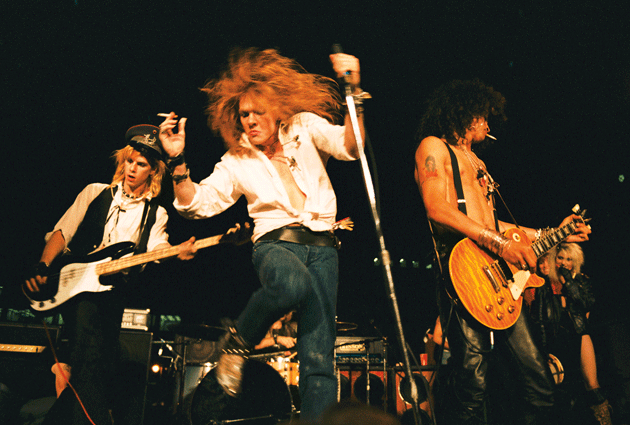
Guns N’ Roses performing at the Los Angeles Street Scene, September 28, 1985 © Marc Canter
Between the composing of parts 1 and 2 of this account came the death of Prince, whose work had inspired Rain the Color of Blue with a Little Red in It. Between the composing of parts 2 and 3 came the release of the four Turkish peace activists, whose imprisonment had given poignancy to The Demons and The Music of Strangers. There is a certain absurdity associated with each event.

Nikkyô Niwano, Shakyamuni Buddha: A Narrative Biography
(Tokyo: Kôsei Publishing Co., 1980; fifth printing, 1989)
On the cover, a modern copy by Ryûsen Miyahara,
owned by Risshô Kôsei-kai, of
“The Nirvana of the Buddha,”
painted in 1086 and owned by temple Kongôbu-ji,
Wakayama Prefecture, Japan

Ayşe was teaching, but I was free to see a movie. The İstiklâl cinemas were twenty minutes by foot from our urban campus, or one subway stop, if you preferred. Our flat was one stop in the other direction. There was a festival cinema in Ortaköy, and another over on the Asian side; but without even considering these (which I have never visited), I had a Canadian, a Mexican, a Polish, and a Turkish film to choose from. I studied them on the festival website, though not too intently. You are not likely to go wrong with any festival film. Moreover, the catalogue synopses do not always provide an accurate sense. I chose the Canadian movie out of interest in this country as being both American and not. It is also where Ayşe and I met. Continue reading
After a preamble on freedom, this is an account of nine movies in three parts.
This part:
Thirst
Rain the Color of Blue With a Little Red in It
Fire at Sea
The Demons
The Music of Strangers: Yo-Yo Ma and the Silk Road Ensemble
Florida
Interruption
Under the Sun
News from Planet Mars

In the summer of 1994, I was a graduate student at the University of Maryland, and I had lived in the state since 1989. My roommate in a suburban apartment complex was finishing her own degree and moving away. I decided to move across the border into the city of Washington, where I had already become involved in some bicycle activism. I found a congenial vegetarian group house. I would bicycle the nine miles to the College Park campus. But moving to the city raised a moral question: should I really give up my political right to a meaningful vote?
This is about the 1918 trial of American radical political cartoonist Art Young and others for conspiracy and interfering with enlistment. Most of the article is a quotation of Young’s own words. The words provide some perspective on today’s struggle for freedom of speech.

Capitalism,
Art Young, private collection (reproduced in Harper’s, Jan 2016, p. 64)
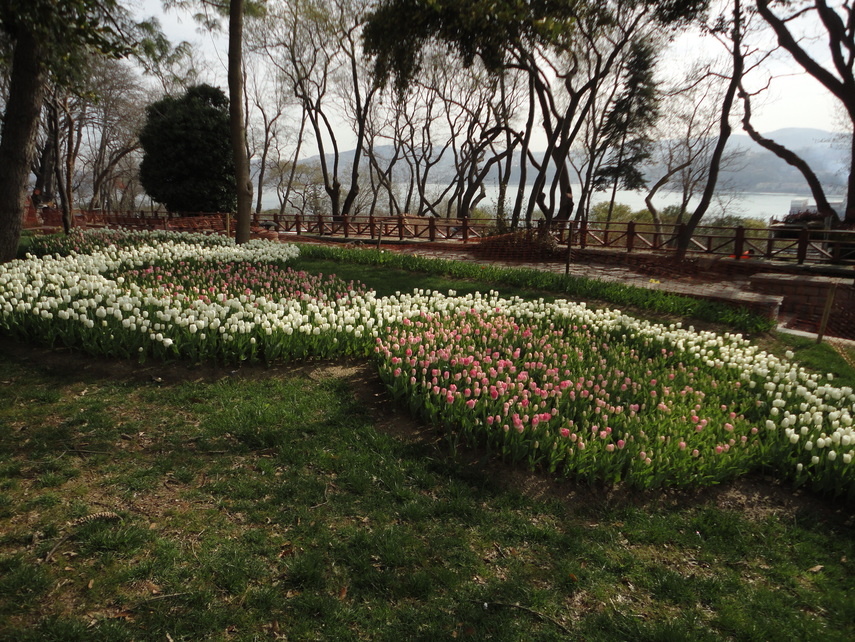
Ayşe was still in Ankara, but I had seen rumors on Twitter that tulips were already blooming in Emirgan Korusu. The bulbs were being dowsed with ice water, lest the flowers be overblown for the Tulip Festival in April. Anyway, I wanted to get away from the crowds of Şişli and Beyoğlu. The morning was mostly sunny. Thus on Saturday, March 12, 2016, I headed out to Emirgan, repeating the trip that we had made the previous April.
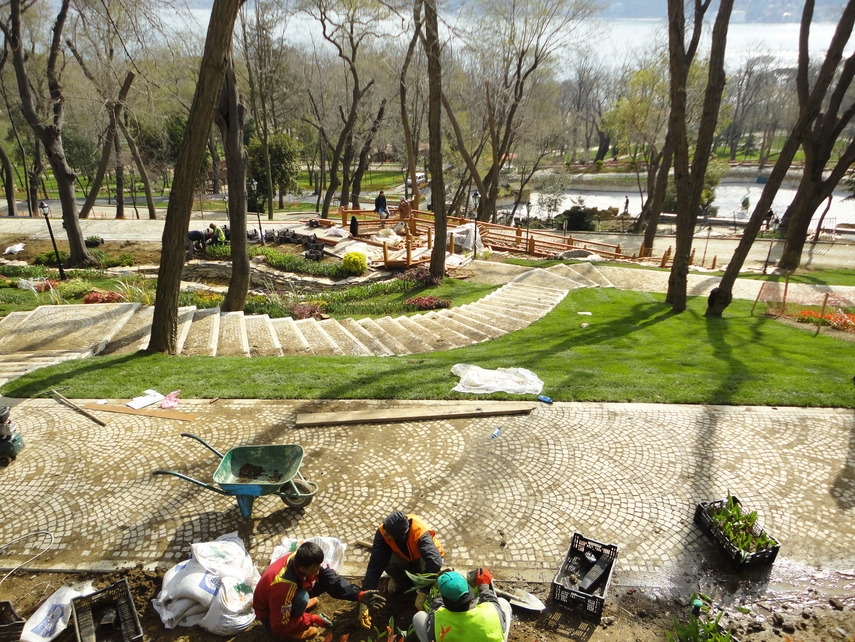
This is about a weekend in the islands, and contemporary art.
The Fourteenth Istanbul Biennial (September 5 to November 1, 2015) had exhibits or installations all over Istanbul, and several of these were on Büyükada, the Big Island, which is Πρίγκηπος in Greek. The Big Island is the last of the four islands visited by the ferry from the mainland. For easier access, Ayşe and I stayed on the second island, Burgazada, the night of Friday, October 23, 2015. We caught the ferry from there to Büyükada on Saturday morning. We visited all of the venues of the Biennial on the island. Illustrating this article are photographs from some of these venues.
I supply some information about the artworks from the Biennal guidebook (which can be downloaded as a pdf file). This was the information that we had at the time of visiting. It turns out that there is more information on the web, sometimes a lot more. Some of the works, at least, do not stand very well on their own. One needs to be told what one is looking at. Without this, one may still look and figure that what one is seeing is meaningful to the artist; but that may be all. In this, the works in the Biennial differ from the photographs and paintings of Emine Ceylan (born 1955), which last month (February, 2016) were on display at my university’s Tophane-i Amire Culture and Art Center. I give one example, from an album of my photos from the exhibit:

Emine Ceylan (title and date unknown to me)
This seems not to be the kind of thing that the big names in art today are interested in doing.
Skip to Michael Attaleiates on Alparslan after the Battle of Manzikert
Published in six volumes between 1776 and 1788, Edward Gibbon’s History of the Decline and Fall of the Roman Empire tells the story of a thousand years and more, from before the founding of Constantinople in 330 till after its loss in 1453. Gibbon can be ridiculed for his title: a millenium is a long time to be in decline. The three thick volumes of the Penguin edition took me a long time to read, if not quite as long as Gibbon took to write. I was living in Ankara at the time, but I enjoyed being able to read Gibbon’s work also while visiting the three old imperial capitals: Istanbul, Rome, and Milan.
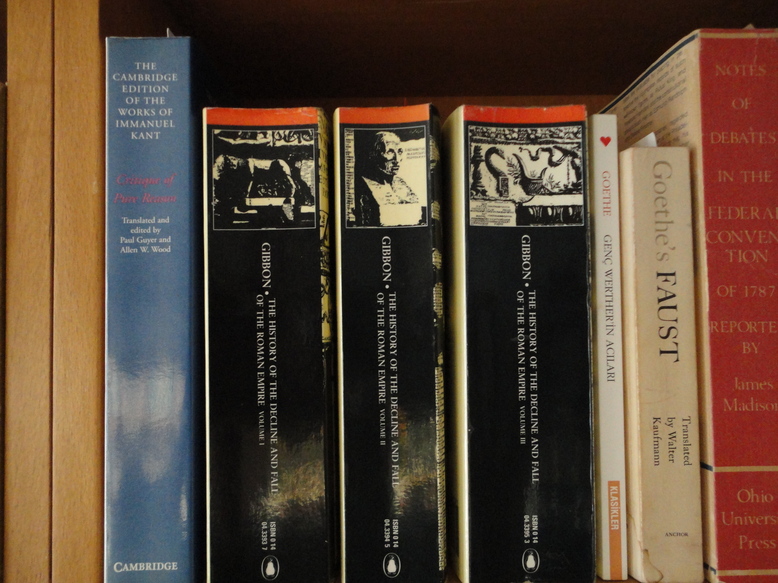
Gibbon’s Decline and Fall on my shelves
(which are arranged according to date of birth of author)
Here are assorted photographs, from recent months, along with my reasons for taking them.
In a tweet there was a photograph of a crowd of excited people, all brandishing cellphones, except for this one old woman.
 Polytropy