Category Archives: Collingwood

Concerning the philosopher R. G. Collingwood (1889–1943). Many if not most of my posts concern Collingwood somehow, so this category may not be of much use. See Articles on Collingwood for some articles by other persons

Return to Narnia

1

My subject is the Chronicles of Narnia of C. S. Lewis (1898–1963). I consider this heptad of books (published 1950–6) as constituting (1) literature (2) for children (3) that I continue to enjoy in my sixth decade, having started in my first.

  1. By literature, I mean a work of art whose medium is prose. Prose may also be a work of craft, intended to fulfil some purpose. This purpose could be to serve a market for fantasy or children’s books. Art as such has no purpose that can be specified in advance.

  2. Writing for children may take certain liberties that annoy adults.

  3. As with any post in this blog, I write out of my own personal interest. As a child, I read other fantasies, such as those of Lloyd Alexander, John Christopher, Ursula LeGuin, and J.R.R. Tolkien. Only the works of C. S. Lewis have stayed with me. This essay may be considered as an exploration of why, or least an example of how.

The seven books of the Chronicles of Narnia, Collier edition

Continue reading

Thoreau and Anacreon

Note added, October 5, 2023. At the end of this post, from sunny days in the first spring of the Covid pandemic, I take up Anacreon’s poem “The Thracian Filly,” translated as “To a Colt” in A Week on the Concord and Merrimack Rivers. Anacreon was from Teos, whose ruins I have visited. Thoreau may not be sensitive to the sexual connotations of the poem. First I review Thoreau’s book, noting in particular:

  • The book is written, like my blog posts, to please the author, who would rather do without money than sell stuff to get it.
  • The author’s relative indifference to human affairs in the face of nature is becoming less tenable, when a Pacific island inhabited by 40 persons and visited once a month by a boat (and once for all, probably, by a travel writer) is losing its palms to an invasive beetle.

Other books discussed or mentioned (and in my physical library) are

  • Bean, Aegean Turkey;
  • Collingwood, The First Mate’s Log;
  • Lawson, The Drinkers’ Guide to the Middle East;
  • Schalansky, Pocket Atlas of Remote Islands;
  • Thoreau, Walden;
  • Trypanis (ed.), The Penguin Book of Greek Verse;
  • Walls, Henry David Thoreau: A Life.

Gray clouds over blue sky over white clouds over buildings

Continue reading

Doing and Suffering

To do injustice is worse than to suffer it. Socrates proves this to Polus and Callicles in the dialogue of Plato called the Gorgias.

I wish to review the proofs, because I think they are correct, and their result is worth knowing.

Loeb Plato III cover

Or is the result already clear to everybody?

Whom would you rather be: a Muslim in India, under attack by a Hindu mob, or a member of that mob?

You would rather not be involved; but if you had to choose, which option would be less bad: to be driven to an insane murderous fury, or to be the object of that fury?

Continue reading

Evolution of Reality

I enjoy and recommend Robert Wright’s Nonzero Newsletter, which presents thought on both American politics and thought itself.

Tiny green plants on red tile roof, cloudy day

In a 2017 post of this blog, I quoted Wright’s 1988 article in The Atlantic Monthly about Edward Fredkin. Somewhat differently from Fredkin, I spelled out my title, “What Philosophy Is,” without actually being a professional philosopher. I touched on a theme that I shall take up now: that thinkers today could benefit from knowing the thought of R. G. Collingwood.

Continue reading

On the Odyssey, Book I

  • In reading his rendition of the Iliad, having enjoyed hearing Chapman speak out loud and bold;

  • having enjoyed writing here about each book, particularly the last ten books in ten days on an Aegean beach in September of this year (2019);

  • having taken the name of this blog from the first line of the Odyssey;

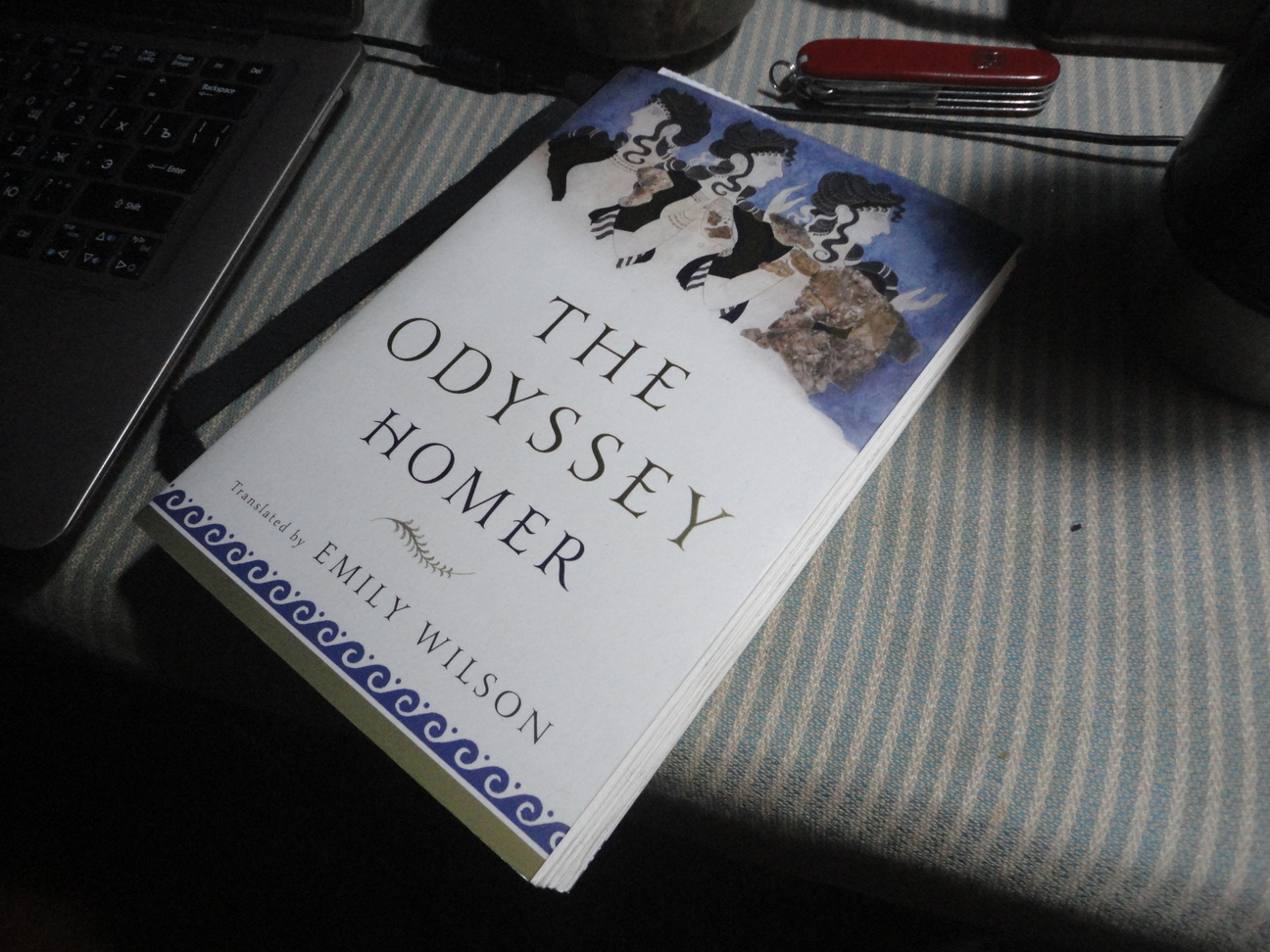
  • having obtained, from Homer Books here in Istanbul, Emily Wilson’s recent translation (New York: Norton, 2018);

  • Book on table, Wilson's Odyssey Continue reading

On the Idea of History

Note added, March 10–11, 2021. The bulk of this post concerns race in the theory of history, particularly the theory attributed to Johann Gottfried Herder (1744–1803). Not having read Herder for myself, I rely on the accounts of

  • R. G. Collingwood in § 2, “Herder,” of Part III of The Idea of History (1946),
  • Michael Forster in “Johann Gottfried von Herder,” Stanford Encyclopedia of Philosophy (summer 2019).

Somebody like Herder may introduce race as an hypothesis to explain history, but ultimately the hypothesis fails, by denying us the freedom that is essential to history as such. Nonetheless, Forster defends Herder as having

an impartial concern for all human beings … Herder does also insist on respecting, preserving, and advancing national groupings. However, this is entirely unalarming,

because, for one thing, “The ‘nation’ in question is not racial but linguistic and cultural.”

Change Collingwood’s word “race” to “linguistic and cultural grouping” then. I think his conclusion remains sound: “Once Herder’s theory of race is accepted, there is no escaping the Nazi marriage laws.”

More detail is in the post below. I go on to review the philosophy of history that Collingwood presents in the Introduction of The Idea of History. This book provided me with a title for the post.

I wrote a lot in this post, as I often do. Growing self-conscious for being opinionated about the theory of history, I listed the published evidence of my actually being an historian (an historian of ancient Greek mathematics in particular).

I originally wrote that my research had been inspired by a tweet. The author of that tweet also wrote the nice long comment on this post. However, although the tweet can be found on the Internet Archive, the author later deleted his Twitter account, and so the tweet appears on Twitter today as a gap in the thread above my own tweet in response to the other tweet.

That missing tweet referred to another tweet of the author, but the Internet Archive seems not to have saved it. It did save the present post; so if one were curious, one could see the changes that I have made since initial publication, or rather since September 29, 2020, when the Archive took the first snapshot.

The changes are for style and local clarity. Any large-scale changes would need me to recover the spirit that possessed me when I originally wrote.

I return to this post now, simply because a friend mentioned reading Middlemarch, and I remembered quoting George Eliot’s novel in a blog post, and that post turned out to be this one.

Had somebody mentioned reading Herder, I might have recalled writing about him in a blog post; that would be this post too.


Our environment may influence our feelings, but what we make of those feelings is up to us. Thus we are free; we are not constrained by some fixed “human nature”—or if we are, who is to say what its limits are?


Rembrandt van Rijn (and Workshop?), Dutch, 1606–1669,
The Apostle Paul, c. 1657, oil on canvas,
Widener Collection, National Gallery of Art

Continue reading

Anthropology of Mathematics

This essay was long when originally published; now, on November 30, 2019, I have made it longer, in an attempt to clarify some points.

The essay begins with two brief quotations, from Collingwood and Pirsig respectively, about what it takes to know people.

  • The Pirsig quote is from Lila, which is somewhat interesting as a novel, but naive about metaphysics; it might have benefited from an understanding of Collingwood’s Essay on Metaphysics.

  • A recent article by Ray Monk in Prospect seems to justify my interest in Collingwood; eventually I have a look at the article.

Ideas that come up along the way include the following.

  1. For C. S. Lewis, the reality of moral truth shows there is something beyond the scope of natural science.

  2. I say the same for mathematical truth.

  3. Truths we learn as children are open to question. In their educational childhoods, mathematicians have often learned wrongly the techniques of induction and recursion.

  4. The philosophical thesis of physicalism is of doubtful value.

  5. Mathematicians and philosophers who ape them (as in a particular definition of physicalism) use “iff” needlessly.

  6. A pair of mathematicians who use “iff” needlessly seem also to misunderstand induction and recursion.

  7. Their work is nonetheless admirable, like the famous expression of universal equality by the slave-driving Thomas Jefferson.

  8. Mathematical truth is discovered and confirmed by thought.

  9. Truth is a product of every kind of science; it is not an object of natural science.

  10. The distinction between thinking and feeling is a theme of Collingwood.

  11. In particular, thought is self-critical: it judges whether itself is going well.

  12. Students of mathematics must learn their right to judge what is correct, along with their responsibility to reach agreement with others about what is correct. I say this.

  13. Students of English must learn not only to judge their own work, but even that they can judge it. Pirsig says this.

  14. For Monk, Collingwood’s demise has meant Ryle’s rise: unfortunately so since, for one thing, Ryle has no interest in the past.

  15. In a metaphor developed by Matthew Arnold, Collingwood and Pirsig are two of my touchstones.

  16. Thoreau is another. He affects indifference to the past, but his real views are more subtle.

  17. According to Monk, Collingwood could have been a professional violinist; Ryle had “no ear for tunes.”

  18. For Collingwood, Victoria’s memorial to Albert was hideous; for Pirsig, Victorian America was the same.

  19. Again according to Monk, some persons might mistake Collingwood for Wittgenstein.

  20. My method of gathering together ideas, as outlined above, resembles Pirsig’s method, described in Lila, of collecting ideas on index cards.

  21. Our problems are not vague, but precise.


When Donald Trump won the 2016 U.S. Presidential election, which opinion polls had said he would lose, I wrote a post here called “How To Learn about People.” I thought for example that just calling people up and asking whom they would vote for was not a great way to learn about them, even if all you wanted to know was whom they would vote for. Why should people tell you the truth?

Saturn eclipse mosaic from Cassini

Continue reading

On Translation

Achilles is found singing to a lyre, in a passage of Book IX of the Iliad. Homer sets the scene in five dactylic hexameters; George Chapman translates them into four couplets of fourteeners.

I wrote a post about each book of the Iliad, in Chapman’s version of 1611. As I said at the end, I look forward to reading Emily Wilson’s version. Meanwhile, here I examine the vignette of the lyre in several existing English translations, as well as in the original.

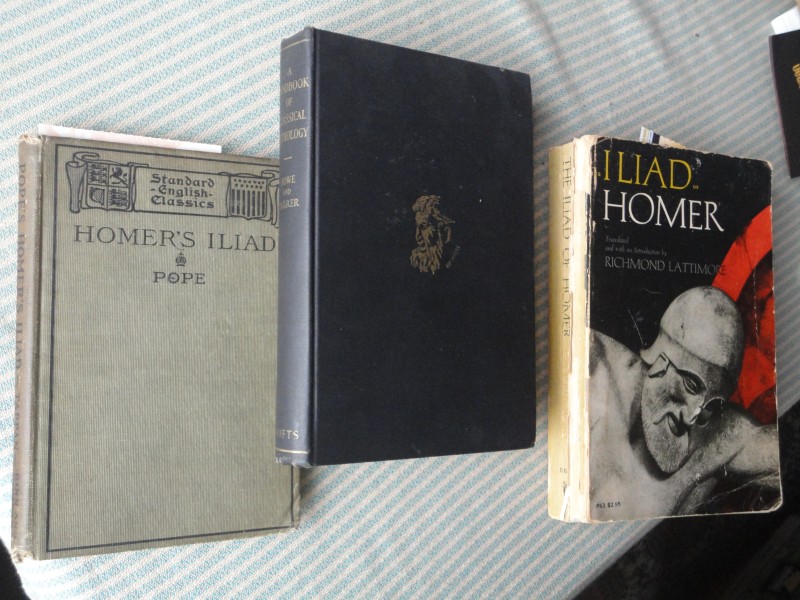
Three books mentioned in the text Continue reading

On Chapman’s Homer’s Iliad, Book XVIII

I analyze Book XVIII of the Iliad into seven scenes.

Branches against sky

Continue reading

Math, Maugham, and Man

Note added, August 28, 2023. The main purpose of this post of September 1, 2019, seems to have been to assemble some information about the etymologies of “man” and “woman,” because of ongoing controversy about what the words even mean today. I started to take up the controversy itself on December 30 of that year, in “Sex and Gender.” Meanwhile, this post suggests, or points out:

  • a generic “person” may still be male in people’s minds;
  • becoming a woman may be like becoming Jewish;
  • there are no gendered pronouns in Turkish;
  • the series freshman, sophomore, junior, senior is like pinkie, ring finger, middle finger;
  • Greek does not have such an interesting series for the fingers;
  • Greek mathematics includes Thales’s Theorem and Pappus’s Hexagon Theorem.

There does not seem to be any connection between the mathematics and the etymology here, except that I was studying both at the same time. I must have been reading The Razor’s Edge too, where Maugham

  • places himself in a tradition founded by Herodotus;
  • uses “he/him” for for somebody who can be a woman as well as a man.

More themes I took up:

  • what it means to be natural;
  • that I don’t consider myself ADHD;
  • the etymology of “squirrel”;
  • the Etymological Fallacy.

A dog lying in the shade of a beach umbrella looks at us; behind him are a woman and a man sitting facing away from us, towards the sea
Woman, man, and dog
Friday, August 18, 2023
Altınova, Balıkesir, Türkiye

Continue reading