Category Archives: Plato

Anthropology of Mathematics

This essay was long when originally published; now, on November 30, 2019, I have made it longer, in an attempt to clarify some points.

The essay begins with two brief quotations, from Collingwood and Pirsig respectively, about what it takes to know people.

  • The Pirsig quote is from Lila, which is somewhat interesting as a novel, but naive about metaphysics; it might have benefited from an understanding of Collingwood’s Essay on Metaphysics.

  • A recent article by Ray Monk in Prospect seems to justify my interest in Collingwood; eventually I have a look at the article.

Ideas that come up along the way include the following.

  1. For C. S. Lewis, the reality of moral truth shows there is something beyond the scope of natural science.

  2. I say the same for mathematical truth.

  3. Truths we learn as children are open to question. In their educational childhoods, mathematicians have often learned wrongly the techniques of induction and recursion.

  4. The philosophical thesis of physicalism is of doubtful value.

  5. Mathematicians and philosophers who ape them (as in a particular definition of physicalism) use “iff” needlessly.

  6. A pair of mathematicians who use “iff” needlessly seem also to misunderstand induction and recursion.

  7. Their work is nonetheless admirable, like the famous expression of universal equality by the slave-driving Thomas Jefferson.

  8. Mathematical truth is discovered and confirmed by thought.

  9. Truth is a product of every kind of science; it is not an object of natural science.

  10. The distinction between thinking and feeling is a theme of Collingwood.

  11. In particular, thought is self-critical: it judges whether itself is going well.

  12. Students of mathematics must learn their right to judge what is correct, along with their responsibility to reach agreement with others about what is correct. I say this.

  13. Students of English must learn not only to judge their own work, but even that they can judge it. Pirsig says this.

  14. For Monk, Collingwood’s demise has meant Ryle’s rise: unfortunately so since, for one thing, Ryle has no interest in the past.

  15. In a metaphor developed by Matthew Arnold, Collingwood and Pirsig are two of my touchstones.

  16. Thoreau is another. He affects indifference to the past, but his real views are more subtle.

  17. According to Monk, Collingwood could have been a professional violinist; Ryle had “no ear for tunes.”

  18. For Collingwood, Victoria’s memorial to Albert was hideous; for Pirsig, Victorian America was the same.

  19. Again according to Monk, some persons might mistake Collingwood for Wittgenstein.

  20. My method of gathering together ideas, as outlined above, resembles Pirsig’s method, described in Lila, of collecting ideas on index cards.

  21. Our problems are not vague, but precise.


When Donald Trump won the 2016 U.S. Presidential election, which opinion polls had said he would lose, I wrote a post here called “How To Learn about People.” I thought for example that just calling people up and asking whom they would vote for was not a great way to learn about them, even if all you wanted to know was whom they would vote for. Why should people tell you the truth?

Saturn eclipse mosaic from Cassini

Continue reading

On Translation

Achilles is found singing to a lyre, in a passage of Book IX of the Iliad. Homer sets the scene in five dactylic hexameters; George Chapman translates them into four couplets of fourteeners.

I wrote a post about each book of the Iliad, in Chapman’s version of 1611. As I said at the end, I look forward to reading Emily Wilson’s version. Meanwhile, here I examine the vignette of the lyre in several existing English translations, as well as in the original.

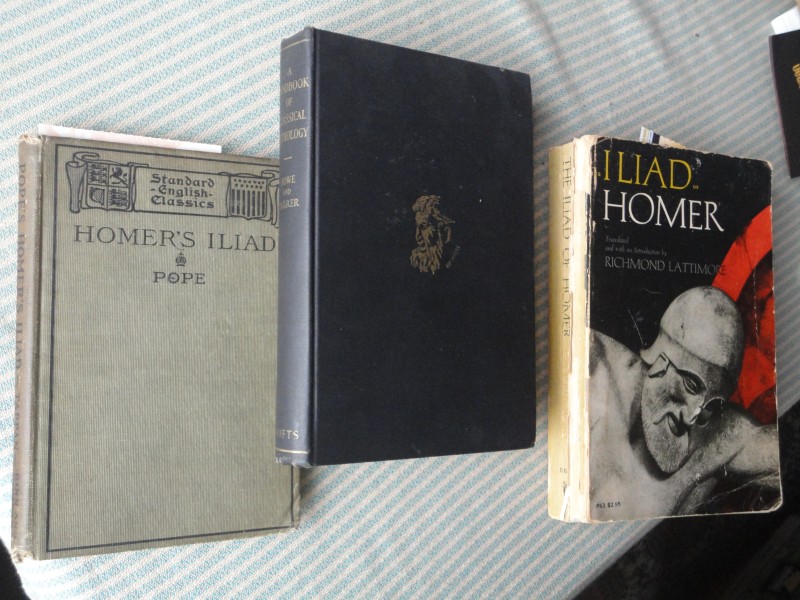
Three books mentioned in the text Continue reading

Math, Maugham, and Man

Note added, August 28, 2023. The main purpose of this post of September 1, 2019, seems to have been to assemble some information about the etymologies of “man” and “woman,” because of ongoing controversy about what the words even mean today. I started to take up the controversy itself on December 30 of that year, in “Sex and Gender.” Meanwhile, this post suggests, or points out:

  • a generic “person” may still be male in people’s minds;
  • becoming a woman may be like becoming Jewish;
  • there are no gendered pronouns in Turkish;
  • the series freshman, sophomore, junior, senior is like pinkie, ring finger, middle finger;
  • Greek does not have such an interesting series for the fingers;
  • Greek mathematics includes Thales’s Theorem and Pappus’s Hexagon Theorem.

There does not seem to be any connection between the mathematics and the etymology here, except that I was studying both at the same time. I must have been reading The Razor’s Edge too, where Maugham

  • places himself in a tradition founded by Herodotus;
  • uses “he/him” for for somebody who can be a woman as well as a man.

More themes I took up:

  • what it means to be natural;
  • that I don’t consider myself ADHD;
  • the etymology of “squirrel”;
  • the Etymological Fallacy.

A dog lying in the shade of a beach umbrella looks at us; behind him are a woman and a man sitting facing away from us, towards the sea
Woman, man, and dog
Friday, August 18, 2023
Altınova, Balıkesir, Türkiye

Continue reading

On Causation

Causation seems commonly to be understood as a physical concept, like being a fossil. The paleontologist seeks the one right answer to the question of when a particular dinosaur bone became part of the fossil record; likewise readers of international news seem to think there is one right answer to the question of whether Donald Trump or Ali Khamenei caused the shooting down of Ukraine International Airlines Flight 752 on January 8, 2020.

There is not one right answer. If you are Trump, you caused 176 civilian deaths by attacking the Iranians and provoking their response. If you are Mitch McConnell, you caused the deaths by inhibiting the removal of Trump from office. If you are Khamenei, you did it by meeting Trump’s fire with fire.

Being a cause does not mean you deserve condemnation or praise: that is another matter.

Continue reading

NL I: “Body and Mind” Again

Index to this series

“We are beginning an inquiry into civilization,” writes Collingwood, “and the revolt against it which is the most conspicuous thing going on at the present time.” The time is the early 1940s.

Human tourists photographing sculptured supine blue ape with chrome testicles outside the Intercontinental Hotel, Prague Continue reading

We the Pears of the Wild Coyote Tree

This is a preliminary report on two recent films:

  • The Wild Pear Tree, by Nuri Bilge Ceylan;
  • We the Coyotes, by Marco La Via and Hanna Ladoul.

The report is preliminary, not because there is going to be another, but because I have seen each film only once, and I may see one of them again.

I remember that François Truffaut liked to see films at least twice. I believe I read this in The Washington Post, and I might have guessed it was in an appreciation published when Truffaut died; however, he died on October 21, 1984, during the first semester of my sophomore year at St John’s College in Santa Fe, and I would not have been reading the Post then.

While in college, I did enjoy seeing some films twice, or a second time; Truffaut’s own 400 Coups was an example, a French teacher having shown it to us in high school.

The two films that I am reviewing now concern young adults trying to find their own way in the world, in defiance of their elders. We all have to do this. In every generation, some will do it more defiantly than others. Heraclitus can be defiant, he of Ephesus and thus one of the Ionian philosophers, whose spirit I imagine to haunt the Nesin Mathematics Village. A further reason to bring up Heraclitus will be a theme that is explicit in Pear Tree, implicit (or metaphorical) in Coyotes: gold.

A book, whose cover shows a bonfire, sits on a rock dampened by waves of the sea, which laps on the sand beyond
A copy of The Logos of Heraclitus,
by Eva Brann,
on Marmara Island, July, 2012

Continue reading

Piety

The post below is a way to record a passage in the Euthyphro where Socrates says something true and important about mathematics.

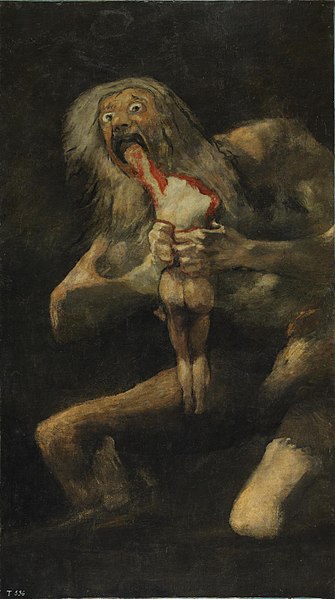
Crude depiction of bug-eyed figure grasping the torso of, and putting into his mouth the arm of, a smaller figure
Goya, [Cronus] Devouring His Son
(see below)

The passage is on a list of Platonic passages that I recently found, having written it in a notebook on May 23, 2018. The other passages are in the Republic; here they are, for the record, with some indication of why they are worth noting (translations are Shorey’s, originally from 1930 and 1935 in the old Loeb edition):

Continue reading

Antitheses

This is an attempt at a dialectical understanding of freedom and responsibility, punishment and forgiveness, things like that. My text is a part of the Gospel, though I attribute no special supernatural power to this. I shall refer also to the Dialogues of Plato.

NL XLIII: The Second Barbarism: The ‘Albigensian Heresy’

Index to this series

Summary. Suppose your society has certain rites and customs, perceived as essential to its functioning. When some persons among you reject those rites and customs, what are you going to do? Persecution would be the normal response of a society that aimed to preserve itself. In the example to be considered here, the society is medieval Christendom, where

  • buildings called churches were customarily the abode of friendly spirits, and
  • the rite of swearing an oath was a sign of special commitment.

Oaths and churches were rejected by persons called Paulicians, or Bogomils, or Albigensians. Their beliefs were Manichaean. These persons were persecuted so successfully that we do not understand them very well. Therefore we must leave open the question of whether they were barbarists.

Here I am going to review, among other things,

  • what it means to fight barbarism;
  • the response to German bombardment described in Goodbye, Mr. Chips;
  • what Jesus Christ says about swearing;
  • how the United States accommodates various beliefs (as by allowing affirming instead of swearing, or allowing Muslims to swear on a Quran);
  • the threat of a lying President;
  • the threat of ignoring climate change;
  • the etymology of heresy;
  • the discussion of mythos and logos in Pirsig.

Fire temple, Yazd, Iran, September 2012. See “Duty to Nature

Continue reading

NL XLII: The First Barbarism: The Saracens

Index to this series

Executive summary: The barbarians who overran the Western Roman Empire were not barbarists in Collingwood’s technical sense. However, “in the seventh century a movement inspired by hostility towards everything Roman … and everything Christian, flared up on the south-eastern frontier of the Roman world” (42. 22). This movement was therefore barbarist. Failing to conquer Europe, either from the east at Constantinople, or from the west at Tours, the movement settled down and ceased being barbarist—by the account in Chapter XLII, “The First Barbarism: The Saracens,” and later, in Collingwood’s New Leviathan. I check this account against more recent sources; it is barbarist to think that the “movement” in question, or indeed any movement, must always be barbarist; I look at the “civilization” of the British Empire as portrayed in a story of Maugham, and I compare a character of the story to Collingwood.


Collingwood’s historical account of barbarisms is a minefield, if one wishes not to sound like a barbarist oneself. The four examples will be

  1. the Saracens,
  2. the “Albigensian Heresy” (or the Bogomils),
  3. the Turks, and
  4. the Germans.

The very formula “the X”—definite article followed by national or quasi-national adjective—this has a barbaric use in branding a people with indelible features. A retort then is “not all X,” as in “not all men.” Collingwood issues such a proviso himself:

45. 68. Please observe, Reader, that I am not talking about all Germans. I do not say that all Germans are liars. I know of some who are not; those heroes, for example, who continue in spite of everything the Nazis can do to run their secret wireless station and keep on printing Das Wahre Deutschland.

Das wahre Deutschland, from a Swiss antiquarian bookshop, Antiquariat Peter Petrej

Continue reading