Category Archives: Plato

NL XLIII: The Second Barbarism: The ‘Albigensian Heresy’

Index to this series

Summary. Suppose your society has certain rites and customs, perceived as essential to its functioning. When some persons among you reject those rites and customs, what are you going to do? Persecution would be the normal response of a society that aimed to preserve itself. In the example to be considered here, the society is medieval Christendom, where

  • buildings called churches were customarily the abode of friendly spirits, and
  • the rite of swearing an oath was a sign of special commitment.

Oaths and churches were rejected by persons called Paulicians, or Bogomils, or Albigensians. Their beliefs were Manichaean. These persons were persecuted so successfully that we do not understand them very well. Therefore we must leave open the question of whether they were barbarists.

Here I am going to review, among other things,

  • what it means to fight barbarism;
  • the response to German bombardment described in Goodbye, Mr. Chips;
  • what Jesus Christ says about swearing;
  • how the United States accommodates various beliefs (as by allowing affirming instead of swearing, or allowing Muslims to swear on a Quran);
  • the threat of a lying President;
  • the threat of ignoring climate change;
  • the etymology of heresy;
  • the discussion of mythos and logos in Pirsig.

Fire temple, Yazd, Iran, September 2012. See “Duty to Nature”

Continue reading →

NL XLII: The First Barbarism: The Saracens

Index to this series

Executive summary: The barbarians who overran the Western Roman Empire were not barbarists in Collingwood’s technical sense. However, “in the seventh century a movement inspired by hostility towards everything Roman … and everything Christian, flared up on the south-eastern frontier of the Roman world” (42. 22). This movement was therefore barbarist. Failing to conquer Europe, either from the east at Constantinople, or from the west at Tours, the movement settled down and ceased being barbarist—by the account in Chapter XLII, “The First Barbarism: The Saracens,” and later, in Collingwood’s New Leviathan. I check this account against more recent sources; it is barbarist to think that the “movement” in question, or indeed any movement, must always be barbarist; I look at the “civilization” of the British Empire as portrayed in a story of Maugham, and I compare a character of the story to Collingwood.


Collingwood’s historical account of barbarisms is a minefield, if one wishes not to sound like a barbarist oneself. The four examples will be

  1. the Saracens,
  2. the “Albigensian Heresy” (or the Bogomils),
  3. the Turks, and
  4. the Germans.

The very formula “the X”—definite article followed by national or quasi-national adjective—this has a barbaric use in branding a people with indelible features. A retort then is “not all X,” as in “not all men.” Collingwood issues such a proviso himself:

45. 68. Please observe, Reader, that I am not talking about all Germans. I do not say that all Germans are liars. I know of some who are not; those heroes, for example, who continue in spite of everything the Nazis can do to run their secret wireless station and keep on printing Das Wahre Deutschland.

Das wahre Deutschland, from a Swiss antiquarian bookshop, Antiquariat Peter Petrej

Continue reading →

NL XLI: What Barbarism Is

Index to this series

Civilization being agreement, barbarism has no chance in the long run (41. 67):

41. 76. For barbarism implies not only a quarrel between any barbarist and any civilized man; it also implies a quarrel between anyone barbarist and any other; and that any state of harmony between them is merely this quarrel suspended.

The barbarist is somebody “who imitates the conditions of an uncivilized world” (41. 53); but an actual attempt to bring about those conditions will need cooperation, and this will be a step towards civility. Here perhaps we should distinguish cooperation from the kind of coerced organization seen in a fascist state. Specific examples will be considered in the later chapters of Part IV of the New Leviathan. We are now considering “What Barbarism Is,” in general terms.

Continue reading →

NL XL: Peace and Plenty

Index to this series

With “Peace and Plenty,” we reach the end of the account of civilization in Collingwood’s New Leviathan. What remains is the account of barbarism. Strictly speaking, we little need it. Civilization quâ ideal of civility is the positive end of civilization quâ process, and as was pointed out on Chapter XXXII, “Society and Nature in the Classical Politics,” the positive end is the primary thing to know in conducting a process (32. 35–6).

“May Day, 1929,” V. V. Kuptsov

Continue reading →

NL XXXIX: Law and Order

Index to this series

In the New Leviathan, three chapters ago, the essence of civilization was found in not using force against one another. Two chapters ago, civilization was found to be achieved, or at least perpetuated, through education by amateurs, especially within families.

Samuel F. B. Morse (American, 1791-1872), The House of Representatives, 1822, probably reworked 1823, oil on canvas, Corcoran Collection (Museum Purchase, Gallery Fund), National Gallery of Art

Continue reading →

NL XXXVII: Civilization As Education

Index to this series

Knowing, from the previous chapter, what civilization is, we ask: How do we bring it about? Collingwood’s answer is to homeschool our children.

This is the New Leviathan’s first detailed piece of positive advice, and it may sound crazy. Rather than list reasons why, I want to see what sense can be made of the ideas.

Civility is respect (37. 15). To respect another person is to recognize their freedom (37. 14). To do this, one needs self-respect (37. 13).

Instead of respect, we may approach another person with servility, namely “the demeanour of a man lacking self-respect towards one whom he fears” (37. 17). The will to barbarism is just the will to servility (37. 19).


Mary Cassatt (American, 1844-1926)
The Boating Party, 1893/1894, oil on canvas
Chester Dale Collection, National Gallery of Art Continue reading →

NL XXXVI: The Essence of Civilization

Index to this series

After thirty-five earlier chapters, we reach the point of the New Leviathan. The essence of civilization is being civil to one another (36. 5).

Henri Rousseau (French, 1844 – 1910), The Equatorial Jungle, 1909, oil on canvas, Chester Dale Collection, National Gallery of Art

That may sound trivial or tautologous. It’s not. We are talking about being civil, in the ancient sense discussed in the previous chapter:

35. 41. Behaving ‘civilly’ to a man means respecting his feelings: abstaining from shocking him, annoying him, frightening him, or (briefly) arousing in him any passion or desire which might diminish his self-respect (13. 31); that is, threaten his consciousness of freedom by making him feel that his power of choice is in danger of breaking down and the passion or desire likely to take charge (13. 67).

Continue reading →

NL XXIX: External Politics

Index to this series

Executive summary (added September 13, 2018, edited July 19, 2019, and May 19, 2026): Dealing with other bodies politic is the third stage of political life, after societies’

  • formation (as if by marriage),
  • dominion over non-social communities (as if by having children).

Having been used in the first two stages, dialectic can be used in the third, to make peace rather than war. Being the eristic of external politics, war has no psychological cause that would absolutely prevent the making of peace. War is a state of mind, which does not think non-agreement can become agreement. Pacifism has this state of mind.


External politics are international relations. These represent the third of the “stages” in political life (29. 1), which we enumerate:

  1. The joining of wills into a society, which rules itself (29. 11).
  2. Such a society’s ruling over a non-social community in a body politic (29. 12).
  3. Dealing with other bodies politic (29. 13).

Beach scene: Against a calm sea, a man in trunks walks along the shore, while a woman seen in profile sits next to somebody in a chair whose back is towards is. In the foreground are several empty beach chairs

Continue reading →

NL XXVIII: The Forms of Political Action

Index to this series

Executive summary (added September 12, 2018), To condemn political discussion is to wish for tyranny: this continues a thought from the previous chapter. The ruling class need not share their deliberations with the ruled class, but it is better if they do. As our understanding of the reason for an action evolves—at first the action is merely useful, but later it conforms to a rule—, so ruling, originally by decree, has evolved to include legislation. However, to be enforced, law does not require a formal structure; international law is an example. The best reason for an action is duty. Though the German Treitschke says our highest duty is to the state, he gives the state no duty, and so his politics are entirely utilitarian.


In Plato’s Republic, Socrates seeks understanding of the just human being through examination of the just state. In Collingwood’s New Leviathan, the order is reversed. What we first considered in somebody, we now look at in the “body politic.”

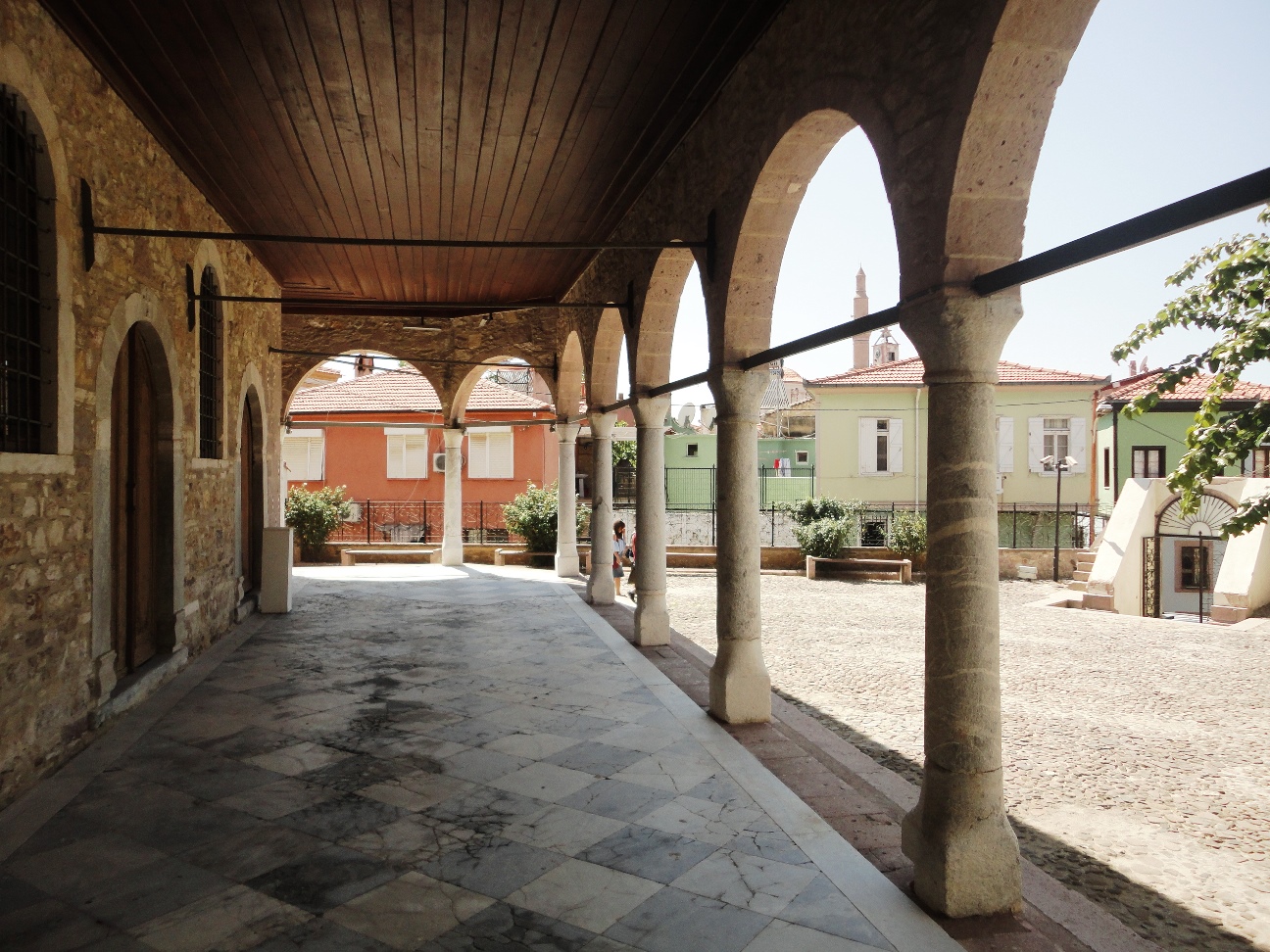
Narthex of the former Taksiyarhis Church (now museum), Ayvalık, Balıkesir, Turkey, August 30, 2018

Continue reading →

NL XXVI: Democracy and Aristocracy

Index to this series

Executive summary (added September 12, 2018, edited January 26, 2019).

  1. Aristocracy and democracy are abstractions (§§26. 1[0]–28). Inseparable from one another, they are properly understood as correlative rules for the ruling class:

    1. Don’t let in anybody who is unqualified.
    2. Don’t keep out anybody who is.
  2. By what Collingwood will call, in Chapter XXXI of the New Leviathan, the Principle of the Limited Objective, (which was recognized by the Early Church Fathers,) the ruling class should be prepared to solve, not every problem (as Plato wanted), but those problems that are expected to come up (§§26. 3[0]–34).

  3. The democratic and aristocratic principles have been at work throughout the history of Europe: in Greece, in Rome, under the feudalism of the Middle Ages. The French Revolution was not only democratic, but also aristocratic, for aiming to give power to the bourgeoisie, not the entire population (§§26. 4[0]–66).

  4. Adapted from the literary concept of peripety, the concept of revolution actually has no place in history, where there are no heroes or villains, just human beings, partly good and partly bad (§§26. 7[0]–82).

  5. The concept of a revolution in history is even dangerous, if it leads you to think a political problem can have been solved once for all (§§26. 9[0]–96).


There can be no pure democracy, not for a length of time, not if we understand a democracy to be a society whose ruling class is the whole of it. Even the most extreme democrat of ancient Greece never contemplated citizenship for women, slaves, or resident foreigners. We may be more liberal today, at least regarding women and slavery. Still we do not open the ruling class to foreigners, such as myself where I am; nor do we open it to children. We could do so, in the sense of extending the franchise to all human residents. Both possibilities were discussed favorably in the early 1990s in The Nation, as I recall, in one case by a legal minor. However, perhaps most children could not be given such adminstrative duties as used to be assigned by lot to Athenian citizens. Even if they could, what of the animals that live among us—shall they be citizens?


Edward Hicks (American, 1780-1849),
The Cornell Farm, 1848, oil on canvas,
Gift of Edgar William and Bernice Chrysler Garbisch,
National Gallery of Art Continue reading →