Tag Archives: Donald J. Brown

Why It Works

The last post, “Knottedness,” constructed Alexander’s Horned Sphere and proved, or sketched the proof, that

  • the horned sphere itself is topologically a sphere, and in particular is simply connected, meaning

    • it’s path-connected: there’s a path from every point to every other point;

    • loops contract to points—are null-homotopic;

  • the space outside of the horned sphere is not simply connected.

This is paradoxical. You would think that if any loop sitting on the horned sphere can be drawn to a point, and any loop outside the horned sphere can be made to sit on the sphere and then drawn to a point, then we ought to be able to get the loop really close to the horned sphere, and let it contract it to a point, just the way it could, if it were actually on the horned sphere.

You would think that, but you would be wrong. Continue reading
What Mathematics Is

Mathematics “has no generally accepted definition,” according to Wikipedia on September 15, 2020, with two references. On September 14, 2023, the assertion is, “There is no general consensus among mathematicians about a common definition for their academic discipline”; this time, there are no references.

I suggest that what really has no generally accepted definition is the subject of mathematics: the object of study, what mathematics is about. Mathematics itself can be defined by its method. As Wikipedia says also (as of either date given above),

it has become customary to view mathematical research as establishing truth by rigorous deduction from appropriately chosen axioms and definitions.

I would put it more simply. Mathematics is the science whose findings are proved by deduction.

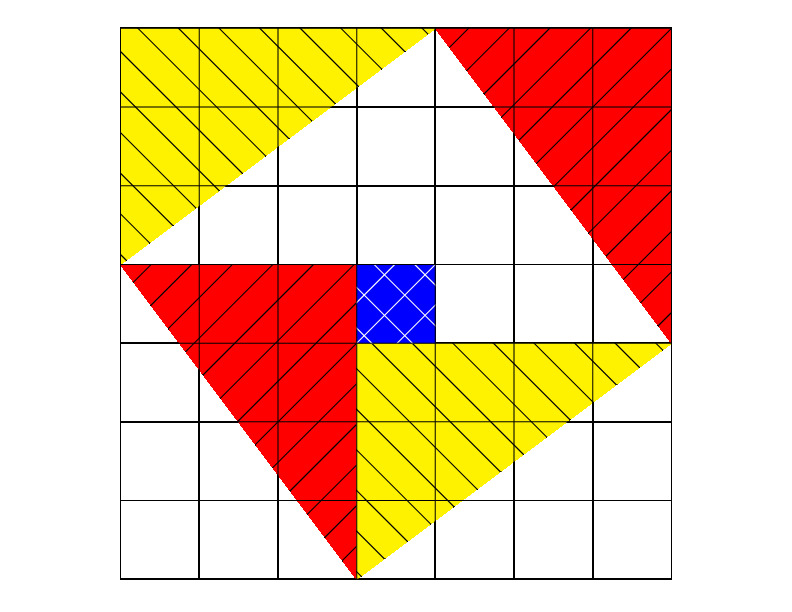
A 7×7 grid of squares, divided into four 3×4 rectangles arranged symmetrically about one square; the rectangles are divided in two by diagonals, which themselves describe a square
The right triangle whose legs are 3 and 4 has hypotenuse 5, because the square on it is
(4 − 3)2 + 2 ⋅ (4 ⋅ 3),
which is indeed 25 or 52. This is also
42 + 32.

Continue reading

Ordinals

This is about the ordinal numbers, which (except for the finite ones) are less well known than the real numbers, although theoretically simpler.

The numbers of either kind compose a linear order: they can be arranged in a line, from less to greater. The orders have similarities and differences:

  • Of real numbers,
    • there is no greatest,
    • there is no least,
    • there is a countable dense set (namely the rational numbers),
    • every nonempty set with an upper bound has a least upper bound.
  • Of ordinal numbers,
    • there is no greatest,
    • every nonempty set has a least element,
    • those less than a given one compose a set,
    • every set has a least upper bound.

Note. Would it be helpful to write that more verbosely?

  • There is no greatest real number.
  • There is no least real number.
  • The set of real numbers has a countable dense subset, namely the set of rational numbers.
  • Every set of real numbers that has an upper bound has a least upper bound.

  • There is no greatest ordinal number.
  • There is a least ordinal number.
  • Indeed,
    • every nonempty set of ordinal numbers has a least element, and
    • the class of ordinals that are less than a given ordinal is a set.
  • Every set of ordinals has a least upper bound.

One can conclude in particular that the ordinals as a whole do not compose a set; they are a proper class. This is the Burali-Forti Paradox.

Diagram of reals as a solid line without endpoints; the ordinals as a sequence of dots, occasionally coming to a limit

Continue reading

On Being Given to Know

  1. What if we could upload books to our brains?
  2. What if a machine could tell us what was true?

We may speculate, and it is interesting that we do speculate, because I think the questions do not ultimately make sense – not the sense that seems to be intended anyway, whereby something can be got for nothing.

Trees, clearings, and houses in the foreground; mountains receding into the background; clouds above
View from Şavşat

Continue reading

Interconnectedness

Note added January 13, 2019. This essay concerns a letter I once wrote about

  • teaching;
  • the infinitely large and small, as contemplated by Pascal in that one of the Pensées headed Disproportion de l’homme;
  • Zen Buddhism.

Since the ideas of Collingwood often dominate this blog, one may ask why they influence me. My old letter provides some evidence, since I wrote it before I had read anything by Collingwood but The Principles of Art.

The present essay has the first of this blog’s several mentions of the slogan

Verba volant scripta manent,

which may not mean what we tend to think today.

Continue reading

Learning mathematics

This is mostly reminiscences about high school. I also give some opinions about how mathematics ought to be learned. The post originally formed one piece with my last article, “Limits.”

I learned calculus, and the epsilon-delta definition of limit, in Washington D.C., in my last two years at St Albans School, in a course taught by a peculiar fellow named Donald J. Brown. The first of these two years was officially called Precalculus Honors, but some time in that year, we started in on calculus proper.

Continue reading

Limits

This is about limits in mathematics: both the technical notion that arises in calculus, and the barriers to comprehension that one might reach in one’s own studies. I am going to say a few technical things about the technical notion, but there is no reason why this should be a barrier to your reading: you can just skip the paragraphs that have special symbols in them.

Looking up something else in the online magazine called Slate, I noted a reprint of an article called “What It Feels Like to Be Bad at Math” from a blog called Math With Bad Drawings by Ben Orlin. Now teaching high-school mathematics, Mr Orlin recalls his difficulties in an undergraduate topology course. His memories help him understand the difficulties of his own students. When students do not study, why is this? It is because studying makes them conscious of how much they do not understand. They feel stupid, and they do not like this feeling. Continue reading