Category Archives: Plato

Mind (Iliad Book XVII)

At the end of Book XVI of the Iliad, Hector

  • pulled his spear from the body of Patroclus,
  • took off in pursuit of Automedon, his victim’s charioteer, who was being drawn by Achilles’s immortal horses.

Around the mossy trunk of a plane tree, four chickens—two white, one brown, one black—scratch in the little dirt that has been left uncovered by the setts that pave a road through a settlement
Postacı Halil Sokağı (Street of Halil the Postman)
Tarabya (Θεραπειά), Sarıyer, Istanbul
Thursday morning, March 2, 2023

Continue reading

Femininity (Iliad Book XIV)

An editor of the Iliad might remove Book XIII, as I said last time; however, the book has

  • its own intrinsic interest, in its portrait of the two brothers, Hector and Paris;
  • a function in Homer’s main story, by showing that Achilles’s labor strike can fail.

The strike can fail through the prowess of scabs. Poseidon encourages crossing the picket line. In Book XIV,

  • Agamemnon worries that not enough men are crossing the line;
  • Hera uses her feminine wiles against the virility of her husband;
  • her brother can now pursue strike-breaking more openly.

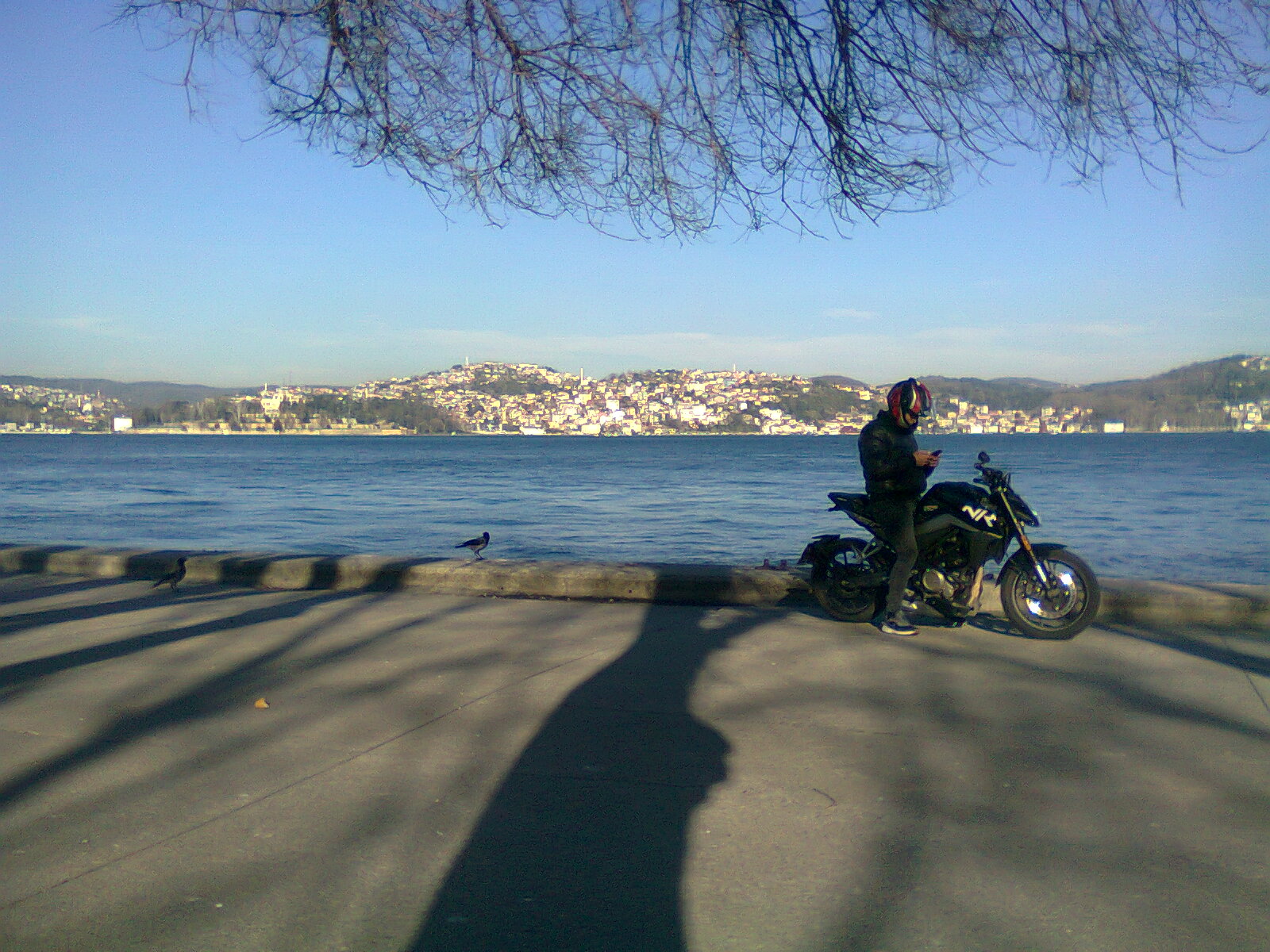
A crow behind him, a helmeted man sits on motorcycle contemplating his mobile while the Bosphorus, and Asia beyond, is to his left At the edge of the Bosphorus, a woman squats to photograph a gull with her mobile

Yeniköy (Νεοχώριον), Sarıyer, Istanbul
Tuesday afternoon, February 21, 2023

Continue reading

On Homer’s Iliad Book I

In Book I of the Iliad, Achilles restrains an impulse to run a sword through Agamemnon.

That may be the greatest act in the whole epic. I say so, having recently completed a reading of Njal’s Saga, which features a lot of impulsive killing. Now I am embarking on the Iliad again, a book at a time. Here I take up Book I, some comparisons with the saga, and some connections with Plato, Augustine, and Collingwood.

I wrote here about Homer’s epic, book by book, between April, 2017, and September, 2019. I was reading Chapman’s Elizabethan translation. In my account of Book I from then, there are details that do not otherwise stand out to me now, when

  • I am reading mainly Murray’s translation in the Loeb Classical Library, and
  • comparisons with Njal’s Saga are in mind.

Bench on concrete wharf, looking out across a bay to the hills beyond; coast guard vessel in view
Sarıyer, Istanbul (European side)
Loeb Iliad, volume I
November 25, 2022

Continue reading

The Ideal

The noun “idea” came to English in the sixteenth century, via Latin, from Plato’s ἰδέα: so the dictionaries tell me. An older version, “idee,” came from the French idée. The adjective “ideal” came via the French idéal from the Latin ideālis, but this seems to have been a native coinage, derived from no Greek term. Leo Strauss corroborates this in a passage that I quoted in “Nature”: “ ‘ideal’ is not a Platonic term.” Nonetheless, in translations of the Republic that are still in print, Benjamin Jowett and Paul Shorey use the word “ideal.” This may blur the distinction between two activities:

  • Making something, such as a meal or a bookshelf, according to a recipe or plan.
  • Creating something brand-new.

I looked at the first creation myth of Genesis in my previous post, whose title quoted the Bible on God’s judgment of what he had created: “It Was Good.” The goodness of the world, I suggested, did not lie in its fitting a plan, since a plan would have had to be spoken into existence, and this is just how the world itself came to be.

I don’t know about God, but if we have a basis for calling something good, we might call this basis an ideal. However, I also don’t know whether this is what Plato actually has in mind when his translators use the term “ideal.”

Bookshelves on one wall, window on another
Hacıosman, Tarabya, Sarıyer, İstanbul
November 12, 2022

Continue reading

Creativity

In the Platonic dialogues, Socrates frequently mentions τέχνη (technê), which is art in the archaic sense: skill or craft. The concern of this post is how one develops a skill, and what it means to have one in the first place.

Books quoted or mentioned in the text, by Midgley, Simone Weil, Thoreau, Amy Mandelker (on Tolstoy), Oliver Byrne (on Euclid), Wittgenstein, Arendt, and Caroline Alexander (on Homer)

Continue reading

Plato and Christianity

Index to this series

This post uses work of Hannah Arendt, Augustine, R. G. Collingwood, Tom Holland, Somerset Maugham, and Ved Mehta.

Elevated highway, way above city streets

Ortaköy, December 27, 2021

In the first post of this series, I gave some reasons to read the Republic, and one of them was the problem of how our political leaders were not always the best. Plato had not solved that problem, since we still had it; but that meant nobody else had solved it either. Plato had at least taught us that people with great worldly power could nonetheless be more miserable than their subjects. In the Republic, Plato has Socrates teach that lesson

  • to Thrasymachus, in the latter part of Book I;
  • to Glaucon, who concludes at the end of Book IV that if having an unhealthy body is bad, having a vicious soul is worse;
  • in Book IX, with the account of the tyrant;
  • with the Myth of Er in Book X.

Continue reading

On Reading Plato’s Republic

Index to this series

In adolescence, when I started visiting art museums in Washington for my own pleasure, I would visit also the museum shops, hoping to be able to take home a souvenir. Eventually, my own memories were enough to take home.

That is what I remember observing about myself, perhaps around the time when my body stopped growing taller. That time may be used to demarcate adulthood, although in kindergarten, it had made no sense to me that our bodies could ever stop growing.

Cycad with seeds
Cycads outside Selenium Twins
in the valley above Ihlamur Kasırları
on the way to Beşiktaş
December 27, 2021

I have not been to a museum since the advent of Covid-19, but I often want a souvenir when I am reading now. The souvenir may be in the form of pencil marks in a book, or pen marks in a magazine, or various interventions in an electronic file. To be able to make such interventions, I save webpages, usually with a browser’s print function or with Print Friendly.

I may also respond to what I read by writing blog posts. This is why I now have eighteen of those on Plato’s Republic: one for each of the fourteen parts in which the dialogue was divided for an online discussion, and four more for when I had an abundance of ideas.

Where has all of that left me?

Continue reading

On Plato’s Republic, 14

Index to this series

In the tenth and final book of Plato’s Republic (Stephanus 595–621), with the help of Glaucon, Socrates does three things:

  1. Confirm and strengthen the ban on imitative poetry carried out in Book III.
  2. Prove the immortality of the soul.
  3. Tell the Myth of Er about how best to make use of that immortality.

Engraving of head and torso of man at sea. Bearded, he holds a bunch of plants to his right jaw as he looks over his left shoulder towards a net on land. A sort of fish tail is behind him or part of him
Bernard Picart
Glaucus Turned into a Sea-God, 1731
Continue reading

On Plato’s Republic, 13

Index to this series

We reviewed the five kinds of polity and soul in Book VIII of Plato’s Republic, but we didn’t get to the tyrannical soul. We take that up now in Book IX (Stephanus 571–92). We also make three arguments for why the tyrant has the least pleasant life. Finally, in order to pursuade Thrasymachus that indeed injustice is never profitable, we introduce a new chimerical image of the soul.

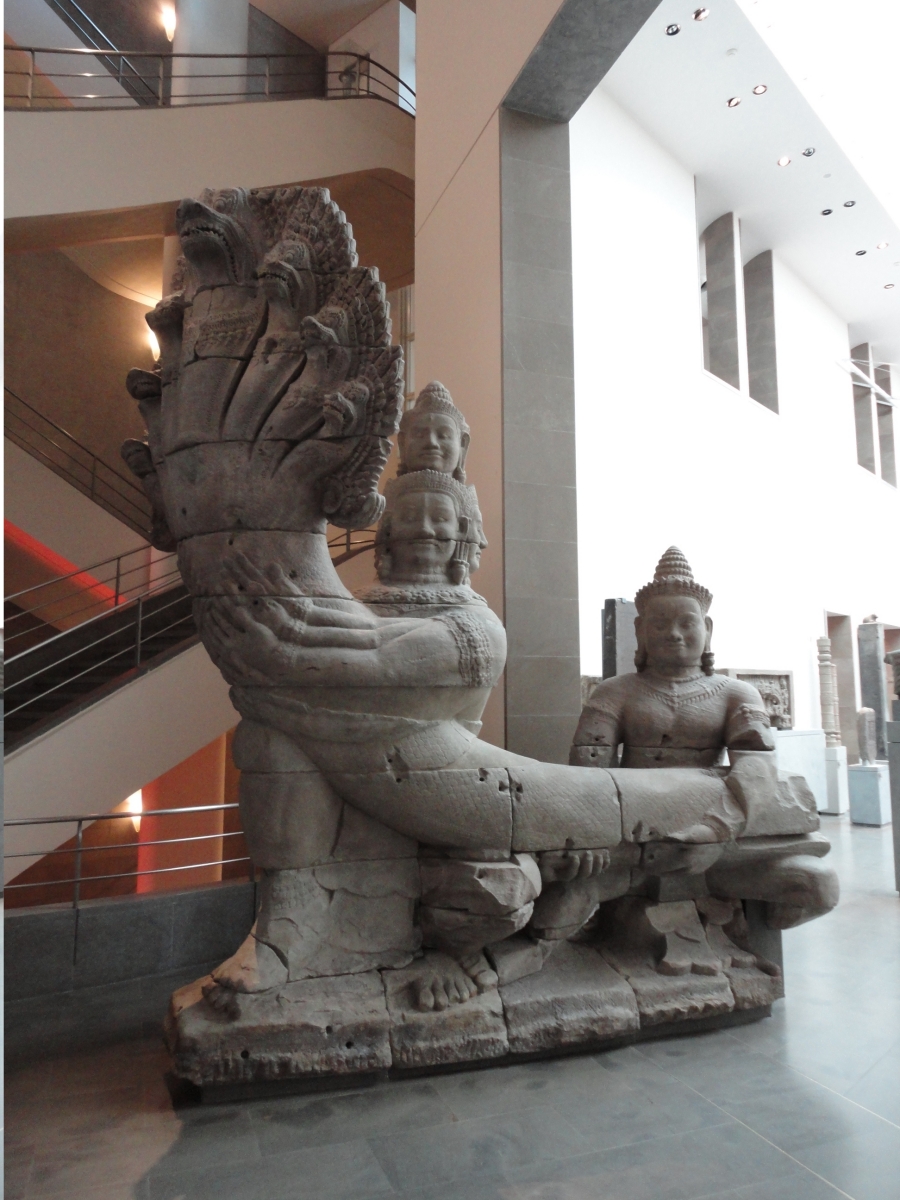
Many-headed man and and another man hold a many-headed serpent
« Chaussée des géants »
Cambodge, Preah Khan, Angkor (province de Siem Reap)
fin du 12e siècle – début du 13e siècle
Musée Guimet, Paris
June 4, 2011

Continue reading

On Plato’s Republic, 12

Index to this series

We have completed the long detour of the Three Waves. In Book VIII of Plato’s Republic (Stephanus 543–69c), we return to the degeneration of the polity and the soul.

Rooster facing the sun at the top of a stairway
Freely ranging rooster
Çetin Emeç Park, Beşiktaş, Ιstanbul
November 22, 2021
Born in 1935, journalist Çetin Emeç was assassinated in 1990

Continue reading