They say the new Odyssey film leaves out all of the gods but Athena.
How would we know?
It’s not a matter of checking the credits or just watching the movie (though I have not seen it).
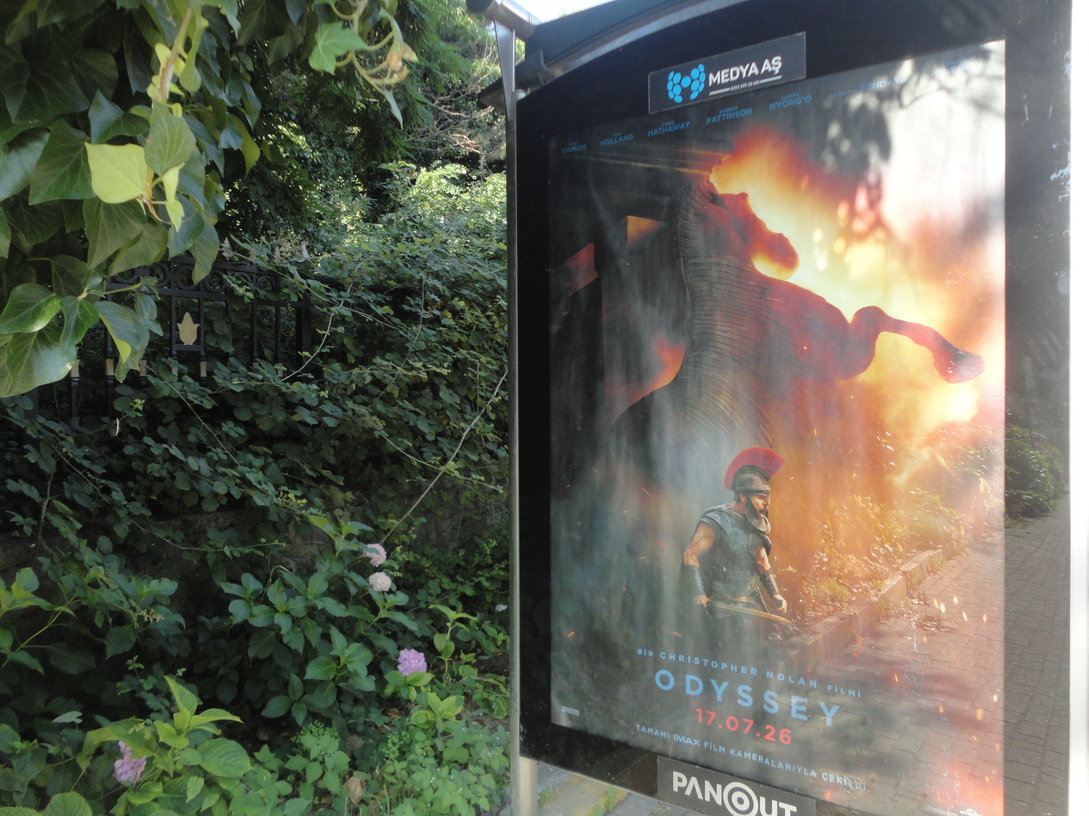
The film was advertised on a bus shelter
near our flat in Tarabya
July 20, 2026
Turkish Caption:
Bir Christopher Nolan Filmi
Odyssey
17.07.26
Tamamı Imax film kamaralarıyla çekildi
(Some documentation about absence of gods
is in a footnote)
In the first book of the epic of Homer called Odyssey, Telemachus is visited by Athena – in the form of a man called Mentes.
It is often that way with gods: we may not recognize them as such.
No character called Mentes is listed in the credits for Christopher Nolan’s film.

The bus shelter with the poster above
and standing just outside the Atatürk City Forest
July 20, 2026
I was met by gods during a bicycle trip in 1995.
I had left from my group house in Washington on Tuesday morning, June 27. I pedalled a hundred seven miles to my uncle’s house in West Virginia, a few miles south of US route 50, west of Capon Bridge. Nobody else was at the house. I stayed two nights. Then I continued west on US 50, up and down, up and down through the Mountain State:
- ninety-five miles on Thursday, to an unincorporated community called Fellowsville;
- a little over a century on Friday, to Parkersburg on the Ohio River.
In Fellowsville, I camped in a churchyard with the permission of the pastor next door. In Parkersburg, I took a hotel room; I had pains in my right knee and my left Achilles tendon.
On Saturday, I rode into the flatland of the State of Ohio. I made about 50 miles before deciding that my knee hurt too much. Before I could actually give up, a local cyclist came up to me and encouraged me to keep going – slowly for a while, after putting ice on the knee.
We were just outside the city of Athens. My fellow cyclist also suggested ibuprofen, which is what he might take after a tough workout. That’s what I remember, but I don’t seem to have written it in my log book. (I drew on a similar log book for “Cumberland Tour 1994.”) I did write down that the fellow was a triathlete and had gone to fight in Vietnam at the tail end of the war.
He could have been Hermes, guiding Priam to retrieve the body of his son from the man who had killed him.
In The Silence of the Girls (2018), Pat Barker describes the events of the Iliad from the point of view, sometimes of Briseis, sometimes of an omniscient narrator in the Greek camp. Here is how the visit of the Trojan king looks:
Priam’s weeping now, swift, silent tears coursing down his cheeks and disappearing into the white beard. “Achilles.”
“You don’t need to keep saying that, I know who I am.” Does he? He’s so thrown by this, he’s not sure he does any more. “I asked you a question. How did you get in?”
“I don’t know. Guided, I suppose.”
“By a god?”
“I believe so.”
“Huh! Really? You didn’t bribe the guards?”
“No, nothing like that.” Priam sounds surprised he should even think it. “I heard what you said when I came in.”
“I didn’t say anything.”
“You did; you said, ‘Father.’ ”
By the account of Homer, reviewed in my own post on Book XXIV, Priam has indeed tried to bribe one of the Myrmidons.
Why would Achilles’s soldier be out wandering between the Greek camp and Troy at night? He says the Achaeans are preparing for battle on the morrow. He also says he is at the war, only by chance: one of the seven sons of Polyctor was going to have to go to Troy, and the lot fell to the youngest. There is nothing personal about the war for him.
From the ransom being brought to Achilles, Priam offers a two-handled cup, if the youngest son of Polyctor will lead the way to the tent of Achilles. The man does not take the gift, but guides Priam anyway. He turns out to have been Hermes, but Priam did not know that – or else he knew that anybody could be a god.
Later in my 1995 bicycle trip, another god appeared to me, when I was heading north out of Port Huron, Michigan. Thunderstorms were going to strike, but I didn’t know; I had just started noticing that I didn’t really need my sunglasses. Then another cyclist came alongside and invited me to take shelter at his house.
Somewhere along the road in West Virginia, there had been a sign:
Jesus is coming, ready or not.
Was this a friendly warning, or a taunt?
My usual response to beggars turns out to be shared by a friend.
There were quite a few beggars in Istanbul in the earlier years of the Syrian Civil War. I did not give them anything. Now there are Palestinian refugees in Yerevan, by the account of Nareg Seferian in “Vignettes on continuity and change in Yerevan” (Armenian Weekly, July 17, 2026; there is a link from Nareg’s blog):
I grew up in a society where begging was widespread and often a racket. It’s rare that I can bring myself to give money to strangers on the street. I am always wary, and in a city like Yerevan, I imagine I most likely will run into the same people – as I have over the years come across those who tell the same story and try to sell the same scam. Now, I didn’t know this family at all or whether they were running a scam. But all the same, I couldn’t bring myself to help them.
It breaks my heart every time.
I did once give some coins to a Syrian man whom I had met in Beşiktaş. He asked about getting a job at my university. I don’t remember what his qualifications were. He knew English, which is what we were talking in, but instruction at my university was in Turkish. He finally asked sheepishly if I could help him get something to eat.
I didn’t want to get out my wallet. The coins in my pocket became like that dime in the poem we read in ninth grade with Stanley Willis:
Christmas was in the air and all was well
With him, but for a few confusing flaws
In divers of God’s images. Because
A friend of his would neither buy nor sell,
Was he to answer for the axe that fell?
He pondered; and the reason for it was,
Partly, a slowly freezing Santa Claus
Upon the corner, with his beard and bell.Acknowledging an improvident surprise,
He magnified a fancy that he wished
The friend whom he had wrecked were here again.
Not sure of that, he found a compromise;
And from the fulness of his heart he fished
A dime for Jesus who had died for men.
Thus Edwin Arlington Robinson, “Karma,” from Dionysius in Doubt (1925).
In the Sermon on the Mount, Matthew 5, Jesus gives a command that I often do not obey:
42 Give to him that asketh thee, and from him that would borrow of thee turn not thou away.
There seems to be a precedent for this in Hebrew scripture; however, I learn this, neither from the New Oxford Annotated Bible (edited by May and Metzger, 1973), nor from the Greek New Testament (edited by Aland et al., 4th revised edition, 11th printing, 2006), although these Bibles generally give many cross-references. It is the 1769 Oxford edition of the King James Bible, as transcribed on Wikisource, that connects Matthew 5:42 to Deuteronomy 15:
7 If there be among you a poor man of one of thy brethren within any of thy gates in thy land which the LORD thy God giveth thee, thou shalt not harden thine heart, nor shut thine hand from thy poor brother:
8 But thou shalt open thine hand wide unto him, and shalt surely lend him sufficient for his need, in that which he wanteth.
11 For the poor shall never cease out of the land: therefore I command thee, saying, Thou shalt open thine hand wide unto thy brother, to thy poor, and to thy needy, in thy land.
Listeners are told to care for people in their land. Such people are neighbors, I would say, and they feature in the Parable of the Good Samaritan in Luke 10:
25 And, behold, a certain lawyer stood up, and tempted him, saying, Master, what shall I do to inherit eternal life?
26 He said unto him, What is written in the law? how readest thou?
27 And he answering said, Thou shalt love the Lord thy God with all thy heart, and with all thy soul, and with all thy strength, and with all thy mind; and thy neighbour as thyself.
28 And he said unto him, Thou hast answered right: this do, and thou shalt live.
29 But he, willing to justify himself, said unto Jesus, And who is my neighbour?
30 And Jesus answering said, A certain man went down from Jerusalem to Jericho, and fell among thieves, which stripped him of his raiment, and wounded him, and departed, leaving him half dead.
31 And by chance there came down a certain priest that way: and when he saw him, he passed by on the other side.
32 And likewise a Levite, when he was at the place, came and looked on him, and passed by on the other side.
33 But a certain Samaritan, as he journeyed, came where he was: and when he saw him, he had compassion on him,
34 And went to him, and bound up his wounds, pouring in oil and wine, and set him on his own beast, and brought him to an inn, and took care of him.
35 And on the morrow when he departed, he took out two pence, and gave them to the host, and said unto him, Take care of him; and whatsoever thou spendest more, when I come again, I will repay thee.
36 Which now of these three, thinkest thou, was neighbour unto him that fell among the thieves?
37 And he said, He that shewed mercy on him. Then said Jesus unto him, Go, and do thou likewise.
One could read the parable like this. Let the class of people whom you help be A, and let the class of your neighbors be B. According to scripture, A should include B. According to Jesus, B automatically includes A, and therefore the two classes should be the same.
One could also just say that the point is to be neighborly, in the best sense. I guess this is what Robert Frost is musing on in Mending Wall:
Something there is that doesn’t love a wall,
That sends the frozen-ground-swell under it,
And spills the upper boulders in the sun;
And makes gaps even two can pass abreast.
The work of hunters is another thing:
I have come after them and made repair
Where they have left not one stone on a stone,
But they would have the rabbit out of hiding,
To please the yelping dogs. The gaps I mean,
No one has seen them made or heard them made,
But at spring mending-time we find them there.
I let my neighbor know beyond the hill;
And on a day we meet to walk the line
And set the wall between us once again.
We keep the wall between us as we go.
To each the boulders that have fallen to each.
And some are loaves and some so nearly balls
We have to use a spell to make them balance:
‘Stay where you are until our backs are turned!’
We wear our fingers rough with handling them.
Oh, just another kind of out-door game,
One on a side. It comes to little more:
There where it is we do not need the wall:
He is all pine and I am apple orchard.
My apple trees will never get across
And eat the cones under his pines, I tell him.
He only says, ‘Good fences make good neighbors.’
Spring is the mischief in me, and I wonder
If I could put a notion in his head:
‘Why do they make good neighbors? Isn’t it
Where there are cows? But here there are no cows.
Before I built a wall I’d ask to know
What I was walling in or walling out,
And to whom I was like to give offense.
Something there is that doesn’t love a wall,
That wants it down.’ I could say ‘Elves’ to him,
But it’s not elves exactly, and I’d rather
He said it for himself. I see him there
Bringing a stone grasped firmly by the top
In each hand, like an old-stone savage armed.
He moves in darkness as it seems to me,
Not of woods only and the shade of trees.
He will not go behind his father’s saying,
And he likes having thought of it so well
He says again, ‘Good fences make good neighbors.’
Jesus went behind his father’s saying.
Frost didn’t like poems to be read in school; at least, I quoted Robert Graves to this effect in “Some Say Poetry,” where I also talked about having to read Frost in eighth grade. We discussed “Mending Wall” in class, or at least our teacher Stephen Bowers talked to us about it. What was it, he asked, that didn’t love a wall, that sent the frozen-ground-swell under it? Frost!
“Oh, that’s just an accident,” somebody said.
“Don’t be so sure” – that’s how I remember the response.
That’s also what freshmen got told at St John’s College, when they said nobody believed in those old Greek gods anymore.
I can note some places in the Odyssey where being neighborly is urged. Having been appealed to by a naked man with a fig-leaf over his privates, Nausicaa tells her companions (6.207f.),
All foreigners and beggars come from Zeus,
and any act of kindness is a blessing.
Later (7.159–67), up in the palace, the girl’s father is told by Echeneus, “an elder statesman of Phaeacia,”
you know it is not right to leave a stranger
sitting there on the floor beside the hearth
among the cinders. Everyone is waiting
for you to give the word. Make him get up,
and seat him on a silver chair, and order
wine to be poured, so we may make libations
to Zeus the Thunderlord, who loves the needy.
The house girl ought to bring the stranger food
out from the storeroom.
out from the storeroom. So Alcinous
Odysseus having been fed (7.178–82),
Majestic King Alcinous addressed
Pontonous, the wine boy.
Pontonous, the wine boy. “Go and mix
a bowl and serve the wine to all our guests,
so we may offer drink to thundering Zeus
who blesses those in need.” The boy mixed up
My last example (there may be more) starts with the most annoying of the suitors for the hand of Penelope (17:477–87).
He answered, “Stranger, shut up, or be off!
If you keep talking, we young men will drag you
across the palace by your hands and feet
and have you flayed alive!”
and have you flayed alive!” But all the others
reproached Antinous insistently.
“You ought not to have hit a poor old beggar!
If he turns out to be a god from heaven
it will end badly! Gods disguise themselves
as foreigners and strangers to a town,
to see who violates their holy laws,
and who is good.”
and who is good.” Antinous ignored
If it is not clear, I add the words in gray to complete Wilson’s lines, since they are meant to have five beats each, as I understand. If there were rhyming couplets, I would complete each of these in gray, as in a post I was recently reviewing, “On Chapman’s Homer’s Iliad, Book IX.”
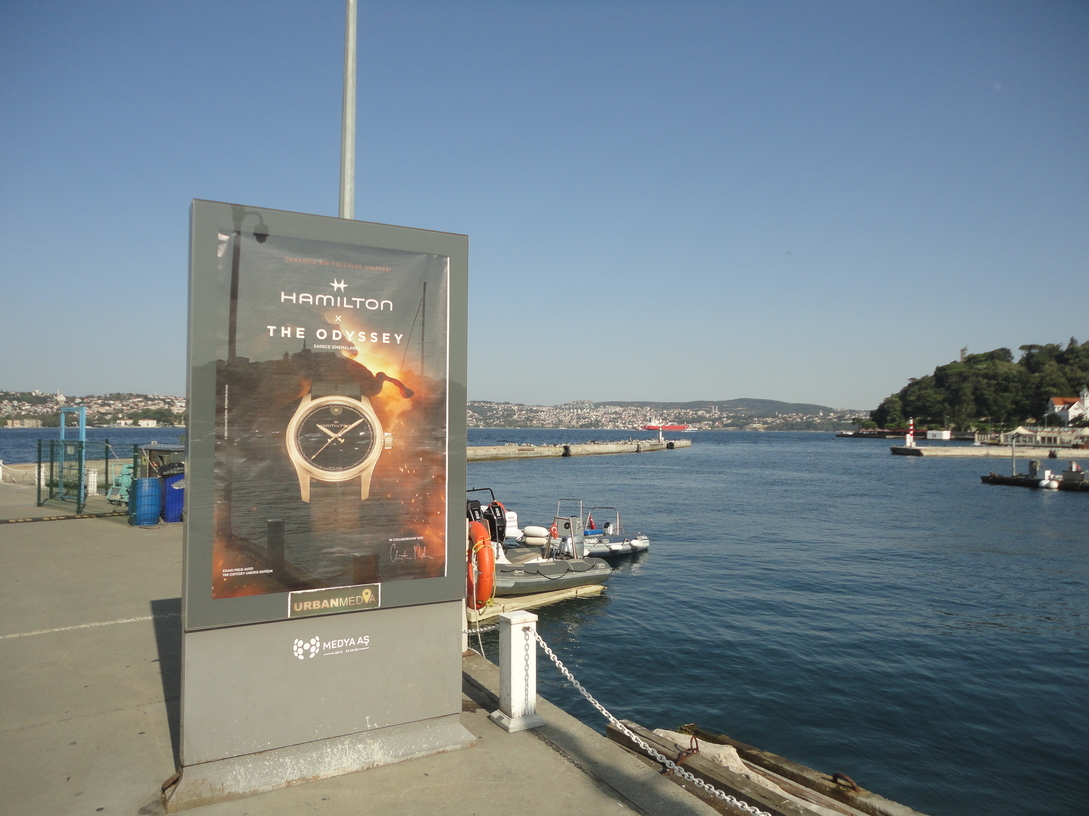
The poster shown earlier was gone after a week
but I found this one, for a wristwatch, down by the harbor
July 22, 2026
Odysseus travelled far
but not this way
which is almost to the Black Sea
Note
The absence of gods has been complained about on the former Twitter. Charlotte Higgins notes it “Christopher Nolan has made an Odyssey for our times – by sacrificing the delicious darkness of Homer’s epic” (The Guardian, July 25, 2026):
Because [Nolan] has removed the Olympian gods from any meaningful role in the film, we miss a blissful moment in which the divine Calypso (played by Charlize Theron) rails to the god Hermes against the sexual double standard (it’s OK for gods to have sex with mortal women, she complains, but not for goddesses to sleep with men). The relationship between Zendaya’s Athena and Damon’s Odysseus lacks the flirtatious spark that’s so enjoyable in the poem.
Higgins observes also that not even Nausicaa is in the film.


2 Comments
I much enjoyed this account of meeting God along the way. Something about the cycling incidents reminded me of the film “The straight story” and (less precisely) the book “The river Why”. Useful thoughts to have in mind before we see the new film (which is on our to-do list).
Apologies – the technology confused me! Not anonymous – this is Tom Ward!