As I understand Western music, there’s a diatonic scale, whose notes correspond to seven consecutive white keys of a piano. The eighth white key (from the left) is an octave above the first. The terminology makes some sense, since an octopus has eight arms, and an octagon has eight sides.
Between two white piano-keys that are an octave apart, there are five black keys. When their notes are added to the diatonic scale, the chromatic scale results.
Perhaps I was given some such understanding in school. It was never quite satisfactory. In part to remedy this problem, I have drafted a paper, “Numbers and Notes in Plato and Euclid,” for which this blog post is now a repository. (The pdf file just linked to has 103 pages, but they are small, size B6; the date is September 22, 2026.)
The draft paper may explain itself, sufficiently well. Its most interesting element may be a black-and-white version of the following diagram, which I am also going to say more about in this post.
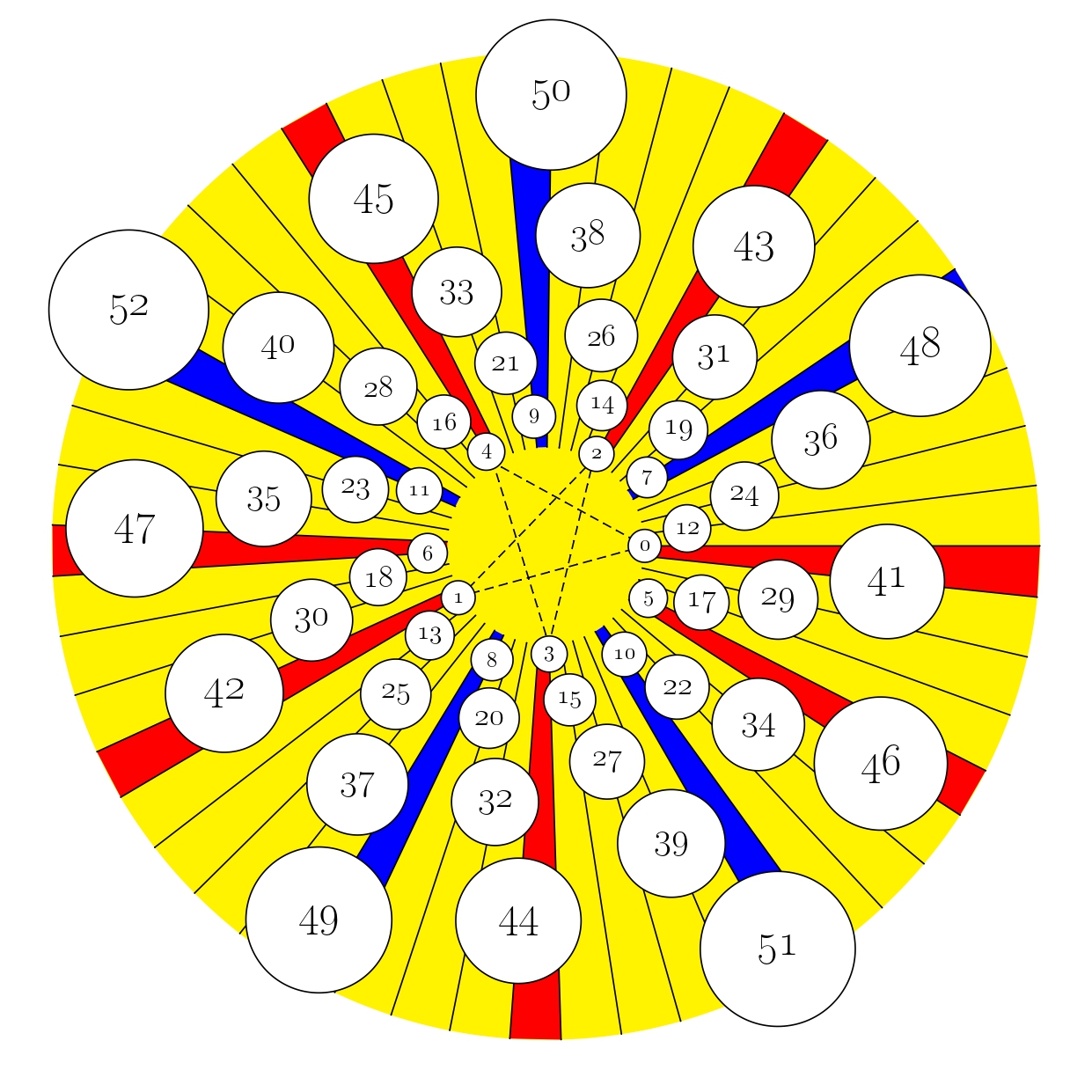
I created the image here with pstricks, pst-eucl, multido, and LaTeX. I converted to ps format with dvips, then pdf format with ps2pdf. After that, I converted to jpg format with ilovepdf.com, since the resolution obtained with convert in my own computer was not great. The figure is drawn within a square whose side is the width of A4 paper; click on the image to get the full version.
In the draft paper, I tried to keep everything simple – musically speaking, at least. I quote some words and passages in Greek, but you need only tolerate seeing them; you need not know the language. You need tolerate almost no modern musical notation; I am pretty ignorant of it myself, which again is part of why I am writing.
Well, OK, in college, I did learn to play what I have remembered as “Bach’s first prelude,” and I sang in a performance of Beethoven’s Choral Fantasy. But one can play and sing music without any theory.
The closing section of my draft paper is pretty dense. For the sake of explaining things like the diagram above, I develop the theory of continued fractions, as concisely as I can. This is a subject that I didn’t know anything about, until I taught the undergraduate elective course Number Theory II at Middle East Technical University in Ankara in 2008. The theory seems as if it ought to be simple, but it’s not. I develop it by means of matrices, and I don’t know whether I learned to do this from somewhere else.
I am not trying to post my draft on arXiv. Since I had posted papers there in the past, I used to think I could go on doing so. Then I tried to post a draft of the paper “On Gödel’s Incompleteness Theorem.” This was ultimately published, with DOI 10.5642/jhummath.KSPX8939, in July of last year (which was 2025). Nonetheless, on March 10, “arXiv Moderation Support” had written me,
Our moderators determined that your submission does not contain sufficient original or substantive scholarly research and is not of interest to arXiv.
The moderators could make the same objection to my new draft. I began it, by way of organizing some notes I had made on
- the Sectio Canonis (“division of the monochord”) of Euclid, back in 2018;
- the Timaeus of Plato, last year during a Catherine Project reading.
Then I started learning more; however, expressed as theorems, everything was already known by others.
For example, there is a mathematically nice way to keep adding keys to the piano, within octaves, so as to obtain a scale of fifty-three notes. This is what is depicted in the diagram above, where the fifty-three notes are shown as lines radiating from a center.
The notes of the diatonic scale correspond to the red strips; the additional notes of the chromatic scale, the blue strips. Those blue strips alone show a pentatonic or five-note scale, as do the five initial notes, joined by a dashed pentagram in the middle.
What I have drawn would seem to be a variant of the “circle of fifths.” I call my figure a spiral of fifths; however, whether with DuckDuckGo or Google, a search on that term has not turned up such an image as mine.
Note added September 23, 2026. Perhaps the connection with the usual circle of fifths is not so clear. In the diagram, the numerical labels represent numbers of fifths above the starting note. The corresponding circle of fifths might then be as on the left below, where, strictly, the “circle” is drawn as a convex regular dodecahedron.
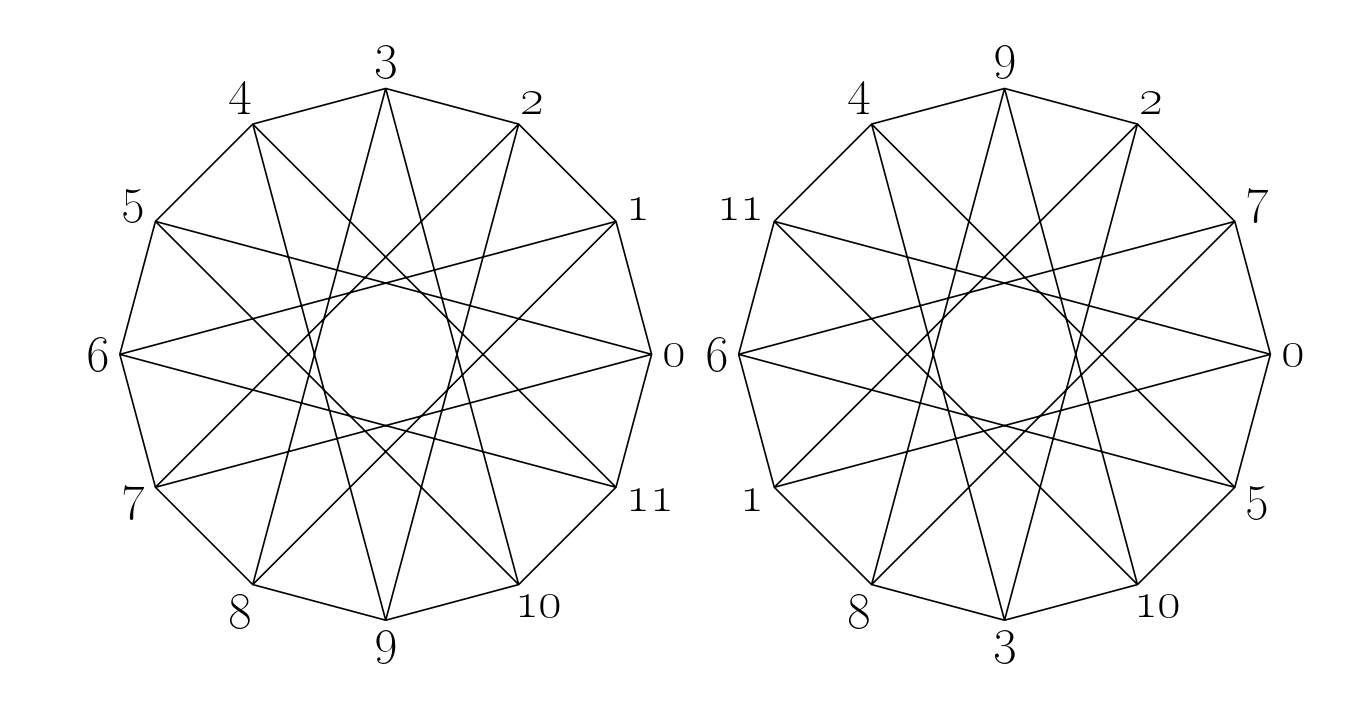
When those fifths are brought down to the same octave, their order is from 0 to 7 to 2, and so on, as indicated by the sides of the inscribed self-intersecting dodecahedron, which is also regular. We can also interchange the two dodecahedra, to get the figure on the right, where the numbers around the outside are in the order found in the big diagram of 53 notes.
It doesn’t always happen that the figures are the same after the interchange. Here is what happens when we use only the seven notes of the diatonic scale.
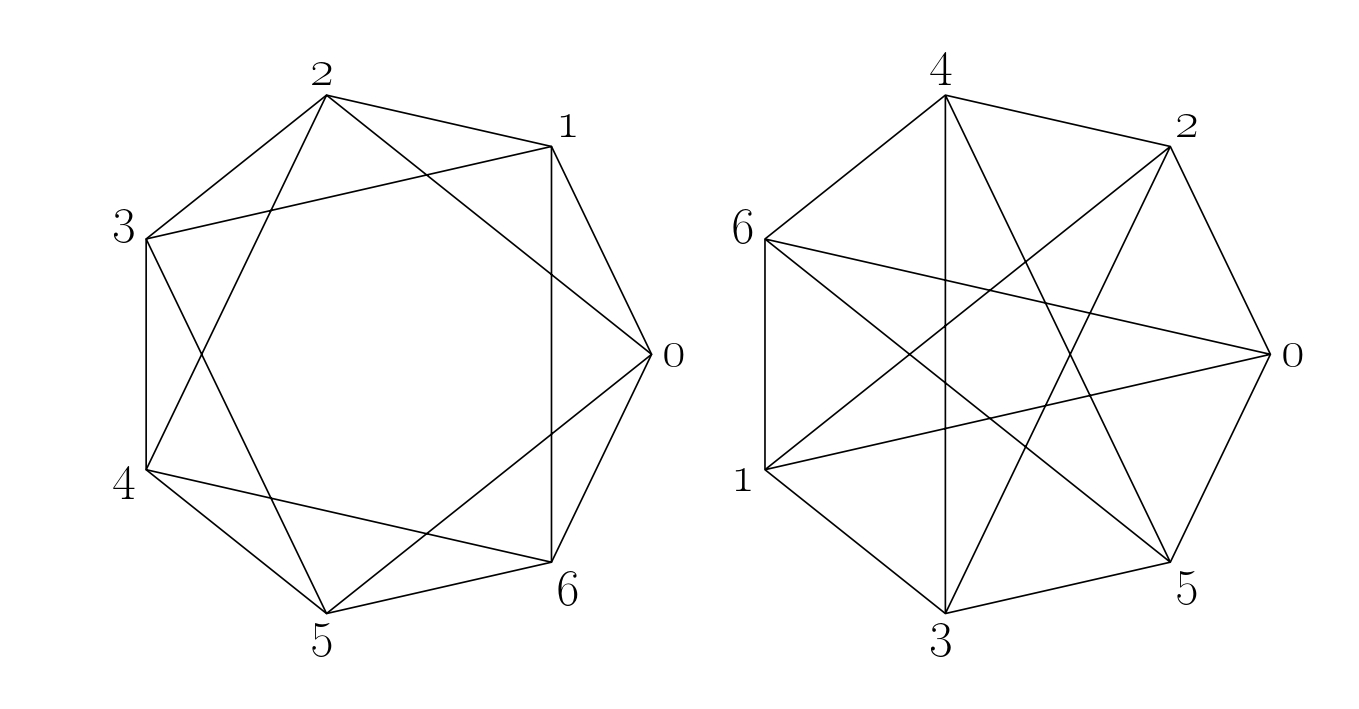
The point is that when one of the polyhedra is regular, so is the other. This is called “symmetry” by Carey and Clampitt in “Aspects of Well-Formed Scales” (2012; DOI 10.1080/17459737.2012.679028).
The idea of the spiral seems simple now. However, when I saw it, more than a year had passed since the time when I could now wish I had seen it. That time was when I was reading the Timaeus, where musical scales are constructed.
Note added September 23, 2026. I talked more about that reading of the Timaeus in “Astronomy Anomaly.” The anomaly in question was the failure of the circle of fifths to close precisely after twelve of them. This is shown in the diagram above, where radial line 12 is not the same as line 0. Lines 1, 2, 5, 12, and 41 approach line 0 from alternate sides. Line 53 would fall between lines 0 and 12. The next in the sequence would be line 306, between lines 0 and 41. The numbers here form A005664 in the On-Line Encyclopedia of Integer Sequences.
If we start with unity, triple it, then halve the result, we get the fraction 3/2, lying between 1 and 2. Tripling that fraction, then halving twice, we get 9/8 between 1 and 2. Tripling again and halving gives us 27/16, and so forth. The first six fractions produced that way, along with 1 itself, correspond to a diatonic scale; five more fractions give a chromatic scale.
One can think that the numbers represent frequencies. With frequencies, doubling means going up an octave, and on a piano, that means moving a fixed distance to the right. What if we take doubling to mean circling some center once? Then tripling also means circling – not once, not twice, not once and a half, but a little more than that: log 3/log 2 times, or about 1.58. To show that we are circling, for each time around, we can move further away from the center by some factor that suits our convenience. In the actual diagram, the factor is 51/84, or about 1.02; that means circling 84 times gets us 5 times further away from the center.
Note added September 23, augmented September 24, 2026. We want to circle the center 84 times, because 353 ≈ 284, equivalently, 53 log 3 ≈ 84 log 2. Indeed, 1200 log2(353/284) ≈ 2.506; that is, 53 fifths exceed 31 octaves by only about 2 cents and a half.
A device for playing the 53-note scale was apparently created by R.H.M. Bosanquet, as noted by H.L.F. von Helmholtz in Sensations of Tone (on page 328 of the English edition). There is a photograph of Bosanquet’s Enharmonic Harmonium on the website of the Science Museum Group; however, the instrument is described there as
Enharmonic harmonium with 4 1/2 octaves tuned in 53 equal temperaments with 84 keys per octave …
Eighty-four keys per octave would seem to mean an 84-note scale. Well, that doesn’t mean that 53 of those notes are not equally spaced. In my diagram, they are almost equally spaced.
Bosanquet’s instrument is discussed by Dave Benson in Music: a Mathematical Offering, in the section called “Fifty-three tone scale.” Benson gives an arrangement of the 53 notes in a “torus of thirds and fifths.”
Note added September 24, 2026. As I understand, in notes numbered as in my diagram, that torus is formed as follows, where the array repeats in all directions:
| 0 | 1 | 2 | 3 | 4 | 5 | 6 | 7 | 8 | 9 |
| 9 | 10 | 11 | 12 | 13 | 14 | 15 | 16 | 17 | 18 |
| 18 | 19 | 20 | 21 | 22 | 23 | 24 | 25 | 26 | 27 |
| 27 | 28 | 29 | 30 | 31 | 32 | 33 | 34 | 35 | 36 |
| 36 | 37 | 38 | 39 | 40 | 41 | 42 | 43 | 44 | 45 |
| 45 | 46 | 47 | 48 | 49 | 50 | 51 | 52 | 0 | 1 |
| 1 | 2 | 3 | 4 | 5 | 6 | 7 | 8 | 9 | 10 |
Moving to the right usually means a rise in pitch by a perfect fifth, ratio 3:2; moving down, a Pythagorean augmented second, ratio 39:214. Thus moving diagonally up and right means a rise in pitch by a Pythagorean diminished fourth, ratio 213:38. In equal temperament, those last two intervals are counted as minor and major third, respectively. The actual intervals, in our scale, once in 53 times, must be decreased in the ratio of 353:284.
In my draft paper, since Plato and Euclid didn’t have the piano, I avoid talking about it, except to say that I am avoiding it.
In music class at school, there was a piano in the room. I remember the teacher’s playing a chord – several notes at once – and then having us sing the same notes in succession. If an octave of white keys are assigned the code letters C, D, E, F, G, A, B, and C′, I think we were singing C, E, G, C′, G, E, C. This would mean singing
- A tonic.
- A third above the tonic.
- A fifth above the tonic.
- An octave above the tonic.
- Then back down.
However, the teacher would change the tonic. If thirteen keys, black or white, are numbered in succession from 0 to 12, then I think we were singing 0, 4, 7, 12, 7, 4, 0. We were not told that we were doing this; we were just asked to sing.
In a later year, we were taught some of the terminology. For example, the notes given as letters above constitute a major scale. The interval between C and E is more precisely a major third; between E and G, a minor third. They are different, because most of the intervals between consecutive notes are whole steps, but between E and F and between B and C′, they are half steps.
That irregularity was never explained, at least not in such a way that I have retained an understanding of it. We had no textbook. This is disappointing, now, especially since, in the next year, the same teacher taught us algebra, and our first assignment was to summarize the introductory sections of the textbook (which was Weeks and Adkins, First Course in Algebra).
Perhaps the point of music is to feel it, not theorize about it. However, when reading is taught with such an attitude, apparently students don’t learn to read very well. At least, that is what I understand, most recently from a remark by Hollis Robbins in “Aristotle and AI” (September 12, 2026):
What does a young person born around 2006 know about language as a corpus? A lot less than people born before the internet. Many college students learned to read by a now discredited method called three-cueing, told to figure out unfamiliar words by looking at a picture and the first letter, guessing what made sense.
In music class in school, if I could have been told that an octave represented the ratio of 2 to 1, and a fifth the ratio of 3 to 2, and everything else came from this, so that when we sang, we were singing numbers – then maybe I would not have had to draft the paper linked to above.
Or maybe I was told, but in some perfunctory way that left no impression.
Note added September 23, 2026. Apparently because I wrote above, “That irregularity was never explained,” a friend offered an explanation in terms of how certain chords make us feel. One can still ask why they do this. A physiological or psychological explanation might be possible. I have been investigating here a mathematical explanation, whereby (with T = tone and S = semitone) we get the pattern
T T T S T T S,
as found between the notes called
F, G, A, B, C, D, E, F,
just by starting with 1, multiplying six times by 3 (or 3/2), then scaling those powers by powers of 2 to bring the numbers back down between 1 and 2.
Edited Wednesday, September 23; Thursday, September 24; and Friday, September 25; 2026


One Trackback
[…] « Fifty-Three Notes […]