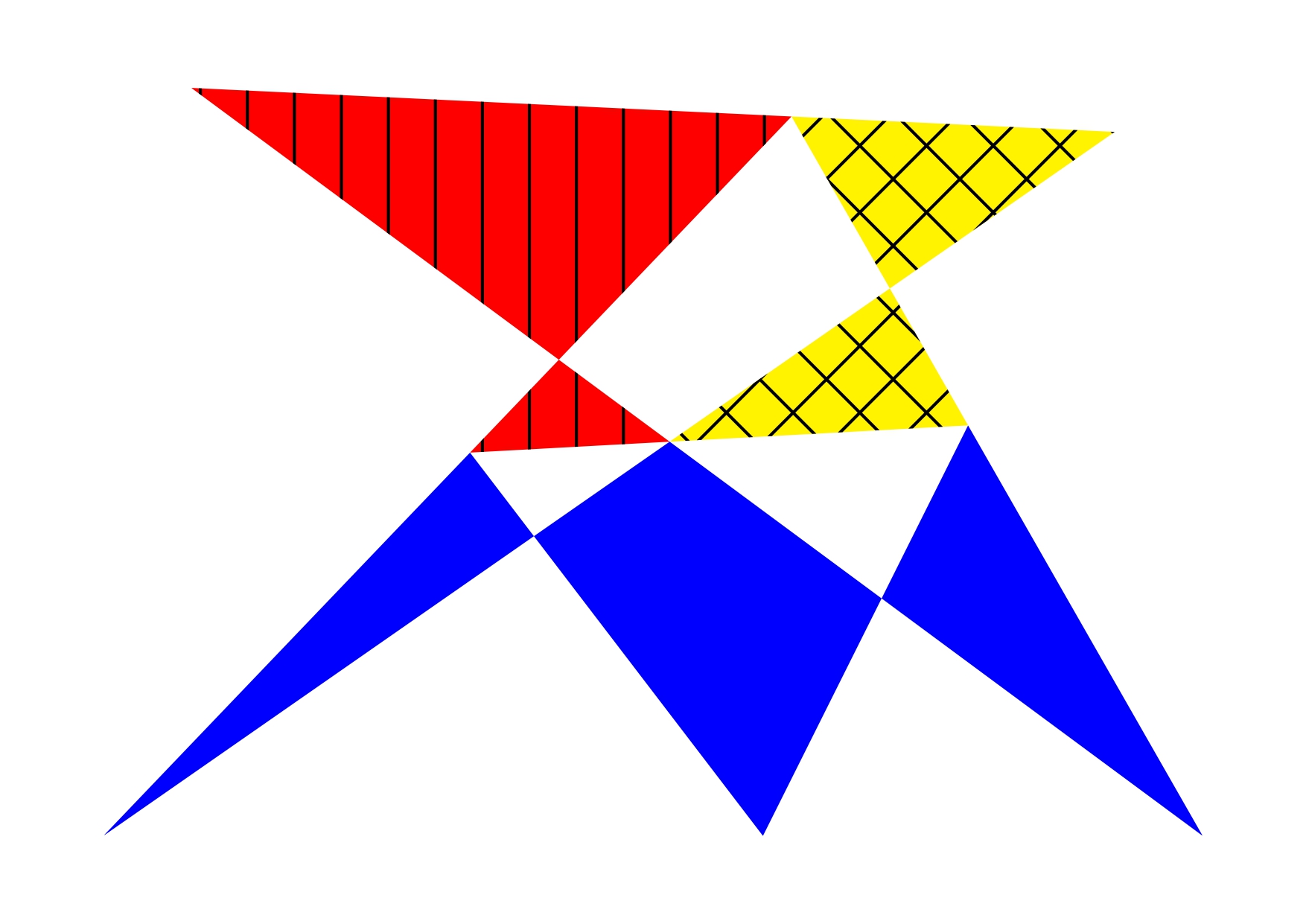
Pappus’s Hexagon Theorem is that, if six straight lines form a hexagon whose vertices lie alternately on a seventh and an eighth straight line, then the intersection points of the pairs of opposite sides of the hexagon lie on a ninth straight line. The theorem can be depicted as just below, in a way that I shall try to verbalize presently.
I created the image here as I did the image of “Fifty-Three Notes,” except without need for multido.
Yes, I am here avoiding the traditional labelling of points with letters. The stars in the night sky are not labelled, and yet one may learn to see them in patterns. To find the North Star, at the end of the handle of the Little Dipper, one follows the straight line on which sit the two stars at the edge of the Big Dipper, opposite its handle.
In the diagram above then, there are
- two triangles in red, scored vertically;
- two triangles in yellow, cross-hatched;
- two triangles and a quadrilateral, in solid blue.
The six triangles and the quadrilateral are non-overlapping, and their edges are non-overlapping. The polygons do share some vertices, and some of their edges lie on the same straight lines. In particular, each of two opposite vertices of the blue quadrilateral is shared with a blue triangle, and the ten edges of all three blue polygons lie on six straight lines in all. Those six lines are the edges of the hexagon (which is not simple) whose vertices are the nonshared vertices of the blue polygons. Those vertices lie on two straight lines. One of those lines has to be imagined, but the other one contains edges of a red triangle and yellow triangle. Edges of the other red and yellow triangles sit on the ninth straight line of the Theorem.
I could be wrong, but I suspect that so-called AI would be of no use in making sense of my description of the diagram. The expression “Artificial intelligence” is still what I called it in the title of my post “Contradiction in Terms.” It may be useful for some things, the way a calculator (kcalc) and spreadsheet (libreoffice) were useful for my previous post, “Fifty-Three Notes” – which holds a draft paper called “Numbers and Notes in Plato and Euclid.”
I started working on that draft right after drafting and submitting “Pappus’s Hexagon Theorem” (98 pages, size B6; the date is August 17, 2026, though apparently I last compiled the file the next day). The theorem in question is proved on the basis of Book I of Euclid’s Elements. There are forty diagrams. None of them is in color, but most of them are lettered. In a couple of cases, it is not points, but areas, that are given letters. Sometimes straight lines as such are not drawn, but are to be understood as the edges of polygons filled out in gray.
In the draft, Pappus’s Theorem is proved in a Euclidean plane. This means there are more cases than the one described above, since some sides of the hexagon may be parallel to their opposites.
This was apparently the ancient way: not to try to combine several results in one big theorem, but just to prove those results. A lecturer could then leave some of those cases as exercises for the listeners. Ultimately one might understand that there is some one thing behind all of the cases, but it seems not to have got written down. I talk about this in § 6 of the paper, bringing in Book X of the Elements as an example.
The example of Book X was fairly fresh in my mind, since my Euclid reading group, meeting since the winter of 2023, had finished that book in March.
I became interested in Pappus’s Theorem when reading Book I of the Elements with our students in Istanbul in a required course. I was later able to work through Pappus’s own account in an elective course.
In a hexagon whose vertices lie alternately on two straight lines, if opposite sides are parallel in two cases, then they are parallel in the remaining case – this is the result called Pappus’s Theorem in “Geometry and Algebra.” In that post, apparently I was trying to spell out the point of my talk, “A Geometry of Points and Polygons” (given remotely at Sultan Qaboos University, Muscat, Oman, Wednesday, April 22, 2026). In the style of the diagram above, the parallel case might be depicted as below.
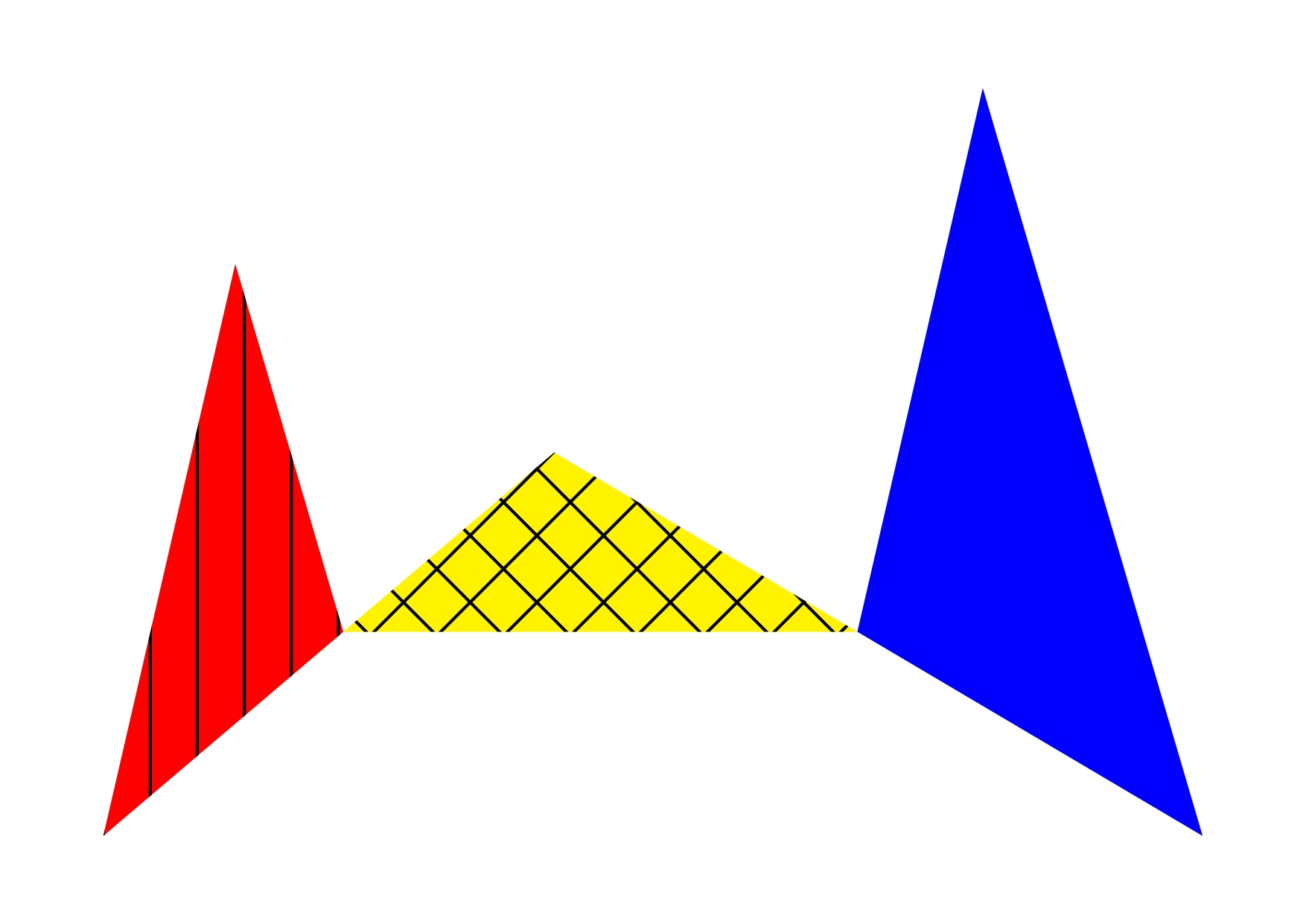
Here, there are three non-overlapping triangles, and their edges do not overlap. The triangles have seven vertices between them, and their edges are segments of seven straight lines. The edges of the unique non-shared vertex of one of the triangles, when extended in straight lines, pass through vertices of each of the other two triangles. The edges that meet at those vertices are respectively parallel. Consequently, the straight line (not shown) joining the other nonshared vertices of those two triangles is parallel to a side of the third triangle.
The reader is left with the mixed case of Pappus’s Theorem, when one pair of opposite sides of the hexagon are parallel, but another are not, so the third pair must not be either.