My title is on the pattern of “Computer Love” (1981), by Kraftwerk, a song enchanting and tragic.
Perhaps the “Kyrie” of the Machaut Mass
is enchanting but not tragic
though it literally begs for mercy
or at least the singers do
As of August 1 of this year (2026), the company called OpenAI claim to have made “Ten advances in mathematics and theoretical computer science.” The claim has the appearance of being documented by two pdf files:
- 249 pages that look like a concatenation of ten research papers in mathematics;
- 62 pages called “How the Ideas Came Together,” with an abstract that begins, “These notes were written by an AI model that read the original chains of thought together with the resulting mathematical papers and writeups.”
Unless and until human beings, or thinking beings, have read and confirmed these documents, they should not be taken as what they seem to be.
OpenAI say,
There are many views as to the role of AI in mathematics, and we have deep respect and understanding for those concerned with its impact, including the signers of the Leiden declaration on AI and Mathematics.
This assertion of “deep respect and understanding” is belied by the sequel:
We believe attribution should honestly reflect how a result was produced: claiming human authorship for a proof generated entirely by an AI system would misrepresent both the system’s contribution and the nature of genuine human intellectual work.
There is no proof generated entirely by an AI system. A proof is not a proof unless it has been thought through. As far as I know, only human beings can do the necessary thinking. Possibly there are other species that think on some level. In any case, machines do not think at all, and an “AI system” is a machine.
Machines do not think at all – I say that, and one may question it.
I say then that a machine does what it is designed to do – or if it doesn’t, it is not a proper machine.
Thinking is by design of the thinker alone. We may talk about the influence of the passions or the unconscious; still, thinking is something else – unless it really were mechanical, and in that case it would not be thinking.
Yes, that is a circular or tautological argument. It begs the question. The point is that thought and mechanism are different kinds of things. We mean different things by them. I am appealing to experience on this. The experience includes thinking about thinking, perhaps not so easy to do.
A machine may be an invaluable aid to our thinking. Just writing is an invaluable aid. I am currently writing by means of the emacs and pandoc programs. With the former, I create a txt file; with the latter, I clean up the the txt file and also produce an html file from it. “Cleaning up” here means making line lengths uniform and so forth; I do not assign copy-editing to AI and have no plans to.
I don’t know how machines could have helped in any other way, in such theorems as I have proved. An “AI system” might indeed have been able to respond to the request to find a geometric model-companion of the theory of fields with n commuting derivations. However, the adjective “geometric” here is imprecise. The point was to find something that we could understand in a certain way. The aim was “visualization,” but not of a kind that a machine could do for us.
Nonetheless, I was recently using the latex program with the pstricks and pst-eucl packages in order to visualize such tetrahedra as had been shown to be equicomplementable by Max Dehn, as I described in “Perception Deception” (April 11, 2025).
Dehn was solving Hilbert’s Third Problem. Dated July 12 of this year (2026), my exposition of the Problem and solution, for readers of Euclid, is 115 pages; however, each page has size A6, which I think should be viewable in the screen of one of today’s mobiles.
See especially Figure 24 and 25, on pages 69 and 71, showing how a pyramid that is one-sixth of a cube can be cut up and rearranged into a triangular prism having one-third the height of the cube. I needed to make the diagrams in order to visualize what was going on.
The associated theorem apparently dates back to 1895 and is due to Hill. How he came up with it, I don’t know, but whatever tools he used (they could be models made of wood or plaster; they could be pencil and paper) – whatever the tools, they didn’t produce the theorem.
Neither can AI produce a theorem.
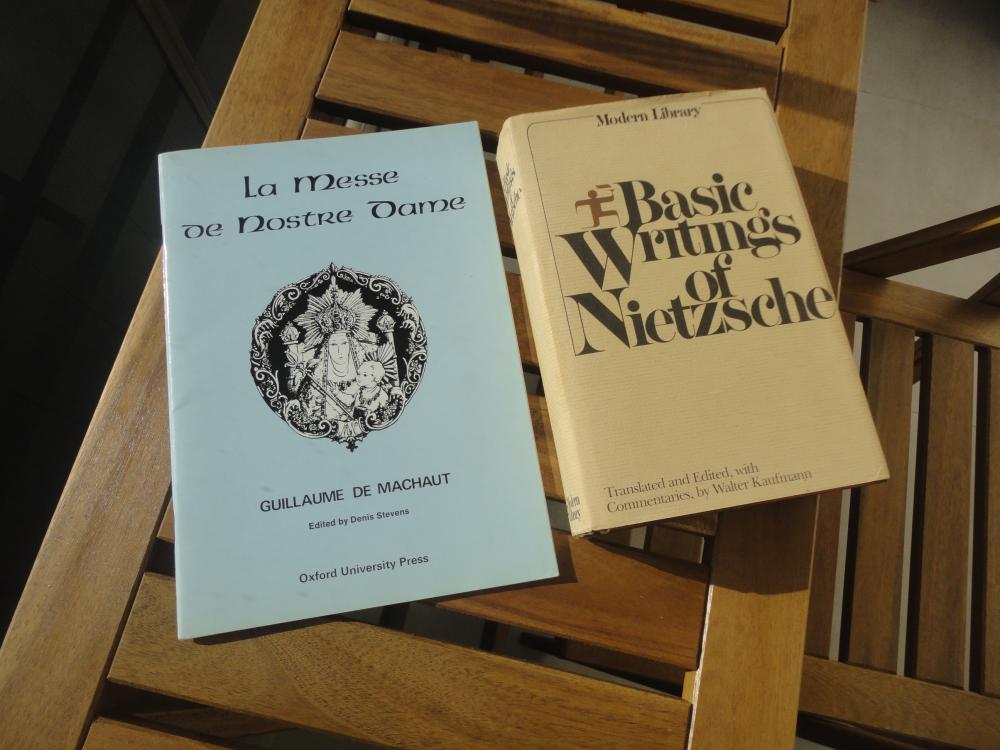
AI may produce something that looks like a theorem. However, a computer file or a printout is not a theorem. Likewise, the score of La Messe de Nostre Dame of Guillaume de Machaut is not the Mass itself.
I use that example, only because I have a copy of the score in my possession; I have kept it from the sophomore music tutorial at St John’s College. I turn now to another print source that I have kept from college.
Unfortunately, Nietzsche does not seem to have been keen on mathematics in school, if I read Wikipedia aright:
In 1854 he began to attend the Gymnasium in Naumburg. Because his father had worked for the state (as a pastor), the now-fatherless Nietzsche was offered a scholarship to study at Schulpforta … His end-of-semester exams in March 1864 showed a 1 in Religion and German; a 2a in Greek and Latin; a 2b in French, History, and Physics; and a “lackluster” 3 in Hebrew and Mathematics.
The second of the three essays that make up Nietzsche’s polemic On the Genealogy of Morals begins,
To breed an animal with the right to make promises – is not this the paradoxical task that nature has set itself in the case of man? is it not the real problem regarding man?
I don’t know what is meant by “real problem” here. Nietzsche’s Nature would seem to be practically a divinity. In any case, I suppose indeed that the freedom of a citizen includes the ability to make promises and to have them accepted.
Nietzsche continues:
That this problem has been solved to a large extent must seem all the more remarkable to anyone who appreciates the strength of the opposing force, that of forgetfulness. Forgetting is no mere vis inertiae as the superficial imagine; it is rather an active and in the strictest sense positive faculty of repression …
Being a free human being involves being able to set oneself a task and stick with it. The task could be proving a conjecture or finding a counterexample. A computer doesn’t do that, any more than a cloud in the sky sets itself the task of dropping rain on the ground.
A computer may give the appearance of solving a task. I see this idea in a recent post by Cory Doctorow, “Dualism” (August 3, 2026):
The erroneous assumption that my phone’s autocomplete is actually a person who understands me well enough to finish my sentences works fine, but the instant I turn to it for understanding, it will fail very badly. Autocomplete’s predictions are always grounded in who you used to be, which means autocomplete knows very little about who you are now, and absolutely nothing about who you will become:
I haven’t really studied the essay at the link (M.R. Sauter, “Instant Recall: How do we remember when apps never forget?” June 27, 2017), but I have noted this relevant passage:
predictive text systems push the user in two directions simultaneously: be more generic – that is, adhere better to the corpus of generic source data – and be more like you have been in the past. Use the same words, the same syntax, the same mannerisms that you have used in the past. Be more like the cliché of you.
Meanwhile, the Leiden declaration to which OpenAI paid lip service says,
Proper evaluation is endangered if results are communicated through informal channels such as press releases or blog posts, often without any research paper or other disclosure of information necessary for scientific evaluation. This practice seeks publicity for new results on market timelines before the accepted processes of community evaluation in mathematics can take place.
OpenAI are seeking publicity in precisely the way described and condemned. For reasons suggested above, while OpenAI seem to have posted research papers to back up their claims, they have not actually done this. They have posted what might as well be fakes.
I say that, even though the purported proofs in the fake papers may have been confirmed by a proof-checking program. Such program can fail.
My documentation for that claim is “only” a Mastodon post, but as far as I understand:
-
Somebody used AI to find a proof of the infamous Collatz Conjecture, that whatever number you start with, if you continually
- halve an even number, but
- triple and add one to an odd number,
eventually you get down to unity. For example, starting with 3 produces the sequence 10, 5, 16, 8, 4, 2, 1.
-
The alleged proof of Collatz was certified by a proof-checking program.
-
The proof was nonetheless invalid, because the original AI had exploited a bug in the checking program.
This adds to an argument that I included in a 2019 blog post, “Anthropology of Mathematics.” I said there that, strictly speaking, a computer could not verify a proof, because:
- A human would still need to check that the theorem had been correctly translated into the computer’s language.
- The hardware of the computer could fail.
Now it seems there is another point:
- The software can fail as well.
I had been thinking that every step of a formal proof is easy to check. The problem is that there may be a million steps or more, and there’s no reason to expect a machine to do even a simple thing correctly that many times.
I guess now an additional problem is that even AI would use shortcuts when searching for a proof that might ultimately take a million lines. Those shortcuts are another potential source of error.
We ourselves are potential sources of error. The tragedy is believing computers can solve this problem.

