Category Archives: Euclid

Salvation

Because Herman Wouk was going to put physicists in a novel, Richard Feynman advised him to learn calculus: “It’s the language God talks.” I think I know what Feynman meant. Calculus is the means by which we express the laws of the physical universe. This is the universe that, according to the mythology, God brought into existence with such commands as, “Let there be light.” Calculus has allowed us to refine those words of creation from the Biblical account. Credited as a discover of calculus, as well as of physical laws, Isaac Newton was given an epitaph (ultimately not used) by Alexander Pope:

Nature and Nature’s laws lay hid in night:
God said, Let Newton be! and all was light.

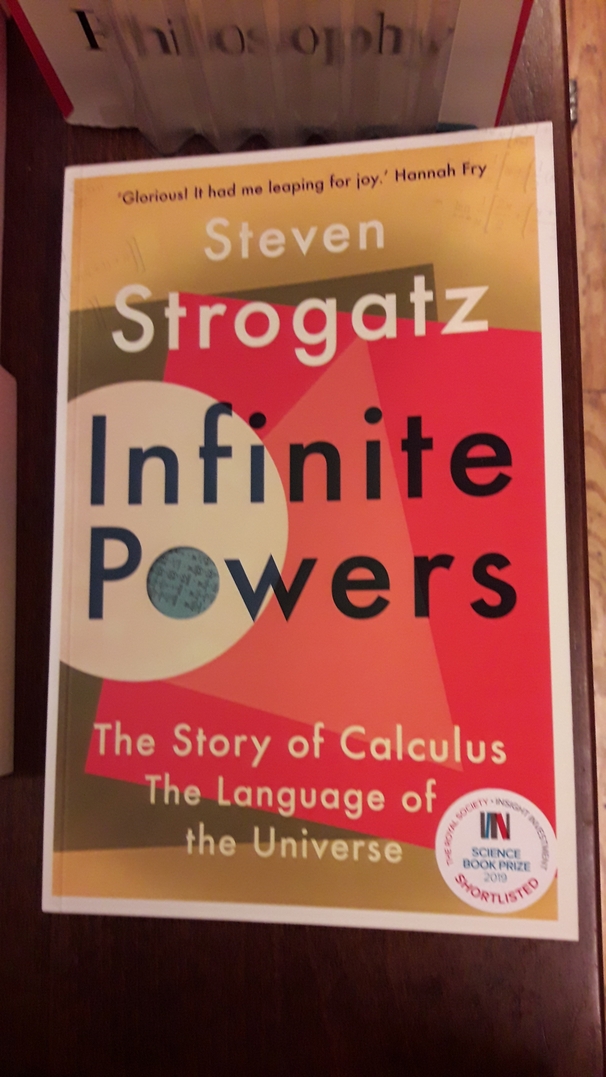
I don’t know, but maybe Steven Strogatz quotes Pope’s words in his 2019 book, Infinite Powers: How Calculus Reveals the Secrets of the Universe. This is where I found out about Wouk’s visit with Feynman. I saw the book recently (Saturday, February 22, 2020) in Pandora Kitabevi here in Istanbul. I looked in the book for a certain topic that was of interest to me, but did not find it; then I found a serious misunderstanding.

book cover: Steven Strogatz, Infinite Powers

Continue reading →

On the Idea of History

Note added, March 10–11, 2021. The bulk of this post concerns race in the theory of history, particularly the theory attributed to Johann Gottfried Herder (1744–1803). Not having read Herder for myself, I rely on the accounts of

  • R. G. Collingwood in § 2, “Herder,” of Part III of The Idea of History (1946),
  • Michael Forster in “Johann Gottfried von Herder,” Stanford Encyclopedia of Philosophy (summer 2019).

Somebody like Herder may introduce race as an hypothesis to explain history, but ultimately the hypothesis fails, by denying us the freedom that is essential to history as such. Nonetheless, Forster defends Herder as having

an impartial concern for all human beings … Herder does also insist on respecting, preserving, and advancing national groupings. However, this is entirely unalarming,

because, for one thing, “The ‘nation’ in question is not racial but linguistic and cultural.”

Change Collingwood’s word “race” to “linguistic and cultural grouping” then. I think his conclusion remains sound: “Once Herder’s theory of race is accepted, there is no escaping the Nazi marriage laws.”

More detail is in the post below. I go on to review the philosophy of history that Collingwood presents in the Introduction of The Idea of History. This book provided me with a title for the post.

I wrote a lot in this post, as I often do. Growing self-conscious for being opinionated about the theory of history, I listed the published evidence of my actually being an historian (an historian of ancient Greek mathematics in particular).

I originally wrote that my research had been inspired by a tweet. The author of that tweet also wrote the nice long comment on this post. However, although the tweet can be found on the Internet Archive, the author later deleted his Twitter account, and so the tweet appears on Twitter today as a gap in the thread above my own tweet in response to the other tweet.

That missing tweet referred to another tweet of the author, but the Internet Archive seems not to have saved it. It did save the present post; so if one were curious, one could see the changes that I have made since initial publication, or rather since September 29, 2020, when the Archive took the first snapshot.

The changes are for style and local clarity. Any large-scale changes would need me to recover the spirit that possessed me when I originally wrote.

I return to this post now, simply because a friend mentioned reading Middlemarch, and I remembered quoting George Eliot’s novel in a blog post, and that post turned out to be this one.

Had somebody mentioned reading Herder, I might have recalled writing about him in a blog post; that would be this post too.


Our environment may influence our feelings, but what we make of those feelings is up to us. Thus we are free; we are not constrained by some fixed “human nature”—or if we are, who is to say what its limits are?


Rembrandt van Rijn (and Workshop?), Dutch, 1606–1669,
The Apostle Paul, c. 1657, oil on canvas,
Widener Collection, National Gallery of Art
Continue reading →

On Gödel’s Incompleteness Theorem

This is an appreciation of Gödel’s Incompleteness Theorem of 1931. I am provoked by a depreciation of the theorem.

I shall review the mathematics of the theorem, first in outline, later in more detail. The mathematics is difficult. I have trouble reproducing it at will and even just confirming what I have already written about it below (for I am adding these words a year after the original publication of this essay).

The difficulty of Gödel’s mathematics is part of the point of this essay. A person who thinks Gödel’s Theorem is unsurprising is probably a person who does not understand it.

Next to a slice from a tree trunk, a worn copy of the book Frege and Gödel: Two Fundamental Texts in Mathematical Logic, edited by Jean van Heijenoort

Continue reading →

Victor Vasarely

Tophane-i Amire
Tophane-i Amire, 2017.03.25

Last week I wrote about the Turkish Impressionist Feyhaman Duran, born in 1886. Now my subject is the Hungarian-French Op Artist born twenty years later as Győző Vásárhelyi. His “Rétrospective en Turquie” is at the Tophane-i Amire Culture and Art Center in an Ottoman cannon foundry.

Vasarely show Continue reading →

The geometry of numbers in Euclid

This is about how the Elements of Euclid shed light, even on the most basic mathematical activity, which is counting. I have tried to assume no more in the reader than elementary-school knowledge of how whole numbers are added and multiplied.

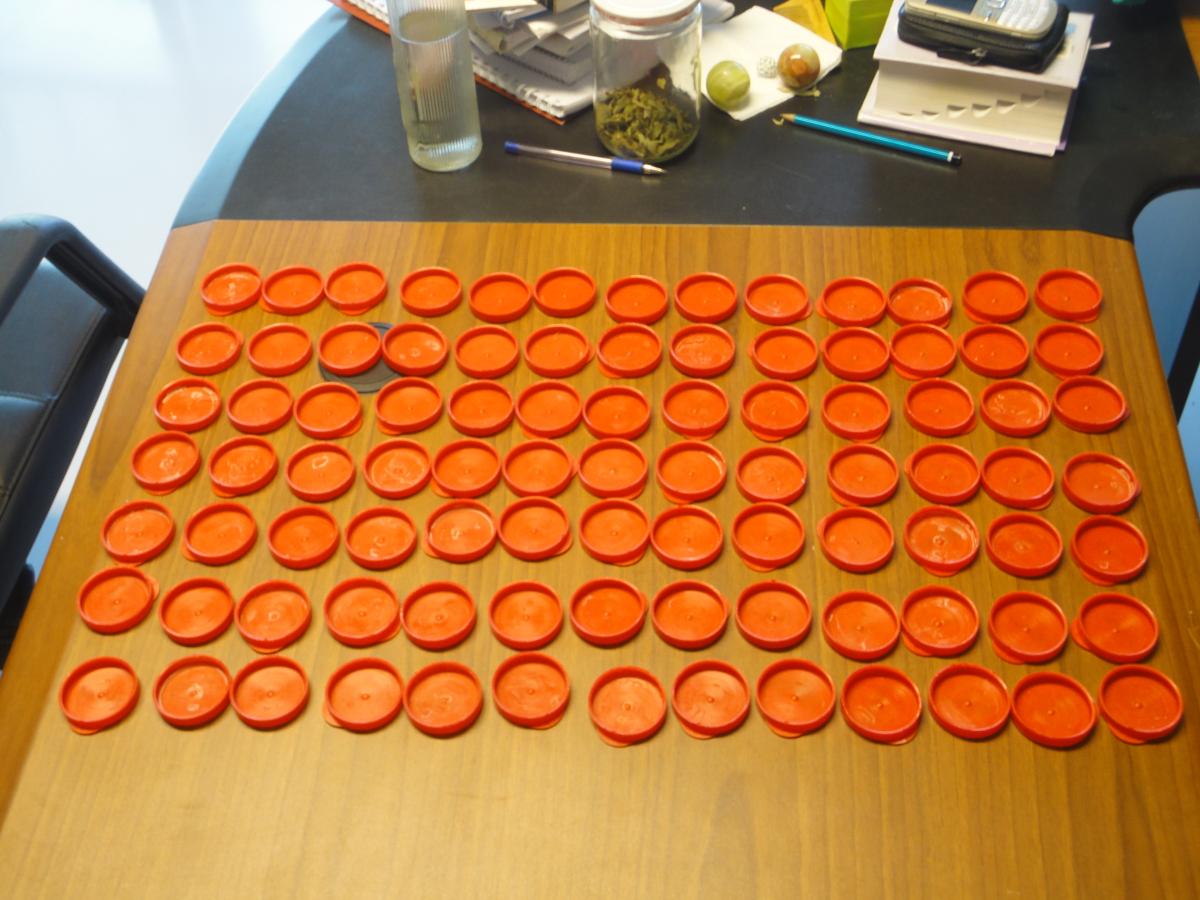
How come 7 ⋅ 13 = 13 ⋅ 7? We can understand the product 7 ⋅ 13 as the number of objects that can be arranged into seven rows of thirteen each.

Bottlecaps arranged on a desk in seven rows, thirteen columns
Seven times thirteen

If we turn the rows into columns, then we end up with thirteen rows of seven each; now the number of objects is 13 ⋅ 7.

The same bottlecaps, now seen from another side as thirteen rows, seven columns
Thirteen times seven

Continue reading →

Thales of Miletus

This is about Thales of Miletus and what it means to study him. I am moved to ask what history is in the first place. It is a study of the freedom in which we face our conditions. Thales had his way of understanding the world, and we may benefit from trying to learn it.

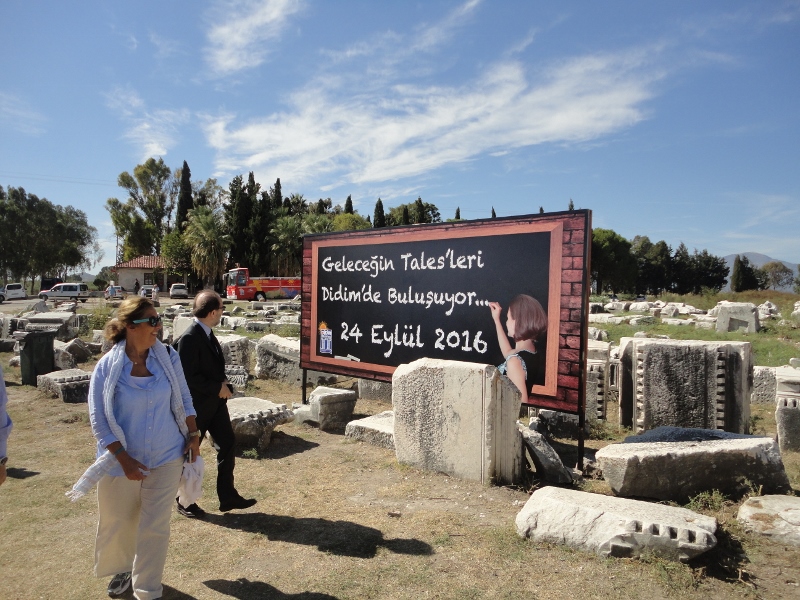
“The Thaleses of the future are meeting in Didim, September 24, 2016”

“The Thaleses of the future are meeting in Didim,
September 24, 2016”

Continue reading →

Equality Is Not Identity

I want to record here an account by Collingwood of Aristotle’s theory of knowledge. The passages quoted below are relevant, both to something I have learned from reading Euclid with students, and to the considerations of consciousness that led to my recent article “Body and Mind.”

Continue reading →

The Peace of Liberal Education

The wall of Dolmabahçe Sarayı, January 11, 2015

The wall of Dolmabahçe Sarayı, January 11, 2015

The occasion of this article is my discovery of a published Turkish translation of Collingwood’s Speculum Mentis or The Map of Knowledge (Oxford, 1924). Published as Speculum Mentis ya da Bilginin Haritası (Ankara: Doğu Batı, 2014), the translation is by Kubilay Aysevenler and Zerrin Eren. Near the end of the book, Collingwood writes the following paragraph about education, or what I would call more precisely liberal education. The main purpose of this article then is to offer the paragraph to any reader who happens to stop by.

Continue reading →

NL III: “Body As Mind”

Index to this series

In Chapter I of The New Leviathan, we stipulated that natural science, the “science of body,” must be free to pursue its own aims. But we ourselves are doing science of mind, and:

1. 85. The sciences of mind, unless they preach error or confuse the issue by dishonest or involuntary obscurity, can tell us nothing but what each can verify for himself by reflecting on his own mind.

All of us can be scientists of mind, if only we are capable of reflection: Continue reading →

NL I: “Body and Mind”

Index to this series. See also a later, shorter article on this chapter

The Chapter in Isolation

“Body and Mind” is the opening chapter of Collingwood’s New Leviathan. The chapter is a fine work of rhetoric that could stand on its own, though it invites further reading. In these respects it resembles the first of the ten traditional books of Plato’s Republic, or even the first of the thirteen books of Euclid’s Elements. The analogy with Euclid becomes a bit tighter when we consider that each chapter of The New Leviathan is divided into short paragraphs, which are numbered sequentially for ease of reference.

Continue reading →