Category Archives: Persons

Words

This post is based on recent readings, often on or through Twitter, of the following writers.

  1. Lilith Saintcrow on “Domestic abusers, white supremacists, and religious bigots.”
  2. C. S. Lewis on gulling the educated, and objectivity as a dubious value.
  3. Marilynne Robinson on consensus as concealing the objectively true.
  4. Neil deGrasse Tyson on objectivity as a good value.
  5. Plato on seeming wise, without being so.
  6. Mark Vernon on imagination in William Blake.
  7. whoever wrote an “Open Letter Concerning Transphobia in Philosophy,” signed by many professional philosophers.
  8. Agnes Callard on how philosophers shouldn’t be signing petitions.
  9. Rebecca Reilly-Cooper, on the incoherence of the notion of gender identity.
  10. Christopher Bertram, a signer of the “Open Letter.”
  11. Nathan Oseroff-Spicer, who noticed who had not signed the letter.
  12. Aaden Friday, on what’s wrong with Reilly-Cooper and other such women.
  13. Brian Earp, on why declaring pronouns is not obviously a good thing.
  14. Liam Kofi Bright, another signer of the “Open Letter.”
  15. Masha Gessen, on wishing he could have transitioned as a teen.
  16. John Steinbeck, on being a man.
  17. Christa Peterson, on what gender identity might be.
  18. Holly Lawford-Smith, on third bathrooms and being banned from social media.
  19. Jason Stanley, who signed the “Open Letter,” but also calls for left unity.
  20. Isaac Asimov, on behaviorism.
  21. Dominic Berry, who will block anybody who follows the editor who published Reilly-Cooper’s essay.
  22. Kathleen Stock, the subject of the “Open Letter.”
  23. Caitlin Green, on what people such as Stock should do if they are going to change their research focus.

Having originally posted this essay on January 9, 2021, I edited and augmented it, on January 19 and December 19 of that year. I return to it now, on June 22, 2023, having posted “On Dialectic,” two days ago; this one is another post that quotes lots of people, and I want to check how it reads. It reads fine, to me, although I did have to correct occurrences of “behavior” spelled as “behavor.” Moreover, although I had forgotten what was here, I recognized it instantly as I read; another reader would not experience this recognition.

What stands out most to me now is Christa Peterson’s suggestion,

A representation of our own gender … could … be a means of picking out people as who we are co-gendered with …

As the essay already suggests, if you replaced “gender” with “race,” then the resulting speculation could get you called a racist, and that is supposed to be something bad. However, if we replace “gender” with “sex,” we obtain a proposition that is fundamental to contemporary biology, as I understand it, because evolution is

  • not only by natural selection, or “survival of the fittest” – selection by the rigors of the natural environment,
  • but also by sexual selection, or selection for mating by members of the opposite sex of one’s (sexually reproducing) species.

I think this is why Nina Paley can say, in a blog post called “Why I Don’t Use ‘Preferred Pronouns’,” which I referred to also in “Imagination,”

Like most mammals, I can’t help but identify someone’s sex with +99% accuracy. (… Women, I think, are better at identifying sex than men, either due to instinct or conditioning for survival …)

We know that there are two sexes, and we know who is of which sex, the way we know that some foods are good to eat. However, Peterson seems to think of this knowledge a bit differently:

Trans people’s dignity and legitimacy does not depend on the success of any one attempt to conceptualize their experience. But the most common way, in terms of “gender identity,” is perfectly functional. The commitments of the popular notion are minimal: people have an internal sense of their own gender that can come apart from their knowledge of their assigned sex, and is generally fixed, and certainly not revisable in the way ordinary beliefs are.

What is the word “assigned” doing here? Does whether you are trans depend on whether somebody made a mistake when checking one of the boxes marked “male” and “female” at your birth?


A lot of old PSA’s about drugs are on YouTube and the Web Archive, and sometimes they are linked to by articles that ridicule them. There is one that I have not been able to find, perhaps from around 1970, in which parents confront their teenager with the drug paraphernalia that they have found in his room. The boy storms out of the house, saying, “You don’t understand!”

There’s a lot that I don’t understand. I must not, since it seems childish, but is coming from adults. Some of these adults stormed the US Capitol the other day; others encourage them; still others are professors of philosophy.

Figure in book showing egg and sperm. The circular egg has a fiery corona, and little sperm with wavy flagella come at it from one side. There are also two sperm with parallel straight flagella whose length is the diameter of the egg
“Human egg and sperm cells.”
Asimov’s New Guide to Science (1984), page 600

Continue reading

Automatia

One day during the Trojan War, Apollo and Athena decide to give the combatants a break. The general conflict is to be replaced with a one-on-one. The Olympians induce Helenus to tell his brother Hector to take on whichever of the Greeks is up for it.

Twilight beach scene
Day or night?
Sunset over Lesbos
From the Anatolian mainland
Tuesday, August 1, 2023

Continue reading

Pacifism

Note added May 19, 2026. I return to this post now, because the question arises with a friend of whether the US should be at war with Iran. This post does not actually answer that or any such question. It would, implicitly, if it said that war was never the answer, or war never solved any problem. This would absolve us from needing to think about any particular case, such as whether the American colonists should have taken up arms against the British Crown, or John Brown should have done the same against slavery. This post is mainly a response, by a mathematician and a product of a great-books program, to contentious or sententious things said by fellow academics. Concerning international relations as such, see the post referred to below, “External Politics.”


Pacifism is properly pacificism, the making of peace: not a belief or an attitude, but a practice. Mathematics then is pacifist, because learning it means learning that you cannot fight your way to the truth. Might does not make right. If others are going to agree with you, they will have to do it freely. Moreover, you cannot rest until they do agree with you, if you’ve got a piece of mathematics that you think is right; for you could be wrong, if others don’t agree.

The book *Dorothy Healey Remembers,* with photo of subject on cover

Continue reading

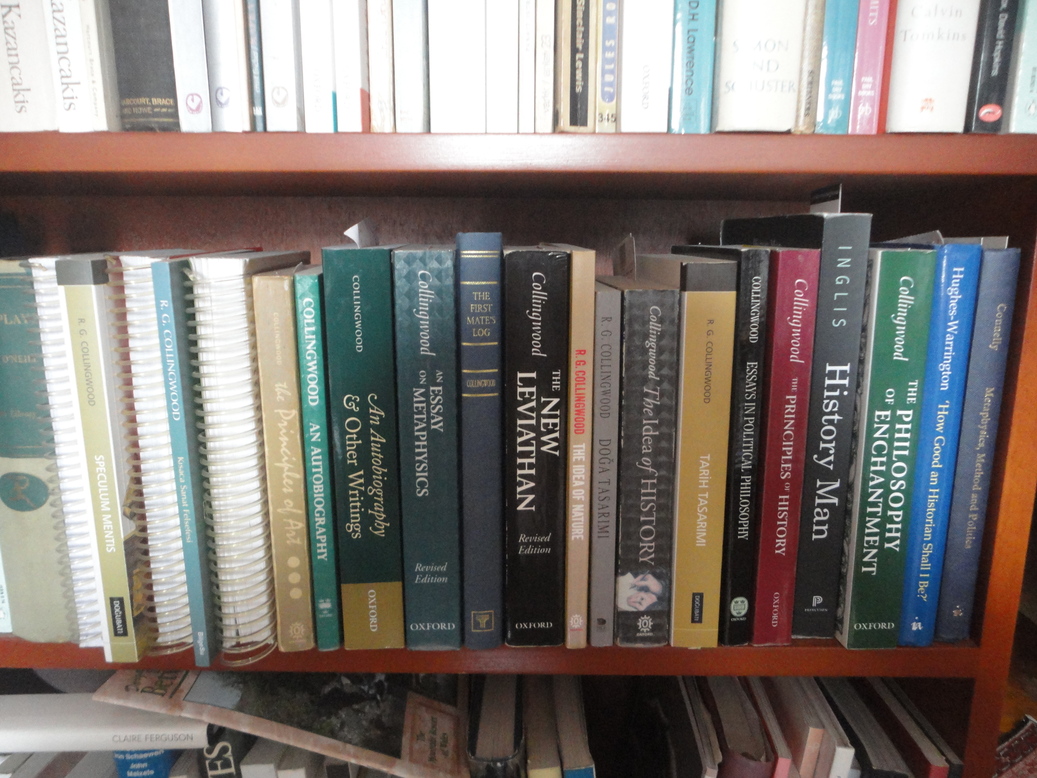
Articles on Collingwood

This article gathers, and in some cases quotes and examines, popular articles about R. G. Collingwood (1889–1943).

  • By articles, I mean not blog posts like mine and others’, but essays by professionals in publications that have editors.

  • By popular, I mean written not for other professionals, but for the laity.

Continue reading

Mathematics and Logic

Large parts of this post are taken up with two subjects:

  1. The notion (due to Collingwood) of criteriological sciences, logic being one of them.

  2. Gödel’s theorems of completeness and incompleteness, as examples of results in the science of logic.

Like the most recent in the current spate of mathematics posts, the present one has arisen from material originally drafted for the first post in this series.

In that post, I defined mathematics as the science whose findings are proved by deduction. This definition does not say what mathematics is about. We can say however what logic is about: it is about mathematics quâ deduction, and more generally about reasoning as such. This makes logic a criteriological science, because logic seeks, examines, clarifies and limits the criteria whereby we can make deductions. As examples of this activity, Gödel’s theorems are, in a crude sense to be refined below, that

  • everything true in all possible mathematical worlds can be deduced;

  • some things true in the world of numbers can never be deduced;

  • the latter theorem is one of those things.

Continue reading

More of What It Is

I say that mathematics is the deductive science; and yet there would seem to be mathematicians who disagree. I take up two cases here.

Page of Greek text with diagram
From Archimedes, De Planorum Aequilibriis,
in Heiberg’s edition (Leipzig: Teubner, 1881)

Continue reading

What Mathematics Is

Mathematics “has no generally accepted definition,” according to Wikipedia on September 15, 2020, with two references. On September 14, 2023, the assertion is, “There is no general consensus among mathematicians about a common definition for their academic discipline”; this time, there are no references.

I suggest that what really has no generally accepted definition is the subject of mathematics: the object of study, what mathematics is about. Mathematics itself can be defined by its method. As Wikipedia says also (as of either date given above),

it has become customary to view mathematical research as establishing truth by rigorous deduction from appropriately chosen axioms and definitions.

I would put it more simply. Mathematics is the science whose findings are proved by deduction.

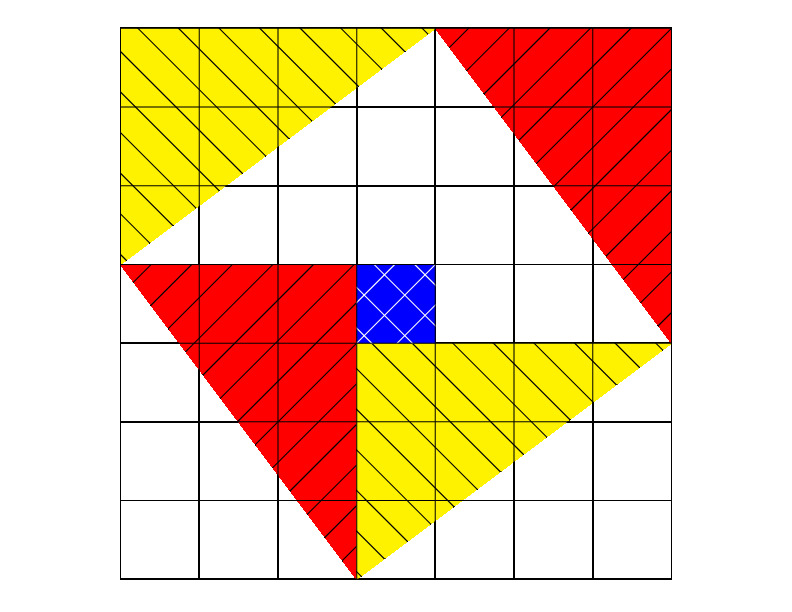
A 7×7 grid of squares, divided into four 3×4 rectangles arranged symmetrically about one square; the rectangles are divided in two by diagonals, which themselves describe a square
The right triangle whose legs are 3 and 4 has hypotenuse 5, because the square on it is
(4 − 3)2 + 2 ⋅ (4 ⋅ 3),
which is indeed 25 or 52. This is also
42 + 32.

Continue reading

Map of Art

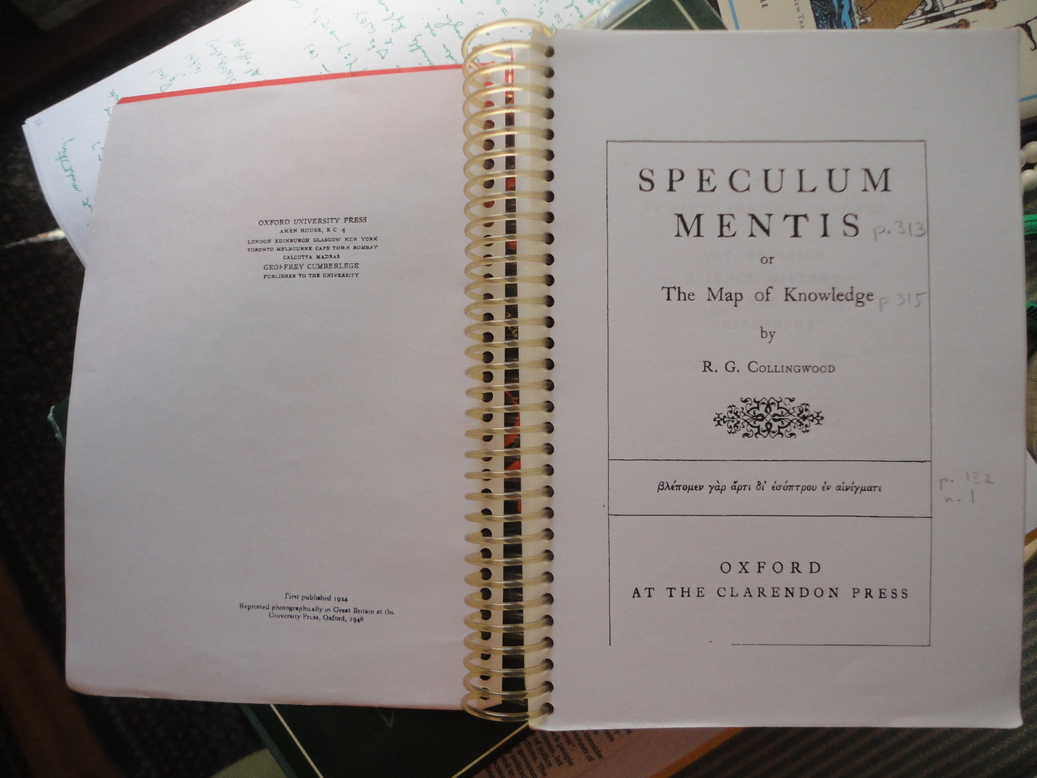
The bulk of this post is a summary of the chapter on art in Collingwood’s Speculum Mentis: or The Map of Knowledge (1924). The motto of the book is the first clause of I Corinthians 13:12:

Βλέπομεν γὰρ ἄρτι δι’ ἐσόπτρου ἐν αἰνίγματι

For now we see through a glass, darkly

The chapter “Art” has eight sections:

Continue reading

An Exercise in Analytic Geometry

This past spring (of 2020), when my university in Istanbul was closed (like all others in Turkey) against the spread of the novel coronavirus, I created for my students an exercise, to serve at least as a distraction for those who could find distraction in learning.

Diagram from textbook page shows, centered at the origin of coordinates, a circle and an ellipse whose four points of intersection are traversed by two lines in red through the origin
From Weeks & Adkins, Second Course in Algebra, p. 395

Note added, April 17, 2023: An account of the mathematics involved in the exercise would ultimately be published as: Pierce, D. (2021). “Conics in Place.” Annales Universitatis Paedagogicae Cracoviensis | Studia Ad Didacticam Mathematicae Pertinentia, 13, 127–150.

Continue reading

Be Sex Binary, We Are Not

Content warning: suicide.

The following sentence is bold in the last paragraph of an essay: “the science is clear and conclusive: sex is not binary, transgender people are real.” I don’t know what the writer means by this. As far as I can tell, as a biological concept used for explaining reproduction, sex has two kinds or parts or sides or aspects, and the essay tacitly affirms this; at the same time, obviously persons called transgender exist.

☾ ♂ ☿ ♃ ♀ ♄ ☉

The title of the essay is a command: “Stop Using Phony Science to Justify Transphobia.” I can support that. I don’t even need the qualifier “phony.” If transphobia is the kind of morbid fear suggested by the suffix “-phobia,” then science ought to help dispel this, not promote it.

One might also just say, Stop using phony science.

Continue reading