Category Archives: Homer

Homer for the Civilian

The sources of this essay (originally posted April 8, 2017) are an earlier one, written as an email in 2009, and a conversation that ensued it, on the theme of what Homer may mean in one’s life, and whether an application to one’s life involves an abuse of the original text. I wrote on this blog, in July 2016, on analogies in Homer and elsewhere, in “Thinking & Feeling.” My last post considered an apparent instance of abuse of the Hebrew Bible.

At the end of the Iliad, to retrieve the body of Hector from its killer, King Priam of Troy visits Achilles in his tent in the evening, in the camp of the hostile Greeks. The scene may recall two political enemies from the 1980s, President Ronald Reagan and Congressman Thomas O’Neill, Speaker of the House: these two were able to be on friendly terms “after 6 PM.”

Homer, Iliad, Wordworth edition
Aleksandr Andreevich Ivanov
“King Priam begging Achilles for the Return of Hector’s Body,” 1824
Tretyakov Gallery, Moscow

Continue reading

Thinking & Feeling

This essay is written as a distraction from current events, though I make some reference to them. I am prompted by questions of analogy provoked by

  1. the similes of Homer and
  2. a recent theater review in Harper’s that mentions the parables of Jesus.

With sea in the background, on the sand of a beach sits Chapman’s Homer: The Iliad, the cover featuring a 16th-century Flemish tapestry (framed by a circle), Scene from Roman History, showing a number of men, the one in the middle armored; a horse is in the foreground

Continue reading

35th Istanbul Film Festival, 2016

After a preamble on freedom, this is an account of nine movies in three parts.

This part:

  • Thirst

  • Rain the Color of Blue With a Little Red in It

  • Fire at Sea

Part 2:

  • The Demons

  • The Music of Strangers: Yo-Yo Ma and the Silk Road Ensemble

  • Florida

Part 3:

  • Interruption

  • Under the Sun

  • News from Planet Mars

Photo of books referred to in this article

In the summer of 1994, I was a graduate student at the University of Maryland, and I had lived in the state since 1989. My roommate in a suburban apartment complex was finishing her own degree and moving away. I decided to move across the border into the city of Washington, where I had already become involved in some bicycle activism. I found a congenial vegetarian group house. I would bicycle the nine miles to the College Park campus. But moving to the city raised a moral question: should I really give up my political right to a meaningful vote?

Continue reading

Turks of 1071 and Today

Skip to Michael Attaleiates on Alparslan after the Battle of Manzikert

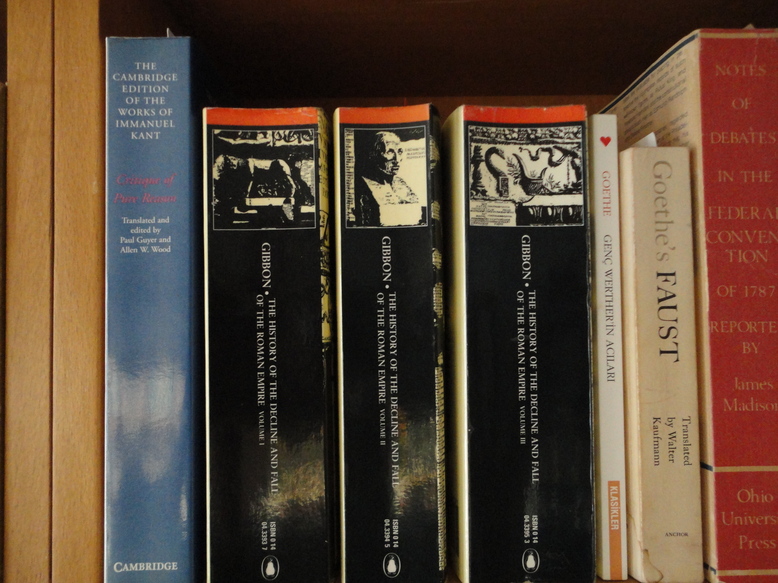
Published in six volumes between 1776 and 1788, Edward Gibbon’s History of the Decline and Fall of the Roman Empire tells the story of a thousand years and more, from before the founding of Constantinople in 330 till after its loss in 1453. Gibbon can be ridiculed for his title: a millenium is a long time to be in decline. The three thick volumes of the Penguin edition took me a long time to read, if not quite as long as Gibbon took to write. I was living in Ankara at the time, but I enjoyed being able to read Gibbon’s work also while visiting the three old imperial capitals: Istanbul, Rome, and Milan.

Gibbon’s Decline and Fall on my shelves (which are arranged according to date of birth of author)
Gibbon’s Decline and Fall on my shelves
(which are arranged according to date of birth of author)

Continue reading

The Peace of Liberal Education

The wall of Dolmabahçe Sarayı, January 11, 2015

The wall of Dolmabahçe Sarayı, January 11, 2015

The occasion of this article is my discovery of a published Turkish translation of Collingwood’s Speculum Mentis or The Map of Knowledge (Oxford, 1924). Published as Speculum Mentis ya da Bilginin Haritası (Ankara: Doğu Batı, 2014), the translation is by Kubilay Aysevenler and Zerrin Eren. Near the end of the book, Collingwood writes the following paragraph about education, or what I would call more precisely liberal education. The main purpose of this article then is to offer the paragraph to any reader who happens to stop by.

Continue reading

NL VI: “Language,” again

Index to this series

This is about language: language the concept, and “Language,” the sixth chapter of Collingwood’s New Leviathan. We shall consider language in a very basic way, not as a means of communicating what we know, but as the way we come to know things in the first place.
Continue reading