The reading is Sellier 755–90. These are labelled below by the enumerations of
Sellier–Le Guern–Lafuma–Brunschwicg.
Apparently S 772–85 were in a manuscript that was discovered, or were discovered to be in a manuscript, by Jean Mesnard in 1962. Those fragments then are not in Lafuma’s edition, much less Brunschwicg’s, except S 781–2, which were already known from another manuscript. These and the rest of the reading are Lafuma 926–35, 937–48, 950–1, 974, 977, 980–2, 984, and 992. One of the fragments, S 786 / L 977 / B 320, is not on the site of Descotes and Proust.
A page at the site that might have more information on the later manuscripts is currently en chantier. Looking elsewhere, I found a review (Girdlestone, C. M. Blackfriars, vol. 34, no. 395, 1953, pp. 100–102. JSTOR. Accessed 30 May 2021) of the translation by G. S. Fraser of Pascal: His Life and Works by Jean Mesnard. The book would seem to correct the picture of Pascal passed along by Eric Temple Bell, as in a quotation I made in connection with 142–110–282 in the second reading. According to the reviewer, Mesnard
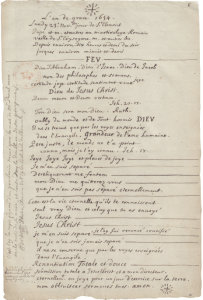
rectifies many a misconception still current about its hero, the image of whom is still often based on that first outlined by Voltaire who had, let it be remembered, only the adulterated Port-Royal edition to judge him by. Pascal was not a ‘madman’, not even ‘of genius’. Even after his mystical experience of November 23, 1654, he never became the ‘fierce solitary of Port-Royal’ of which so many biographers speak. He did not abandon the world but sought to conquer it. He never ‘discovered’ for himself, as a child of twelve, the first thirty-two theorems of Euclid and his sister never claimed he did; what she says is that ‘he was surprised by his father when he was seeking to demonstrate the thirty-second theorem’ itself. Divided as he was between scientific and mathematical research and the pursuit of that unum necessarium which Baudin calls his soteriologial pragmatism, he would swing from one to the other, but he did not give up his scientific studies till 1659, a couple of years before his death, and he did so not under the influence of frigid asceticism but of ill-health, which made sustained thought impossible. In this light, the tendentious lamentations of Sully-Prudhomme or Paul Valéry, weeping over the loss to science caused by his devotion to religion, sound rather ludicrous.
Continue reading →



 Polytropy