Category Archives: Philosophy

On Plato’s Republic, 3

Index to this series

We are reading now Book II of Plato’s Republic, Stephanus pages 357–83, covering:

  1. The conventional arguments in favor of injustice and justice, reviewed by Plato’s brothers Glaucon and Adeimantus respectively.
  2. The beginning of the construction of the city in speech, wherein the advent of justice is to be discerned; the guardians of the city are to be like dogs and to be given a traditional education, although with none of the traditional stories, since they talk about things like parricide and bad luck.

A book next to a dog lying on the beach

Dog with copy of Alain Badiou, Plato’s Republic:
A Dialogue in Sixteen Chapters, with a Prologue and an Epilogue, 2012
Profesörler Sitesi, Altınova, Balıkesir, Turkey, September 2, 2021

Continue reading

On Plato’s Republic, 2

Constituting the latter part of Book I, the second of the Republic readings features the only sustained contribution of Thrasymachus, who argues that, if it can be pursued perfectly, injustice is superior to justice.

According to my electronic search of Jowett’s translation, confirmed with a search of Bloom’s, Socrates will mention Thrasymachus and his argument in Books II, VI, VIII, and IX, but the man himself will speak again only near the beginning of Book V, to agree with the demand of Polemarchus, Adeimantus, and Glaucon that Socrates explain the community of women and children in the imaginary city that Socrates will have been describing.

Continue reading

On Plato’s Republic, 1

After the Pensées of Pascal and the Canterbury Tales of Chaucer, here begins another series on readings of a classic, now the Republic of Plato. The sections (after this one) of the present post are

Continue reading

Hostility and Hospitality

After seventeen weekly posts of readings with my annotations, the Pensées of Pascal join two other works that I have blogged about systematically, chapter by chapter or book by book:

  • R. G. Collingwood, The New Leviathan, or Man, Society, Civilization, and Barbarism (1942);

  • Homer, the Iliad, in George Chapman’s translation.

Do three authors belong together, for any other reason than that I have spent time with each of them?

  • For Pascal, the Torah is history, but the Iliad was written too late to be that, and is just a novel (S 688 / L 436 / B 628). It has no concept of law, he says (S 691 / L 451 / B 620), but later Greeks took this and other things from the Jews. I discussed this in “Judaism for Pascal.” For example, Philo Judaeus thinks that when Heraclitus says, “We live their death and we die their life,” this is the death wrought by eating of the tree of the knowledge of good and evil in Genesis.

  • Pascal and Collingwood both come to terms with a world of contrariety. Collingwood calls it “a Heraclitean world,” alluding to how Plato has Socrates tell Hermogenes in the Cratylus (402a, Loeb translation by Harold North Fowler),

    Heracleitus says, you know, that all things move and nothing remains still, and he likens the universe to the current of a river, saying that you cannot step twice into the same stream.

    Continue reading

Pascal, Pensées, S 791–813

Index for this series

The text of our final reading of Pascal’s Pensées is below in black. The fragments are Sellier 791–813, labelled below by the enumerations of

Sellier–Le Guern–Lafuma–Brunschwicg.

The last fragment, discovered in 1952, is thus not in Lafuma or Brunschvicg. The rest are Lafuma 956–67, 969, 971–2, 983, 985–91, 993.

Connections

This section is based on an email that I sent to the discussion group. For our final discussion, one participant has proposed looking back also at fragments in our third reading:

  • S 230 / L 199 / B 72: “The Disproportion of Man”

  • S 231 / L 200 / B 347: “Man is but a reed, the most feeble thing in nature; but he is a thinking reed …”

These are a reason why I wanted to join this group in the first place. I propose to include the continuation,

  • S 232 / L 200 / B 347 “All our dignity consists then in thought. That’s how we must elevate ourselves, and not by space and time, which we could never fill. Let us then try to think well: this is the principle of morality.”

Continue reading

Pascal, Pensées, S 755–790

Index for this series

The reading is Sellier 755–90. These are labelled below by the enumerations of

Sellier–Le Guern–Lafuma–Brunschwicg.

Apparently S 772–85 were in a manuscript that was discovered, or were discovered to be in a manuscript, by Jean Mesnard in 1962. Those fragments then are not in Lafuma’s edition, much less Brunschwicg’s, except S 781–2, which were already known from another manuscript. These and the rest of the reading are Lafuma 926–35, 937–48, 950–1, 974, 977, 980–2, 984, and 992. One of the fragments, S 786 / L 977 / B 320, is not on the site of Descotes and Proust.

A page at the site that might have more information on the later manuscripts is currently en chantier. Looking elsewhere, I found a review (Girdlestone, C. M. Blackfriars, vol. 34, no. 395, 1953, pp. 100–102. JSTOR. Accessed 30 May 2021) of the translation by G. S. Fraser of Pascal: His Life and Works by Jean Mesnard. The book would seem to correct the picture of Pascal passed along by Eric Temple Bell, as in a quotation I made in connection with 142–110–282 in the second reading. According to the reviewer, Mesnard

rectifies many a misconception still current about its hero, the image of whom is still often based on that first outlined by Voltaire who had, let it be remembered, only the adulterated Port-Royal edition to judge him by. Pascal was not a ‘madman’, not even ‘of genius’. Even after his mystical experience of November 23, 1654, he never became the ‘fierce solitary of Port-Royal’ of which so many biographers speak. He did not abandon the world but sought to conquer it. He never ‘discovered’ for himself, as a child of twelve, the first thirty-two theorems of Euclid and his sister never claimed he did; what she says is that ‘he was surprised by his father when he was seeking to demonstrate the thirty-second theorem’ itself. Divided as he was between scientific and mathematical research and the pursuit of that unum necessarium which Baudin calls his soteriologial pragmatism, he would swing from one to the other, but he did not give up his scientific studies till 1659, a couple of years before his death, and he did so not under the influence of frigid asceticism but of ill-health, which made sustained thought impossible. In this light, the tendentious lamentations of Sully-Prudhomme or Paul Valéry, weeping over the loss to science caused by his devotion to religion, sound rather ludicrous.

Continue reading

To Be Civilized

A fellow mathematician called Robert Craigen told me in a tweet last October (2020),

I’m quite comfortable with the definition and usage of the term [“civilization”] in the work of Niall Ferguson.

Ferguson’s work then is going to be my concern here. I had asked Craigen in July,

Have you got a theory of civilization, to explain what is being destroyed? I admire (and have blogged about) Collingwood’s theory, worked out in The New Leviathan (1942) in response to the Nazis.

This was in response to his saying,

If you listen closely to those pushing all these things, destruction of civilized society is an explicitly articulated goal.

He was talking about a thread of tweets by Peter Boghossian. I am not going to talk about those tweets as such, but here they are for the record:

How to destroy civilization in 10 easy steps:

Continue reading

Pascal, Pensées, S 739–754

Index for this series

The remaining three readings are of fragments “not registered by Copy B” (Ariew).

The present reading is Sellier 739–54, of which all but 741 correspond to Lafuma 913–25, 936, 975–6, and 978–9. Each of these but one (namely Mémorial, S 742, L 913) n’est pas encore analysé at the Descotes–Proust site.

Major fragments:

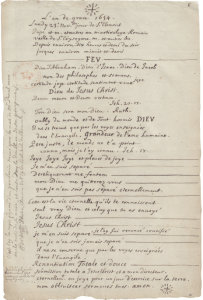
  • Mémorial (742–711–913–[0])

  • Texte Amour propre (743–758–978–100)

  • The Mystery of Jesus: 749–717–919–553, 751–(717)–(919)–(553), (751)–(717)–(919)–791

Themes

  • Contrariety of inside and outside, now in (751)–727–936–698 and S 753, but seen also in the ninth reading, 499–514–923–905.

  • The Jesuits against the Jansenists: 744–712–914–882, 745–713–915–902 bis, 746–714–916–920, 750–718–920–957. Thus the importance of speaking the truth as one sees it. This was seen also in:

    • Third reading, 184–151–211: If we refuse to act as if alone, we witness our greater esteem for the esteem of others than for the truth.

    • Ninth reading, 492–505–592–750, and the last reading: The Jews are the best witnesses for not having all converted; thus one needs to be free to convert or not.

    • Eleventh reading, (672)–(457)–505–(260). Believe according to your own lights. The punishment for those who sin is error (thus perhaps error is its own punishment).

Summary of each fragment

Pascal, Pensées, S 720–738

Index for this series

The reading is Sellier 720–738, which is Lafuma 485–503:

Labels are Sellier–La Guern–Lafuma–Brunschvicg.

Summary

A difficult reading for its quotations, paraphrases, and unexplained citations from the Hebrew Bible; but also, in another sense, for its attempt to explain (even in Pascal’s own words) what’s wrong with the Jews.

Continue reading

Judaism for Pascal

This blog’s occupation with Pascal may continue four more weeks. Four readings of the Pensées remain to be posted here, with my annotations.

The present post will take up a question raised by the latest reading so far, which is the thirteenth.

In the twelfth reading, to somebody looking for faith, Pascal recommended acting as if he already had it. For the person of today, faced with various options, at least in a liberal society, the question remains (which was asked in our seminar) of which faith to follow. Could the person of Pascal’s day, whether gentile or Jew by breeding, have sensibly considered the option of Judaism as a faith, according to Pascal?

Continue reading