Author Archives: David Pierce

Mathematician & logician; amateur of philosophy; relation of journalists; alumnus of St John’s College (USA)

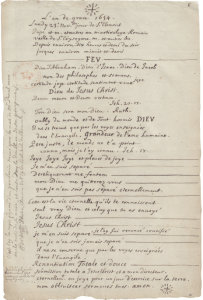
Judaism for Pascal

This blog’s occupation with Pascal may continue four more weeks. Four readings of the Pensées remain to be posted here, with my annotations.

The present post will take up a question raised by the latest reading so far, which is the thirteenth.

In the twelfth reading, to somebody looking for faith, Pascal recommended acting as if he already had it. For the person of today, faced with various options, at least in a liberal society, the question remains (which was asked in our seminar) of which faith to follow. Could the person of Pascal’s day, whether gentile or Jew by breeding, have sensibly considered the option of Judaism as a faith, according to Pascal?

Continue reading

Pascal, Pensées, S 688–719

Index for this series

The reading is Sellier 688–719, which is Lafuma 436–484, or

Labels are Sellier–La Guern–Lafuma–Brunschvicg. There is an extra fragment, 698–425 bis–973–919.

Points of Note

Jews revere a holy book that tells them how bad they are and will always be, Pascal observes admiringly in 692–422–452–631. In 688–407–436–628 he criticizes the Iliad for being fiction intended for diversion; but I think it is the Greek holy book, even while showing that

  • the Greeks are fools for trusting in the gods they do;
  • the best human beings may be foreigners.

Christianity is nearly as far from deism as from atheism, according to Pascal in (690)–419–449–556. You may be led to either extreme by the natural light of reason. Pascal will base no argument on this, he goes on to say; scripture doesn’t, he points out in 702–431–463–243. The proof of religion is only enough to justify the inclination of your heart, according to 700–429–461–584 and 717–447–482–289.

Les hommes sont tout ensemble indignes de Dieu et capables de Dieu, says Pascal in (690)–414–444–557: “men are both unworthy and capable of God,” as Trotter has it, or “men are all at once unworthy and capable of God,” for Ariew. Whether in French or English, such use of capable is obsolete, but is found, before Pascal, in Anglican theologian Richard Hooker:

Happiness … containeth in it … the highest degree of all our perfection. Of such perfection capable we are not in this life … Capable we are of God, both by understanding and will.

Continue reading

Pascal, Pensées, S 680–687

Index for this series

The reading is Sellier 680–7, which is Lafuma 418–35, or

Labels are

Sellier–La Guern–Lafuma–Brunschvicg.

Summary

We have here le discours de la machine, promised in the first reading, Ordre, first in S 39, L 5, B 247:

Une lettre d’exhortation à un ami pour le porter à chercher. ¶ Et il répondra : Mais à quoi me servira de chercher ? Rien ne paraît. ¶ Et lui répondre : Ne désespérez pas. ¶ Et il répondrait qu’il serait heureux de trouver quelque lumière, mais que selon cette religion même, quand il croirait ainsi, cela ne lui servirait de rien et qu’ainsi il aime autant ne point chercher. ¶ Et à cela lui répondre : La machine.

Continue reading

Pascal, Pensées, S 651–679

Index for this series

Simon Stevin, “La Spartostatique”
Les Œuvres Mathematiques (1634)
See S 667 below

The reading is Sellier 651–79, which is Lafuma 432, 504–14, and 799–829, thus:

Labels are

Sellier–La Guern–Lafuma–Brunschvicg.

Themes

Persuasion

How does one come to believe or understand?

655–664–808–245

Il y a trois moyens de croire :

  1. la raison,
  2. la coutume,
  3. l’inspiration la révélation.

La religion chrétienne, qui seule a la raison, n’admet point pour ses vrais enfants ceux qui croient sans inspiration

Continue reading

Pascal, Pensées, S 612–650

Index for this series

624–634–754–501

Fragment non autographe
écrit probablement par un enfant
ou une personne qui vient d’apprendre à écrire

The reading is Sellier 612–50, which is Lafuma 730–98, or

  • Pensées diverses IV (SÉRIE XXVI): 23 fragments

  • Pensées diverses V (SÉRIE XXVII): 7 fragments

  • Pensées diverses VI (SÉRIE XXVIII): 5 fragments

Labels are

Sellier–La Guern–Lafuma–Brunschvicg.

Summary

IV.1 (612)

In John, contradictions

  • Scripture itself (Psalm 82) has God calling men gods

  • Jesus says,

    • Lazarus

      • will not die
      • is sleeping
      • is dead
    • Lazarus, come forth

IV.2 (613)

Ces gens manquent de cœur / On n’en ferait pas son ami / Poète et non honnête homme

IV.3 (614)

La source de toutes les hérésies est l’exclusion de quelques‑unes de ces vérités

  1. Jesus Christ is god and man
  2. The sacramental bread is his body and symbol (figure)
  3. Indulgences (not spelled out)

Continue reading

Pascal, Pensées, S 491–611

Index for this series

The reading is Sellier 491–611, which is Lafuma 592–729 and 970, or

Numbers of fragments are in the order Sellier–Le Guern–Lafuma–Brunschvicg, possibly preceded by number within the bundles above.

Massimo Stanzione
Loth et ses Filles (c. 1640)
Musée des Beaux-arts et de l’Archéologie de Besançon
(photo source)
For Pascal if perhaps not painters like Stanzione,
the daughters of Lot (III.65–591–606–713–923) show how virtue is not mechanical.

Continue reading

Abraham and Gideon

The general question of this post is of the relation between

  • Pascal’s thinking in the Pensées and
  • the thinking of himself and his contemporaries about the physical and mathematical worlds.

The specific question is why Pascal juxtaposes Abraham and Gideon in two fragments of the Pensées.

A simple answer to the specific question is that

  • God demands a sacrifice of each man, and
  • the sacrifice is followed by a miracle.

A bald bearded man holds the head of a boy in his left hand, a knife in his right. He looks to another young man on his right, who points towards the ram on the man’s left.

Caravaggio, Sacrifice of Isaac, 1603, Uffizi

Continue reading

Pascal, Pensées, S 452–90

Index for this series

Of this reading, of Pensées Diverses I, a theme is—no theme! There is no general ruleIl n’y a point de règle générale—in the following matters.

Continue reading

Pascal, Pensées, S 438–451

Pascal, Pensées, S 415–437

Before the annotated text of the Pensées of Pascal, Sellier 415–437, here is an attempt at a detailed summary. I have tried to indicate all chapters of the Bible (OT, Apocrypha, NT) quoted from by Pascal or by me. I may have figured out what passages are by looking at the notes of Descotes and Proust. I may not always have completed this work, which can be tedious and which I hope not to be doing so much for later readings. Pascal may be study scripture as scientists such as himself study nature, and Isaac Newton (nineteen years younger) may resemble him in this.

Continue reading