Feminist Epistemology

To this post, I am adding this introduction in July 2021. I have returned to some of the ideas of the post, and I see that I left them in a jumble. They may still be that, but I am trying to straighten up a bit.

Beyond this introduction, the post has three parts. Part III takes up more than half of the whole post and consists of my notes on

  1. Elizabeth Anderson, “Feminist Epistemology and Philosophy of Science,” Stanford Encyclopedia of Philosophy, February 13, 2020. 61 pages.

In Anderson’s article I see – as I note below – ideas that are familiar, thanks to my previous reading of philosophers such as Robin George Collingwood, Mary Midgley, and Robert Pirsig. Henry David Thoreau may not exactly be one of those philosophers, but he is somehow why I came to write this post in the first place.

Here is a table of contents for the whole post:

Continue reading

Words

This post is based on recent readings, often on or through Twitter, of the following writers.

  1. Lilith Saintcrow on “Domestic abusers, white supremacists, and religious bigots.”
  2. C. S. Lewis on gulling the educated, and objectivity as a dubious value.
  3. Marilynne Robinson on consensus as concealing the objectively true.
  4. Neil deGrasse Tyson on objectivity as a good value.
  5. Plato on seeming wise, without being so.
  6. Mark Vernon on imagination in William Blake.
  7. whoever wrote an “Open Letter Concerning Transphobia in Philosophy,” signed by many professional philosophers.
  8. Agnes Callard on how philosophers shouldn’t be signing petitions.
  9. Rebecca Reilly-Cooper, on the incoherence of the notion of gender identity.
  10. Christopher Bertram, a signer of the “Open Letter.”
  11. Nathan Oseroff-Spicer, who noticed who had not signed the letter.
  12. Aaden Friday, on what’s wrong with Reilly-Cooper and other such women.
  13. Brian Earp, on why declaring pronouns is not obviously a good thing.
  14. Liam Kofi Bright, another signer of the “Open Letter.”
  15. Masha Gessen, on wishing he could have transitioned as a teen.
  16. John Steinbeck, on being a man.
  17. Christa Peterson, on what gender identity might be.
  18. Holly Lawford-Smith, on third bathrooms and being banned from social media.
  19. Jason Stanley, who signed the “Open Letter,” but also calls for left unity.
  20. Isaac Asimov, on behaviorism.
  21. Dominic Berry, who will block anybody who follows the editor who published Reilly-Cooper’s essay.
  22. Kathleen Stock, the subject of the “Open Letter.”
  23. Caitlin Green, on what people such as Stock should do if they are going to change their research focus.

Having originally posted this essay on January 9, 2021, I edited and augmented it, on January 19 and December 19 of that year. I return to it now, on June 22, 2023, having posted “On Dialectic,” two days ago; this one is another post that quotes lots of people, and I want to check how it reads. It reads fine, to me, although I did have to correct occurrences of “behavior” spelled as “behavor.” Moreover, although I had forgotten what was here, I recognized it instantly as I read; another reader would not experience this recognition.

What stands out most to me now is Christa Peterson’s suggestion,

A representation of our own gender … could … be a means of picking out people as who we are co-gendered with …

As the essay already suggests, if you replaced “gender” with “race,” then the resulting speculation could get you called a racist, and that is supposed to be something bad. However, if we replace “gender” with “sex,” we obtain a proposition that is fundamental to contemporary biology, as I understand it, because evolution is

  • not only by natural selection, or “survival of the fittest” – selection by the rigors of the natural environment,
  • but also by sexual selection, or selection for mating by members of the opposite sex of one’s (sexually reproducing) species.

I think this is why Nina Paley can say, in a blog post called “Why I Don’t Use ‘Preferred Pronouns’,” which I referred to also in “Imagination,”

Like most mammals, I can’t help but identify someone’s sex with +99% accuracy. (… Women, I think, are better at identifying sex than men, either due to instinct or conditioning for survival …)

We know that there are two sexes, and we know who is of which sex, the way we know that some foods are good to eat. However, Peterson seems to think of this knowledge a bit differently:

Trans people’s dignity and legitimacy does not depend on the success of any one attempt to conceptualize their experience. But the most common way, in terms of “gender identity,” is perfectly functional. The commitments of the popular notion are minimal: people have an internal sense of their own gender that can come apart from their knowledge of their assigned sex, and is generally fixed, and certainly not revisable in the way ordinary beliefs are.

What is the word “assigned” doing here? Does whether you are trans depend on whether somebody made a mistake when checking one of the boxes marked “male” and “female” at your birth?


A lot of old PSA’s about drugs are on YouTube and the Web Archive, and sometimes they are linked to by articles that ridicule them. There is one that I have not been able to find, perhaps from around 1970, in which parents confront their teenager with the drug paraphernalia that they have found in his room. The boy storms out of the house, saying, “You don’t understand!”

There’s a lot that I don’t understand. I must not, since it seems childish, but is coming from adults. Some of these adults stormed the US Capitol the other day; others encourage them; still others are professors of philosophy.

Figure in book showing egg and sperm. The circular egg has a fiery corona, and little sperm with wavy flagella come at it from one side. There are also two sperm with parallel straight flagella whose length is the diameter of the egg
“Human egg and sperm cells.”
Asimov’s New Guide to Science (1984), page 600

Continue reading

Law and History

I learned about Peter Turchin recently through his profile in the Atlantic by Graeme Wood. I had learned about the Atlantic article from historians on Twitter such as James Ryan, who does “Turkish history and other stuff,” according to his own Twitter profile, and who tweeted in response to Wood’s article,

This is really interesting research, but, uh, it is only history in the way that a particle physicist does history.

In response to that, a thread began:

Needless to say, no historian would find this “approach” acceptable. There’s a reason we spend so much time on historiography when new historians are trained; we have complex, rich debates that have continued for longer than any field except philosophy on how to approach history.

That was by Axel Çorlu, living in the US, but “Born in Izmir, Turkey, to a Levantine (Italian/Greek/French/Armenian) family” according to his Academia page.

Continue reading

The Asıl of the Iliad

Etymologically speaking, the asıl of a thing is its root. The Arabic root of the Turkish word means bitki kökü, “vegetable root,” according to Sevan Nişanyan’s Turkish etymological dictionary.

In the Iliad, why is Achilles so affronted by Agamemnon as to refuse to help the Greeks, even as their attack on Troy is becoming a defensive war, at the wall that they have erected about their own ships? If the answer is to be found through study, then Book IX of the Iliad is what to study.

Continue reading

Automatia

One day during the Trojan War, Apollo and Athena decide to give the combatants a break. The general conflict is to be replaced with a one-on-one. The Olympians induce Helenus to tell his brother Hector to take on whichever of the Greeks is up for it.

Twilight beach scene
Day or night?
Sunset over Lesbos
From the Anatolian mainland
Tuesday, August 1, 2023

Continue reading

Pacifism

Note added May 19, 2026. I return to this post now, because the question arises with a friend of whether the US should be at war with Iran. This post does not actually answer that or any such question. It would, implicitly, if it said that war was never the answer, or war never solved any problem. This would absolve us from needing to think about any particular case, such as whether the American colonists should have taken up arms against the British Crown, or John Brown should have done the same against slavery. This post is mainly a response, by a mathematician and a product of a great-books program, to contentious or sententious things said by fellow academics. Concerning international relations as such, see the post referred to below, “External Politics.”


Pacifism is properly pacificism, the making of peace: not a belief or an attitude, but a practice. Mathematics then is pacifist, because learning it means learning that you cannot fight your way to the truth. Might does not make right. If others are going to agree with you, they will have to do it freely. Moreover, you cannot rest until they do agree with you, if you’ve got a piece of mathematics that you think is right; for you could be wrong, if others don’t agree.

The book *Dorothy Healey Remembers,* with photo of subject on cover

Continue reading

Directory

This directory has the following sections.

The links in the sections are sometimes to posts of this blog, but mostly to pages and media (especially pdf files).

Posts, pages, and media are what this blog has, because it uses the WordPress.org content management system, by virtue of being hosted by WordPress.com. You are now reading a post, as you can tell from its having an initial publication date both in its address and somewhere at the end of its body. The contents of any post can always be edited. I shall be editing this post in order to make available, or highlight, pages, verbal media (namely pdf files) and some series and categories of posts.

In principle, all of my posts can be seen at polytropy.com, in reverse chronological order. I have them listed in forward order, by year, on my About page. As I explain there, I try to keep track of posts with tags and categories. Moreover, if one post revisits a theme of another post, I try to link to that post. Every post is supposed to show automatically (at the bottom) which other posts are linked to it.

I have expressed the dream, never to be realized, to have all of my ideas as well-organized as in Wittgenstein’s Tractatus Logico-Philosophicus.

I don’t know how the random visitor can find my pages, although search engines find at least some of them. Much less do I know how one would find my media, although the media allowed by WordPress now include pdf files. I have uploaded a number of these, and created a number of pages.

It would be possible to have all top-level pages included automatically in the menu which now forms a horizontal list at the top of each post and page.

The directory proper now begins.

Prose

Poetry

Poetry, in the broad etymological sense of something made; call it conceptual art, or whatever you like, but it’s all referred to in the post “Discrete Logarithms”:

Mathematics

For Courses, see also below. Most of my mathematics is somewhere on my deparmental website, but the Covid-19 Pandemic restricted my access for a while. Here on the blog are some things I have written, perhaps only for my own amusement.

Categories

Pages describing (as well as listing) categories of posts

Series

There are series of posts about (and sometimes including the texts of) particular works of prose and poetry. I could make each series into a category, but so far I have not. One post in the series may serve as an index, or else a page may serve.

Courses

For my courses, I normally prepare pages on my department’s server. Since I could not access that server from home for the first part of the Covid-19 Pandemic, I used this blog for the following.

  • Şirince 2021, for the two courses I was going to give, on infinitesimal or nonstandard analysis and the foundations of geometry; there are links to my own notes:
  • Geometriler (“Geometries,” namely projective and hyperbolic, based on Pappus and Lobachevski, spring 2022)
  • Kümeler Kuramı (“Set theory,” including my attempts to summarize in html the contents of a course in axiomatic set theory for which I have also written a full text in LaTeX. For the summary of fall 2019, I had not yet discovered the usefulness of pandoc as described in “LaTeX to HTML”)
  • Analitik Geometri Özeti (“summary of analytic geometry,” for a course in spring 2020; as the Covid-19 lockdown took hold, the page just became the course page)
  • Ordinal Analiz (“ordinal analysis,” that is, set theory with emphasis on the ordinals as a structure analogous to the linearly ordered set of real numbers studied in so-called real analysis; the post “Ordinals” also takes up the analogy; I made the page for a course in Şirince, in case I wanted to change the page while I was there, though in the event I didn’t; notes from the second week, in English, are on a departmental page, along with the syllabus for a summer course in 2020 that was cancelled)
  • Öklid (Resources for the course Öklid geometrisine giriş, “introduction to Euclidean geometry,” fall 2020)
  • Topoloji (homepage for a graduate topology course, fall 2020, with links to weekly notes in English. The notes are mostly in pdf format, for A6 paper in landscape orientation; but one week I used html)
  • Ayşe Berkman’ın yedek sayfasıdır (for her spring 2020 course during the lockdown)

Writing of others

Sometimes annotated by me:

Updated December 17 and 18, 2024

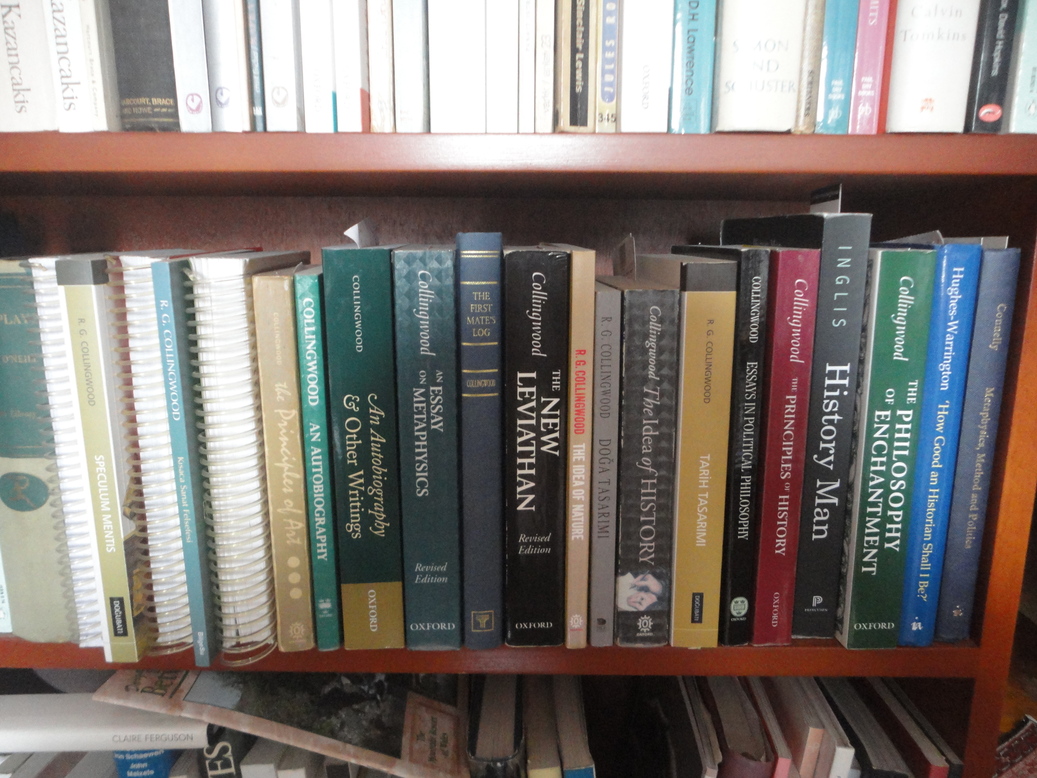
Articles on Collingwood

This article gathers, and in some cases quotes and examines, popular articles about R. G. Collingwood (1889–1943).

  • By articles, I mean not blog posts like mine and others’, but essays by professionals in publications that have editors.

  • By popular, I mean written not for other professionals, but for the laity.

Continue reading

Mathematics and Logic

Large parts of this post are taken up with two subjects:

  1. The notion (due to Collingwood) of criteriological sciences, logic being one of them.

  2. Gödel’s theorems of completeness and incompleteness, as examples of results in the science of logic.

Like the most recent in the current spate of mathematics posts, the present one has arisen from material originally drafted for the first post in this series.

In that post, I defined mathematics as the science whose findings are proved by deduction. This definition does not say what mathematics is about. We can say however what logic is about: it is about mathematics quâ deduction, and more generally about reasoning as such. This makes logic a criteriological science, because logic seeks, examines, clarifies and limits the criteria whereby we can make deductions. As examples of this activity, Gödel’s theorems are, in a crude sense to be refined below, that

  • everything true in all possible mathematical worlds can be deduced;

  • some things true in the world of numbers can never be deduced;

  • the latter theorem is one of those things.

Continue reading

Multiplicity of Mathematics

I continue with the recent posts about mathematics, which so far have been as follows.

  1. What Mathematics Is”: As distinct from the natural sciences, mathematics is the science whose findings are proved by deduction. I say this myself, and I find it at least implicit in an address by Euphemia Lofton Haynes.
  2. More of What It Is”: Some mathematicians do not distinguish mathematics from physics.
  3. Knottedness”: Topologically speaking, there is a sphere whose outside is not that of a sphere. The example is Alexander’s Horned Sphere, but it cannot be constructed physically.
  4. Why It Works”: Why there can be such a thing as the horned sphere.

When I first drafted the first post above, I said a lot more than I eventually posted. I saved it for later, and later is starting to come now.

Octahedron with edges divided in the Golden Ratio by the vertices of an icosahedron

Continue reading